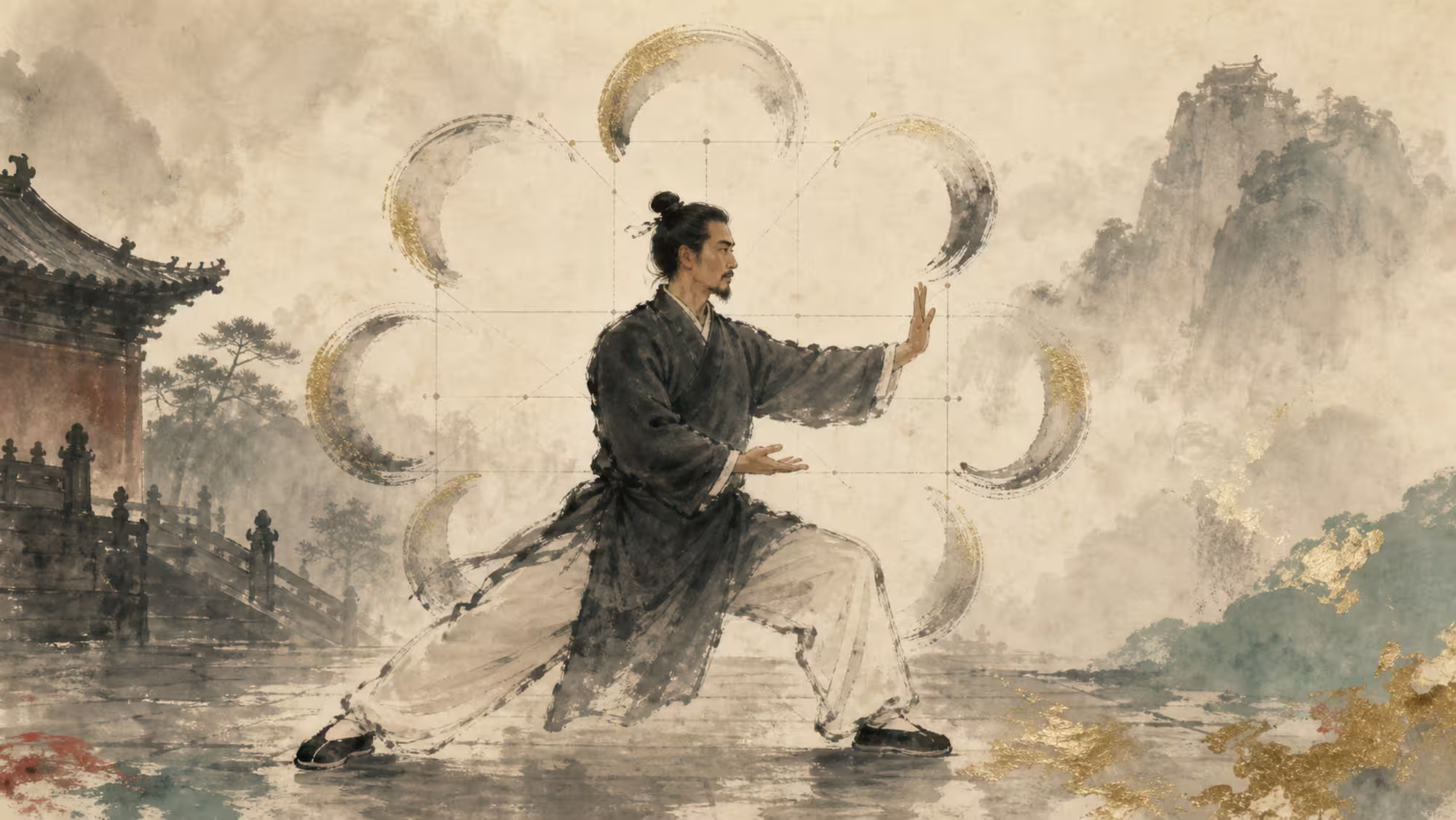
The old sequence is suddenly being discussed in the language of trials, blood pressure numbers, adherence, and public health.
Baduanjin, often translated as the Eight Brocades, has always had a practical appeal. It is short. It has a memorable structure. It does not require equipment, a large room, a partner, or athletic clothing. A beginner can copy the outer shapes quickly enough to feel that something is happening. A serious student can spend years discovering how much is hidden inside those same eight movements.
That combination makes the form easy to share online. It also makes it easy to flatten.
In recent weeks, Baduanjin has been moving through health articles, Reddit discussions, newsletters, class listings, and casual recommendations with a new kind of authority attached to it. A large randomized clinical trial published earlier this year compared Baduanjin with self-directed exercise and brisk walking in adults with high-normal blood pressure. In May, the study was picked up again by general science and wellness outlets. Reddit threads turned the result into a public conversation. Commenters asked where to learn it, whether YouTube was enough, whether it was just slow exercise, and whether a traditional Chinese routine could really be compared with brisk walking.
This is the point where students of Qigong and internal arts should pay attention.
Not because one study turns Baduanjin into medicine. It does not. Not because every dramatic headline about an ancient practice should be believed. It should not. The interesting part is more specific: a traditional form is being translated into a language modern readers understand, and the translation is both useful and incomplete.
The Study Is Not the Whole Practice
The trial that triggered much of the recent attention followed adults over a year and measured changes in blood pressure. The Baduanjin group practiced a standardized routine regularly. The comparison with brisk walking made the result easy for health writers to explain, because walking already has a familiar place in public health advice.
That is why the story traveled.
"Ancient Chinese exercise lowers blood pressure" is a simple headline. "A low-cost mind-body routine may be easier for some people to maintain than conventional exercise advice" is less dramatic, but closer to the useful point. In the study context, Baduanjin was not a mystical intervention floating free from structure. It was a defined practice, taught as a routine, repeated over time, and measured against specific outcomes in a specific group of adults.
That distinction matters.
A clinical trial has to narrow the world so that something can be measured. It needs inclusion criteria, endpoints, time frames, and a protocol that researchers can reproduce. Traditional practice moves in a wider field. It includes rhythm, attention, correction, imagery, breath, posture, cultural vocabulary, teacher preference, personal habit, and the slow change in how someone inhabits the body.
The trial can tell part of the truth. It cannot hold the whole thing.
For a student, the danger is not the research itself. Good research can protect a practice from both dismissal and fantasy. The danger is the way research becomes internet shorthand. A careful study becomes a claim. A claim becomes a promise. A promise becomes a reason to rush through a video and wait for a result.
Baduanjin resists that treatment when it is practiced well. Each movement looks simple enough to invite casual copying, then reveals details that casual copying misses.
Why Eight Movements Travel So Easily
Part of Baduanjin's current appeal is that it fits the mood of the moment.
Many people want practices that are short, gentle, repeatable, and not obviously tied to gym culture. They want something that can be done in a living room before work, between meetings, after a walk, or during a period of recovery when harder training feels unavailable. The wellness internet is full of routines promising nervous-system regulation, mobility, longevity, balance, breath, and better aging. Baduanjin can be made to sound like all of these at once.
There is some truth in that broadness. The sequence asks the body to reach, open, turn, settle, bend, rise, and coordinate breath with attention. It works through the spine, shoulders, ribs, hips, knees, and feet without demanding speed. It gives the mind a sequence to remember, but not so much complexity that the beginner is buried by choreography.
That is why it has become a favorite recommendation in online discussions. Someone asks how to begin Qigong. Someone else suggests Eight Brocades. Someone asks for a gentle routine for stiffness or age. Baduanjin appears again. Someone reads a headline about blood pressure and asks whether the form can be learned from YouTube. Another person replies with a link, a teacher name, or a warning that the details matter.
The pattern is familiar. A traditional practice becomes visible because it is easy to access. Then the visible version begins to define the practice for people who have never met it any other way.
For Baduanjin, that means the form is often introduced as a beginner health routine. It can be that. It is also more than that.
The name Eight Brocades suggests something woven. That image is useful. The form is not just eight separate exercises in a row. A good version connects the pieces through posture, breath, gaze, intent, and transitions. The rising of the hands is not separate from the settling of the feet. The opening of the chest is not separate from the softening of the back. The turn of the waist is not a decorative twist, but a test of whether the body moves as one coordinated structure.
When these details are absent, the routine can still be pleasant. It may still help someone move more often. But the difference between pleasant movement and trained movement is not small.
Evidence Can Make Practice More Honest
The best use of the current attention is not to argue that tradition was right all along and science has finally caught up. That is too easy, and it often hides sloppy thinking.
A better response is more sober: when a traditional method is studied carefully, both sides become clearer. Researchers have to define what was practiced. Practitioners have to look at what can actually be claimed. Students get a chance to ask better questions.
What was the routine? How often was it practiced? Who taught it? Who were the participants? What was measured? What was not measured? Was the result compared with doing nothing, with walking, with another exercise, or with medical care? Did the benefit depend on consistency? Were there adverse events? Did people keep practicing when supervision was reduced?
These questions do not weaken respect for Baduanjin. They strengthen it.
Traditional arts suffer when every benefit is explained with vague certainty. They also suffer when modern readers assume that anything old is either superstition or secret medicine. The current Baduanjin discussion gives students a better middle path. A form can be culturally old, practically useful, and still subject to careful limits. It can have health relevance without becoming health advice. It can be simple enough for beginners and still deep enough to require correction.
That balance is especially important for Qigong, because Qigong sits near many sensitive claims. Breath, stress, blood pressure, sleep, pain, energy, mood, immunity, and aging are all tempting subjects. They are also easy to exaggerate. A student should not treat Baduanjin as a replacement for medical care, medication, diagnosis, rehabilitation, or professional advice. The form belongs in the category of practice: something repeated, observed, adjusted, and integrated into life.
The recent evidence does not remove that responsibility. It makes it more visible.
The YouTube Problem
One recurring response in the online discussion is practical: just search for Baduanjin on YouTube.
That advice is understandable. Video is often the first doorway. A clear demonstration can help a beginner learn the order of the movements, the basic rhythm, and the general feeling of the sequence. For people without a local teacher, video may be the only realistic starting point.
But Baduanjin learned only as screen choreography easily becomes arm exercise.
The hands move. The shoulders lift. The knees lock. The breath becomes theatrical. The spine stiffens while the student tries to imitate the visible shape. The eyes follow the teacher on the screen rather than the movement inside the body. The routine is completed, but the training question is missed.
That question is simple: can the body become more organized while the movement remains soft?
In Baduanjin, the answer is found in ordinary details. The feet need to feel the floor without gripping. The knees need to bend without collapsing inward. The pelvis needs enough neutrality that the lower back is neither forced flat nor left hanging. The chest opens without military stiffness. The shoulders release while the arms still have direction. The breath supports the movement without being dragged into performance.
None of this requires secrecy. It requires attention.
A student using video can still practice intelligently. The first goal is to learn the sequence without rushing. The second is to reduce obvious strain. The third is to notice whether the movement feels more connected over time. If the neck tightens, the knees complain, the lower back pinches, or the breath becomes forced, those are not signs of deeper internal work. They are information. The form is asking to be simplified.
The most useful teacher in the beginning may be the pause before doing more.
A Form That Rewards Repetition
Baduanjin is well suited to the current desire for short daily practice, but it should not be confused with a hack.
A hack promises a result while trying to avoid the process. Baduanjin works in the opposite direction. Its value comes from making a small process repeatable enough that the body can change its habits. The same eight movements return each day. At first, the student remembers the order. Later, the student notices the shoulders. Then the breath. Then the feet. Then the places where attention disappears. Then the difference between stretching upward and lifting the ribs. Then the difference between bending and folding. Then the difference between relaxing and collapsing.
This is why the form can be both accessible and demanding.
It does not demand athletic display. It demands honesty. The student cannot hide impatience inside complexity because the sequence is too clear. The body either settles or it does not. The breath either becomes quieter or it does not. The movement either joins through the center or breaks into parts.
That is also why Baduanjin belongs naturally beside Taiji and other internal training. It teaches the same larger lesson in a compact frame: slow movement is not automatically internal movement. Gentle movement is not automatically relaxed movement. Repetition is not automatically practice. The inner quality has to be cultivated.
The current evidence moment may bring many new people to Eight Brocades. Some will arrive through a headline about blood pressure. Some will arrive through a Reddit thread. Some will arrive because a class listing makes the routine sound approachable. Some will arrive because a video promises a complete session in fifteen minutes.
That is not a problem. Doorways are allowed to be simple.
The responsibility begins after the doorway. If Baduanjin is treated as eight magic gestures, the trend will pass like every other wellness trend. If it is treated as a small daily laboratory for posture, breath, attention, and restraint, the old sequence still has work to do.
At the end of a careful session, nothing dramatic has to happen. The room is the same. The floor is the same. The hands lower. The breath settles. For a moment, the body may feel less like a collection of parts trying to be fixed, and more like something being quietly rewoven.