There's a moment in every martial artist's journey where the diet question hits. Not because someone told you to eat better — but because you felt it. You did Zhàn Zhuāng after a heavy lunch and your legs were concrete. You had ice water before morning practice in February and spent the first twenty minutes trying to wake your body up. You ate light, simple, warm food for three days straight and suddenly your form felt different. Smoother. Cleaner.
That's not a coincidence. And in the Daoist tradition, it's not news either. They've been thinking about this for over two thousand years — and they left behind a body of dietary knowledge that ranges from the deeply practical to the genuinely radical.
We recently published two in-depth articles in the Wudang Knowledge Wiki that explore the Daoist relationship with food from both angles. One covers the practical, TCM-based guidelines that any practitioner can apply today. The other dives into the spiritual and philosophical traditions — grain avoidance, internal parasites, monks who claimed to live on air. Together they form one of the most complete and unusual pictures of food and the human body you'll find anywhere.
Forget Calories — Think Temperature
Here's the thing that surprises most Westerners about Traditional Chinese Medicine and food: TCM doesn't care about your macros. It doesn't count calories. It doesn't distinguish between carbs and protein in the way modern nutrition does. Instead, it classifies every food by its thermal effect on the body after digestion — and by its flavor correspondence to specific organ systems.
Every food falls on a five-point thermal scale. Ginger, lamb, and cinnamon are warming. Watermelon, cucumber, and raw salads are cooling. Rice, potatoes, and eggs sit in the neutral middle. Chili peppers and dried ginger are outright hot. Crab, seaweed, and bitter melon are cold. The practitioner adjusts their intake based on three variables: the season, their own constitutional tendency, and their current condition.
Winter? Eat warm. Summer? Eat cooler. Running hot with inflammation? Cool it down. Always cold with low energy? Build warmth. Someone with a naturally cold constitution eating raw salads in January is actively working against their own body. Someone who runs hot eating lamb stew in July is pouring fuel on a fire. The system is intuitive once you understand the logic — and remarkably effective once you start paying attention.
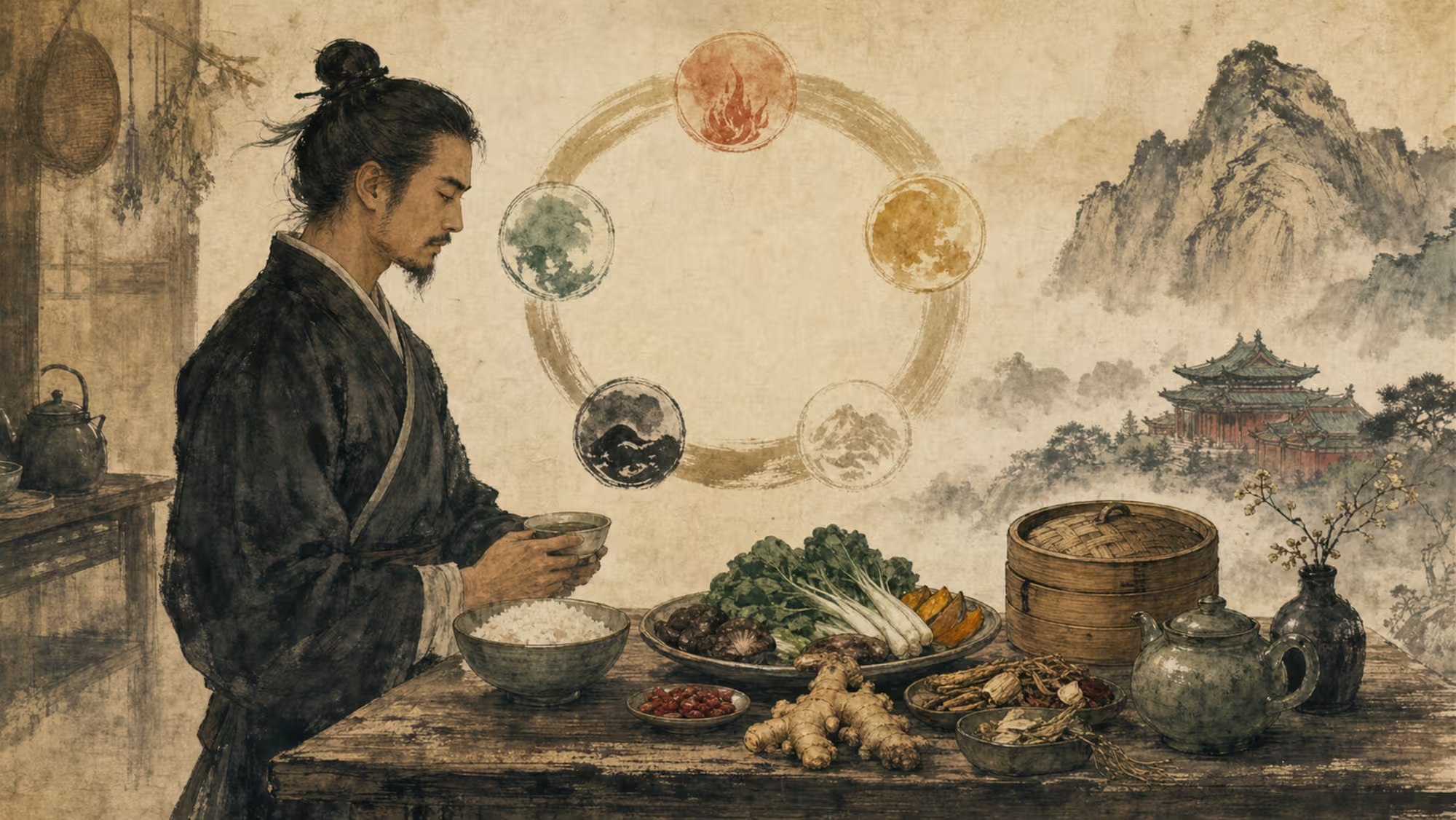
Then there's the flavor system. TCM maps five flavors to the Five Phases (Wǔxíng 五行) and their corresponding organs. Sour foods — vinegar, lemon, plum — have a gathering, astringent quality and support the Liver. Bitter foods — dark tea, bitter melon, dandelion — dry dampness and clear heat from the Heart. Sweet foods — and this means the natural sweetness of rice, dates, and sweet potato, not refined sugar — tonify and nourish the Spleen. Pungent foods — ginger, garlic, radish — disperse stagnation and open the Lungs. Salty foods — seaweed, miso, soy sauce — soften hardness and nourish the Kidneys.
A balanced diet includes all five in appropriate proportion. Overload any single flavor and the corresponding organ suffers. The Shí Yǎng article in the wiki lays all of this out in detail — including how to eat around training sessions, how to develop awareness of your own constitution, and why the Spleen and Stomach are considered the center of the entire system.
The Rules on Wudang Mountain
If you want one actionable takeaway from the entire Daoist dietary tradition, it's probably this: drink warm tea, not ice water. That single piece of advice has been repeated on Wudang Mountain for centuries, and every Wudang teacher will give it to you. The reasoning: cold drinks shock the Spleen and Stomach, creating internal cold that your body must then burn extra Qì to overcome. In TCM, the digestive organs function like a cooking pot — they need warmth to transform food into usable energy. Flood that pot with ice and you weaken the entire process.
The other practical rules are equally straightforward but just as important.
Eat at regular times. The body's Qì follows a circadian rhythm. The Stomach's peak energy window is 7–9 AM in TCM's organ clock system, which is why the traditional schedule calls for a substantial breakfast. Irregular eating — skipping meals, eating at random hours, heavy meals at midnight — disrupts the digestive cycle and scatters Qì.
Stop at seventy percent full. This is one of the oldest and most consistent pieces of dietary advice in Chinese culture. Overeating creates stagnation — the food sits, the body labors, energy drops. Under-eating creates deficiency. The target is satisfaction without heaviness. Daoist temple practice takes this further: monks traditionally keep one-third of the stomach empty at all times.
Eat simply. A bowl of rice, some cooked vegetables, a clear soup. Maybe some tofu or a small amount of fish. The traditional Wudang temple diet was built on exactly this: rice, seasonal vegetables, mushrooms, tofu, and simple preparations. Partly this reflected Daoist philosophy — simplicity, moderation, alignment with nature. Partly it was practical mountain-temple economics. Either way, the principle holds: simple food converts to Qì more efficiently than a complex feast.
Adjust to the season. Warmer, heartier foods in winter when Yīn dominates. Lighter, cooler foods in summer when Yáng peaks. This mirrors the Yīn-Yáng cycle of the year itself. A practitioner who eats the same diet year-round is ignoring one of the most fundamental patterns in Chinese medicine.
None of this requires specialized knowledge. It's the accumulated common sense of a medical tradition that has been observing the human body for millennia. But the Daoist relationship with food doesn't stop at the practical. It goes somewhere much stranger — and much more interesting.
The Oldest Diet Book in the World
In 1973, archaeologists excavating a Hàn dynasty tomb at Mǎwángduī (马王堆) near Chángshā, Húnán Province, discovered a collection of silk manuscripts sealed since 168 BCE. Among them was a text called the Quègǔ Shíqì (卻穀食氣) — "Eliminating Grain and Eating Qì." It is the oldest documented dietary regimen for grain avoidance ever found.
The manuscript is short and practical. It describes a method for progressively replacing grain with specific breathing exercises performed morning and evening, supplemented by the medicinal fern Shíwěi (石韦, Pyrrosia lingua) as a diuretic to manage the side effects of eliminating cereals. It also contains one of the most striking cosmological statements about food in any ancient text:
"Those who eat grain eat what is square. Those who eat Qì eat what is round. Round is Heaven. Square is Earth."
This is not metaphor. It's a cosmological map. Grain ties you to the earth — to agriculture, to the material, to the square and bounded. Qì connects you to heaven — to the cosmic, to the circular, to the unbounded. What you eat determines which world you belong to.
The Mǎwángduī text wasn't isolated. By the fourth century CE, the Daoist Canon documented over one hundred distinct methods for grain avoidance — each with its own herbal formulas, breathing techniques, and progressive stages. This wasn't a fringe practice. It was one of the central pillars of Daoist cultivation.
Why Daoists Stopped Eating Grain
The practice of Bìgǔ (辟谷) — literally "avoiding grains" — is the most distinctive dietary tradition in Daoism. It refers to the progressive elimination of the Five Grains (Wǔ Gǔ 五谷): rice, wheat, foxtail millet, proso millet, and soybeans. These five crops formed the caloric foundation of Chinese civilization. To reject them was to reject the agricultural order itself.
The earliest literary allusion appears in the Zhuāngzǐ, which describes transcendent beings on a distant mountain who "do not eat the five grains" but instead "inhale the wind and drink the dew." The Huáinánzǐ (淮南子, c. 139 BCE) goes further, presenting a complete hierarchy of diet and destiny:
"Those who feed on flesh are brave and daring but cruel. Those who feed on grain are knowledgeable and clever but short-lived. Those who feed on Qì attain spirit illumination and long life. Those who do not feed on anything do not die and are spirits."
This wasn't just philosophy. Real historical figures practiced it. Zhāng Liáng (张良, 262–189 BCE) — the brilliant military strategist who helped found the Hàn dynasty — officially retired from government to pursue Bìgǔ and Dǎoyǐn breathing exercises. Sīmǎ Qiān records that Zhāng requested permission to "lay aside the affairs of this world and join the Master of the Red Pine in immortal sport." The emperor granted it. When Empress Lǚ later urged him to eat normally, arguing that life is too short to waste on austerities, Zhāng refused.
Centuries later, the monk Dèng Yù (邓郁), living around 500 CE, reportedly sustained himself for over thirty years on nothing but minerals absorbed from spring water. In the eighth century, the hermit Pān Shìzhēng (潘师正) lived on Mount Sōng for more than twenty years eating only pine needles and water. The Língbǎo Wǔfú Xù (灵宝五符序), a fourth-century Daoist text, prescribed five specific "wonder plants" for practitioners transitioning away from grain: pine resin, sesame, pepper, ginger, and calamus (sweet flag root).
Are these accounts literal? Exaggerated? Spiritual metaphor? The tradition deliberately leaves this question open. What's certain is that Bìgǔ was practiced widely, documented extensively, and taken seriously by some of the most sophisticated minds in Chinese history.
The Three Corpses — Daoism's Strangest Idea
The cosmological justification for Bìgǔ is the doctrine of the Three Corpses (三尸 Sān Shī), also called the Three Worms (三虫 Sān Chóng). This is one of the most unusual ideas in any world religion, and it directly connects diet to spiritual destiny.
According to Daoist belief, three malevolent spirits enter the human body at birth and take up residence in the three Dāntián: the upper (brain), middle (heart), and lower (abdomen). These spirits are not passive. They actively work to shorten their host's life — because when the host dies, the Three Corpses are released as free-roaming ghosts who can steal sacrificial offerings.
Their method is twofold. First, they weaken the body's energy centers from within. Second, every sixty days — on the Gēngshēn (庚申) night, the 57th day of the sexagenary calendrical cycle — they ascend to Heaven while the host sleeps and report the host's misdeeds to the Sīmìng (司命, Director of Fates), who shortens the host's lifespan in response.
And the Three Corpses feed on grain.
This is why Bìgǔ exists. Eliminate grain, and you starve the internal parasites that are literally tattling on you to the celestial bureaucracy. The fourth-century Huángtíng Jīng (黄庭经, Yellow Court Scripture) combines both countermeasures: abstain from grain to weaken the Three Corpses, and stay awake through the Gēngshēn night so they cannot ascend to make their report.
The Three Corpses doctrine sounds bizarre to modern ears, but it encodes something real: the idea that unconscious forces within the body work against the practitioner's conscious intentions, and that disciplined practice — dietary, meditative, and moral — is required to overcome them. Whether you take it literally or metaphorically, it's a remarkably sophisticated model of internal conflict and purification.
The Five Forbidden Vegetables
Beyond grain avoidance, Daoist monks observe the prohibition of the Five Pungent Vegetables (五荤 Wǔ Hūn): garlic, scallions, chives, leeks, and rakkyo (a type of Chinese allium). All are members of the Allium family and share the sulfur compounds responsible for their strong smell.
The prohibition operates on three levels. Practically, the strong flavors were believed to agitate the mind and make the stillness required for meditation difficult to achieve. Physiologically, they were thought to increase anger when eaten raw and sexual desire when cooked — both states that obstruct spiritual cultivation. Ritually, the lingering odor was considered a form of pollution incompatible with prayer, ceremony, and contact with the divine.
The eighth-century Yàoxiū Kēyí Jièlǜ Chāo (要修科仪戒律钞) specified that Daoist priests submitting memorial prayers who had consumed these vegetables faced one hundred days of penance.
This prohibition is shared with Mahāyāna Buddhism — not coincidentally. Centuries of Daoist-Buddhist cross-influence in China produced overlapping dietary codes, particularly in monastic contexts. The Quánzhēn (全真) order — the dominant monastic tradition on Wudang Mountain since the Yuán dynasty — practices permanent vegetarianism for ordained monks and nuns, combined with the allium prohibition.
An Ancient Debate
The Daoist dietary tradition was never without its critics — and the most interesting criticisms came from within the tradition itself.
The philosopher Wáng Chōng (王充, c. 27–97 CE), writing in his Lùnhéng (论衡, Critical Essays), argued that longevity came from natural constitution, not from grain avoidance. Practitioners who appeared long-lived, he claimed, had simply been born that way.
Even Gě Hóng (葛洪, 283–343 CE) — one of the most important Daoist alchemists and a serious advocate for cultivation practices — was cautious about Bìgǔ. In his Bàopǔzǐ (抱朴子), he acknowledged that fasting could support alchemical practice but warned that it was difficult and should not be undertaken lightly. His practical advice: if you're taking alchemical medicines, a hundred-day fast beforehand helps. If you can't manage that, take them anyway — it just works slower.
The texts themselves documented the side effects honestly: dizziness, weakness, drowsiness, diarrhea, difficulty moving. They insisted these symptoms passed after thirty to forty days, but they didn't pretend the process was painless. This kind of internal honesty — acknowledging difficulty rather than promising easy transcendence — is characteristic of the serious Daoist literature.
What This Means for Your Training
The Sānfēngpài (三丰派) system recognizes three progressive levels of practice — the Three Vehicles of Wǔshù (武术, martial arts), Yǎngshēng (养生, health cultivation), and Nèidān (内丹, internal alchemy) — and each carries its own relationship to food.
At the martial arts level, the practitioner needs fuel. Intensive physical training — running Xuángōng Quán, conditioning drills, kicks, stance work — depletes Qì and demands recovery. The practical TCM guidelines from the Shí Yǎng article are designed for exactly this: eat warm, eat regularly, eat simply, adjust to the season and your own constitution. Pre-training meals should be light enough to avoid heaviness during deep stance work. Post-training meals should be warm and nourishing — congee, soup, rice with moderate protein.
At the Yǎngshēng level, the practitioner begins refining. Stimulants decrease. Meals get simpler. Awareness of how specific foods affect energy, mood, and practice quality sharpens naturally. The benefits of lighter eating become apparent through direct experience rather than theory.
At the Nèidān level — for serious monastic practitioners — dietary discipline becomes part of the alchemical process itself. The internal refinement of Jīng (精), Qì (气), and Shén (神) requires progressively cleaner, lighter input. This is where forms of Bìgǔ and extended vegetarian practice historically entered the picture.
The key point: this progression is natural, not forced. Nobody in the Wudang tradition tells a martial arts student to stop eating grain. The body's requirements change as practice deepens. A practitioner doing heavy physical conditioning has different nutritional needs than one engaged primarily in seated meditation. The tradition respects this — it doesn't impose monastic austerities on fighters or dismiss the spiritual dimensions of food as irrelevant to martial artists.
What tends to happen, simply, is that the training develops your awareness. Foods that once seemed fine begin to feel heavy. You notice the gap between a meal that generates clear energy and one that generates fog. You start choosing warm tea over cold water not because someone told you to, but because you can feel the difference.
That's the beginning. The Daoist Dietary Traditions article describes where it can lead — if you're curious enough to follow it.
Start with warm tea. See where it goes.
Read both articles in the Wudang Knowledge Wiki:
- Dietary Practice in the Wudang Tradition (食养 Shí Yǎng) — practical TCM-based guidelines for training and health
- Daoist Dietary Traditions (道教饮食 Dàojiào Yǐnshí) — the spiritual and philosophical deep dive