The internet has found another ordinary human position and turned it into a test.
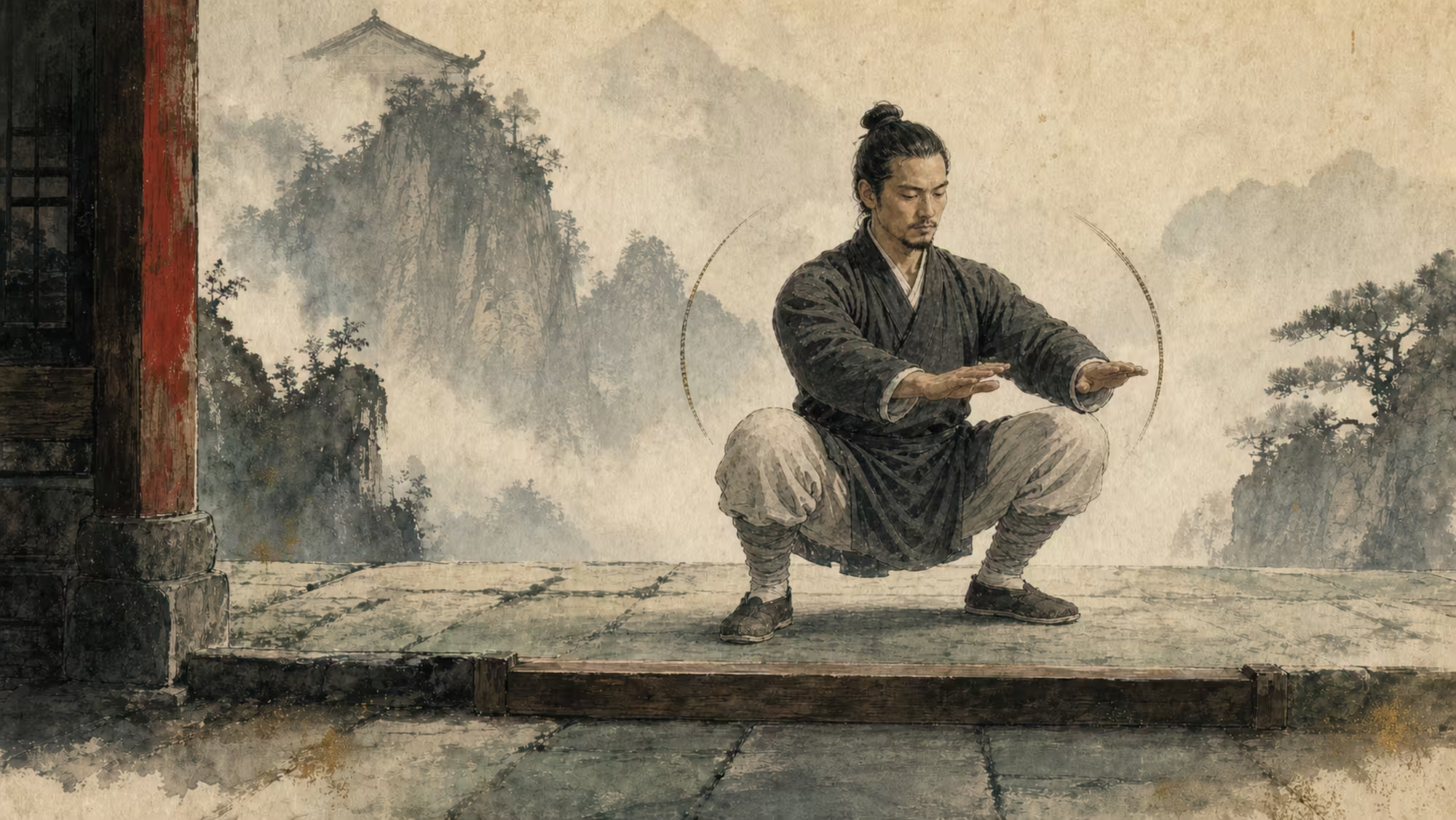
This time the position is the deep squat: feet flat, hips low, knees folded, spine trying to remain alive rather than collapsed. In fitness and wellness circles it is being called a longevity pose, a mobility marker, a way to recover something chairs have taken away. Short videos show people dropping to the floor with ease or laughing when they cannot. Comment sections turn the posture into a cultural comparison, a fitness challenge, a nervous-system reset, or proof that modern bodies have forgotten how to rest close to the ground.
At the same time, a recent Taiji discussion gave the squat a sharper edge. One practitioner recalled being told that a student should not really begin Taiji until they can squat comfortably with flat feet and an upright spine. The replies did what serious practice conversations often do: they split the question open. Some people treated the squat as a basic requirement. Some treated it as useful but not universal. Others pointed out that low stances, deep folds, and rooted frames are part of Chinese martial training, but that squatting for depth is not the same thing as developing whole-body structure.
That is where the trend becomes useful.
For Taiji and Qigong students, the deep squat is not important because everyone must look the same at the bottom. It is important because it exposes several questions that practice cannot avoid forever. Can the ankles bend without the arches collapsing? Can the knees track without panic? Can the hips fold without the lower back rounding into surrender? Can the spine stay suspended when the body comes close to the floor? Can the breath remain quiet when balance feels uncertain?
A posture that simple can become a mirror.
The Problem With a Gate
Calling the deep squat a prerequisite sounds clean. It gives the art a standard. It cuts through the soft marketing language that sometimes surrounds Taiji and Qigong. It reminds students that internal practice is not vague relaxation. The body has to be trained. The joints must have range. The legs must be able to receive weight. The spine must stay organized under changing angles. Root is not an idea if the lower body cannot support it.
But a gate can also become lazy.
If the rule is "squat first, then practice," many students are excluded before practice has had a chance to help them change. Older practitioners, people with different hip structures, students recovering from injury, and those who have spent decades in chairs may not be able to drop into a full resting squat on demand. Some can improve gradually. Some need props, higher stances, or medical guidance. Some will never look like the person in the video, and the art still has work for them.
The better question is not whether the squat should admit or reject a student. The better question is what the squat reveals.
In that sense, the deep squat is less a gate than a diagnostic. It does not say, "You are allowed." It says, "Look here."
What the Squat Shows
A full squat is not one joint doing one thing. It is a negotiation between the foot, ankle, knee, hip, pelvis, spine, breath, and attention.
The ankle is often the first visible limit. If the heel lifts immediately, the body may be running out of dorsiflexion, the shin's ability to move forward over the foot. In Taiji language, that matters because the foot is not just a base. It is part of a line. A stiff ankle can make weight transfer abrupt. It can pull the knee out of relationship with the toes. It can make the student grip the floor instead of receiving it.
The hip is the next conversation. A useful squat asks the hips to fold deeply without dragging the lower back into collapse. That is close to the problem found in many stances and transitions. The kua (胯) has to open and close without the pelvis becoming dead weight. If the hips cannot fold, the student may compensate by rounding the spine, forcing the knees, or leaning forward until the posture is no longer a squat but an argument with gravity.
The spine makes the problem obvious. In a relaxed resting squat, the back may naturally round somewhat, especially outside a martial frame. But in Taiji training, the question is more demanding. Can the spine remain spacious? Can the head stay connected to the body without jutting forward? Can the chest avoid lifting in pride or collapsing in defeat? Can the tailbone release without tucking so aggressively that the whole structure loses spring?
These details are not cosmetic. They are the body language of practice.
Low Does Not Mean Rooted
One reason the squat conversation keeps returning is that low positions look convincing. A deep stance seems serious. A flat-footed squat seems primal. A student who can sink close to the ground appears connected, patient, and strong.
Sometimes that is true. Often it is only partially true.
Low can be rooted, but low can also be heavy. Low can be relaxed, but low can also be collapsed. Low can show mobility, but it can also hide bracing in the jaw, shoulders, pelvic floor, or breath. A student can sit at the bottom of a squat and still have no usable connection from foot to hand. Another student can work at a higher range and maintain a clearer relationship through the whole body.
This matters in internal arts because the goal is not to collect impressive shapes. The goal is to refine relationships.
In form practice, a low stance that breaks the spine teaches the body to break the spine. A deep bend that twists the knee away from the foot teaches the body to borrow from the joint instead of organizing through the center. A squat held with facial tension and breath pressure teaches the nervous system that depth means threat. None of that is better simply because it is lower.
The old mistake is to confuse visible hardship with training quality.
The Wellness Version
The broader wellness trend frames the deep squat as something modern life has erased. Chairs, cars, desks, couches, and phones have made many bodies unfamiliar with the ground. A position that children often find natural becomes, for adults, a mobility project. That story is not wrong, but it is easy to oversell.
The deep squat is useful because it gathers several capacities into one position. It asks for ankle range, hip range, knee tolerance, balance, leg strength, and enough ease in the trunk to breathe. It can be a gentle daily exposure to the body's lower ranges when approached gradually. It can remind people that resting does not always have to mean collapsing into furniture.
Still, students should be careful with the language around it. A squat is not a cure-all. It is not a guarantee of longevity. It is not proof of cultural authenticity. It does not make a practice traditional by itself, and it does not replace strength training, walking, form work, standing practice, partner work, or recovery.
The useful part of the trend is smaller and more precise: many people are noticing that the body loses what it never visits.
For a Taiji or Qigong student, that observation is enough. Practice is full of ranges that disappear when they are not tended. The ankles stop listening. The hips become guarded. The feet lose detail. The breath rises. The mind rushes past transitions. The body still moves, but it moves around its blind spots.
The deep squat simply makes some of those blind spots harder to ignore.
How to Work With the Question
The safest training question is not, "Can this body force the full squat today?" It is, "What version of this shape lets the body learn without losing organization?"
For one student, that may mean holding a door frame and lowering only partway. For another, it may mean placing support under the heels while the ankles slowly adapt. For another, it may mean working with a higher horse stance, wall squats, slow sit-to-stand transitions, or Qigong movements that open the hips without loading the knees as sharply. For someone with pain, recent injury, joint disease, dizziness, or uncertainty, the intelligent next step is not internet bravery but qualified guidance.
In practice, the details matter more than the depth.
Let the feet stay awake. Let the toes spread without clawing. Let the knees follow the direction of the toes. Let the hips fold without yanking the lower back into a hard tuck. Let the breath stay quiet enough that the nervous system does not treat the posture as an emergency. Let the spine look for length, not military stiffness. Come out before the position becomes a contest.
This is not a prescription. It is a way of reading the body.
If the squat improves, good. If it does not, the information is still useful. A student who discovers that the left ankle is less responsive than the right has learned something that will appear again in stepping. A student who discovers that the hips grip whenever balance feels uncertain has learned something that will appear again in kicks, turns, and push hands. A student who discovers that the breath stops at the bottom has learned something about effort.
The squat is not separate from practice. It is another place where practice can be seen.
The Cultural Translation Trap
The phrase "Asian squat" is popular because it is quick, visible, and easy to share. It points to a real cultural difference: in many places, people grow up using floor-level postures more often than people raised in chair-dominant environments. Squatting can be part of resting, eating, waiting, working, or using a toilet. A body shaped by those habits may keep a range that another body loses.
But the phrase can also flatten the subject. It can turn a daily-life posture into an exotic badge. It can make a complex mix of environment, age, anatomy, habit, work, class, and training sound like a single inherited trait. It can turn a living posture into a challenge performed for a camera.
Traditional practice deserves better than that.
The deep squat is not valuable because it looks foreign to some viewers. It is valuable because it shows how culture enters the body. Floors, chairs, shoes, toilets, classrooms, offices, and training halls all teach posture. They teach what feels normal, what feels inconvenient, and what the body avoids until avoidance becomes limitation.
Taiji and Qigong students already know this in another language. Practice is the slow study of what habit has made invisible.
A Better Standard
There is still a place for standards. Without standards, practice becomes mood. Without physical requirements, internal arts drift into performance, metaphor, or vague wellness. Students need honest feedback. They need to know when a stance is collapsing, when a knee is being forced, when the hips are locked, when the spine has lost connection, and when relaxation has become passivity.
But a good standard should make training clearer, not smaller.
The deep squat can be one standard among many if it is handled correctly. It can ask whether the lower body has enough mobility for the work ahead. It can reveal whether the student knows the difference between sinking and dropping. It can show whether root is being confused with heaviness. It can help a teacher choose an appropriate stance height, warm-up, or preparatory exercise.
What it should not become is a purity test.
The student who cannot yet squat may still learn to soften the chest, release the shoulders, coordinate breath and movement, distinguish empty and full, and build steadier legs over time. The student who can squat easily may still need years to understand structure. Mobility opens a door. It does not walk through it.
That is the useful correction to the current trend. The deep squat is not the secret. It is a question written in the body.
Stand with the feet a little wider. Lower only as far as the structure stays honest. Notice where the breath changes, where the heels want to lift, where the knees hesitate, where the hips grip, where the spine gives up. Then rise without drama.
The floor has given its report. The next movement will show whether anyone was listening.