
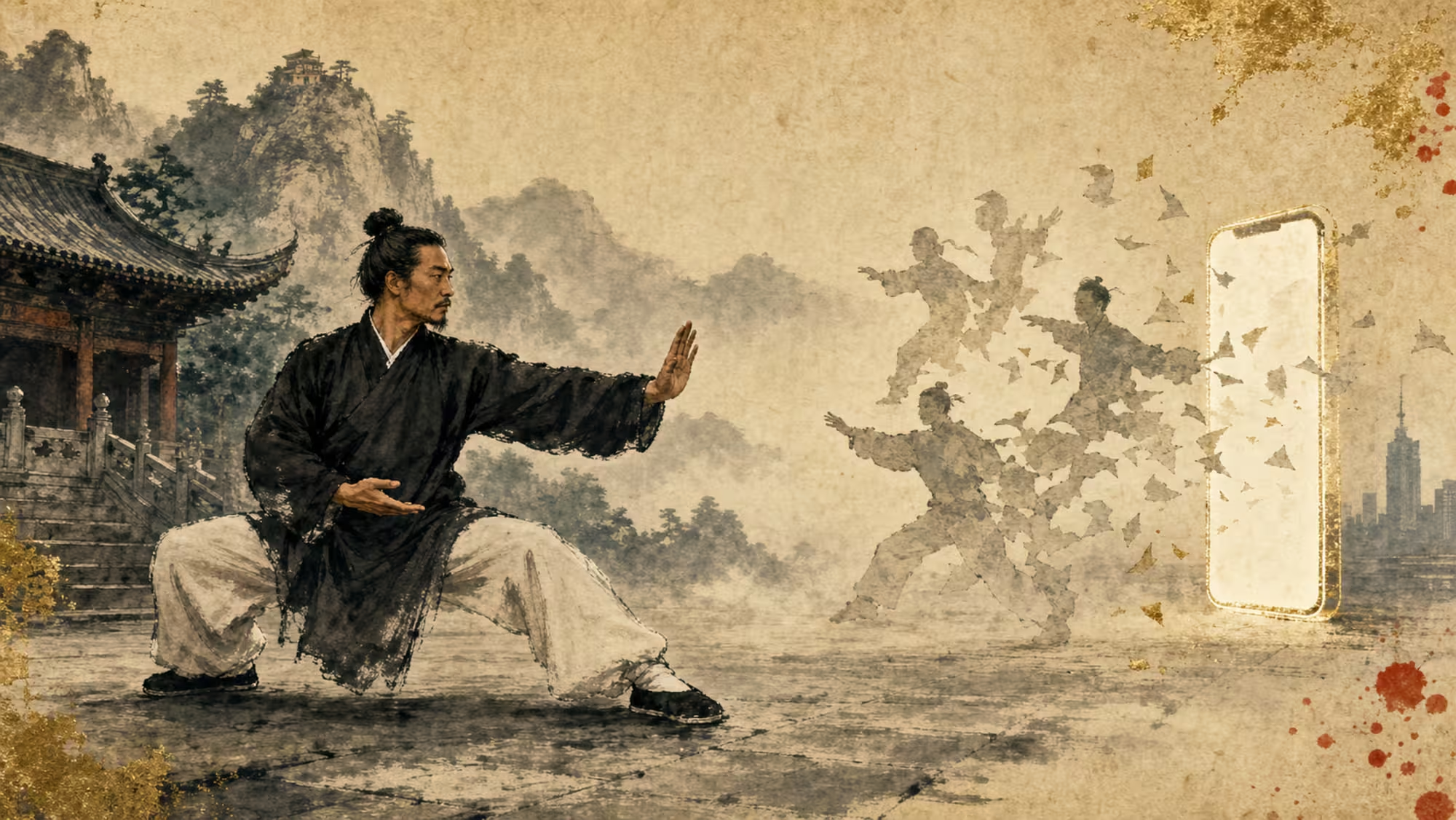
Scroll through Facebook or Instagram long enough and you will see it: a soft-focus video, gentle piano music, someone sitting in a chair making slow circles with their hands. The caption reads something like "Ancient Tai Chi — Transform Your Body in 10 Minutes a Day." A bright button invites you to download the app.
The app is called MadMuscles. And what it teaches has nothing to do with Taijiquan.
Before I go further, let me say something clearly: seated exercise is fine. Making movement accessible to people with limited mobility is a good thing. What is not fine is wrapping generic stretches in the language of an art that carries centuries of martial depth, internal training, and living lineage — when the product contains none of it.
What Is MadMuscles, Really?
At its core, MadMuscles is a general fitness app — HIIT routines, calisthenics, meal plans, workout tracking. At some point, their marketing team realized that "Tai Chi" attracts a massive search audience, particularly among older adults looking for gentle, health-oriented movement.
So they created "Chair Tai Chi." Then "Tai Chi Monk Power." Then "Master Lee's Tai Chi." Then "Tai Chi for Golfers." Their website talks about "traditional Tai Chi principles," Qi (气) cultivation, and inner peace.
But who is Master Lee? Where did he train? Who was his teacher? There are no answers, because there is no lineage. There is no transmission of form or principle. What users describe, across thousands of reviews, is a collection of arm movements done while sitting — dressed up in borrowed terminology from an art nobody at the company appears to have studied.
Call it what it is: stretching with a stolen name.
Subscription Traps and Dark Patterns
The content problem is only the surface. MadMuscles has drawn thousands of user complaints describing deceptive subscription practices. The pattern repeats across review platforms: someone clicks a "free Chair Tai Chi" ad, enters their details, and then finds unexpected charges on their card — sometimes for multiple services they never selected. Cancelling is deliberately confusing. Support responses are automated and unhelpful. Renewal prices spike after the introductory period.
This is the company presenting itself as your guide to "ancient wisdom."
I am not interested in tearing down a business. People can choose where to spend their money. But when a company operating like this becomes the primary gateway through which millions first encounter the words "Tai Chi" — that affects every honest teacher and school trying to share this art with integrity.
The Real Cost to Authentic Schools
People outside the martial arts world rarely see this side of things. Real Taijiquan schools run on trust and reputation, not advertising budgets. Most genuine Taiji teachers spent decades training under a qualified master — often far from home, often in uncomfortable conditions — before they were ready to teach. There is no shortcut to that.
I built Wudang Academy because I saw a real need: practitioners around the world who wanted to learn authentic Wudang arts but could not travel to China or Austria. Every course on the platform reflects direct lineage transmission — the same forms, principles, and corrections I received from my teacher, Master Yuan Xiu Gang. Building that library took years of careful filming, structuring, and refining. You can read more about the academy and its background here. That is what building an honest online school actually looks like.
Now picture someone typing "learn Tai Chi online" into a search engine. The algorithm cannot tell the difference between years of lineage-based instruction and a fitness app that added "Tai Chi" to its keyword list last quarter. MadMuscles outspends schools like ours on advertising by enormous margins. Their "Chair Tai Chi" ad appears first. The person clicks, gets charged, waves their arms around for a few weeks, feels nothing meaningful — and walks away believing Tai Chi does not work. They never discover Wudang Academy. They never find any real teacher. A door that was opening quietly closes.
This happens daily. Not just to us — to every authentic school offering Taijiquan instruction, online or in person.
And when someone does eventually reach our platform after months of exposure to these ads, they often carry a distorted picture of what the art actually is. They expect it to be effortless. They expect instant results. When they meet real training — which demands patience, physical effort, and the willingness to be corrected — some of them leave. Not because the training failed, but because it did not match the fantasy they were sold.
The damage is not about losing students to a competitor. It is about the slow destruction of public understanding.
Each time an algorithm promotes "Chair Tai Chi" over a real teacher, the collective perception of Taijiquan thins a little more. It becomes "that relaxation thing people do sitting down." The martial roots vanish. The internal principles — Song (松), relaxing into structure; Ting (听), deep listening through the body; Hua (化), the art of neutralizing force — get replaced by empty buzzwords. What remains is a shell.
There is also a financial dimension that nobody talks about. When a well-funded app floods social media with "Tai Chi" ads, it inflates advertising costs for that entire keyword space. Schools built by practitioners — not investors — simply cannot compete in a bidding war over their own tradition's name. We are being priced out of the conversation about the art we carry.
What Taijiquan Actually Demands
Real `Taijiquan (太极拳)` is a martial art. The character 拳 means fist. It is a complete fighting system grounded in the principle that softness can overcome hardness, that yielding is a form of power, that sensitivity to another person's force and intention can be trained to extraordinary levels. These are not poetic metaphors. They are tangible skills, developed through methods passed down across generations.
In the Wudang San Feng Pai tradition, training begins with Wuji (无极) standing — learning stillness before movement. You build your legs, your structural alignment, your breathing. Weeks or months pass before you begin learning a form. The Wudang Taiji 28 form alone contains layers of martial application, energy cultivation, and meditative awareness that only reveal themselves through years of consistent practice.
No app can deliver any of this through a screen showing someone waving their arms in a chair.
When I trained under Master Yuan Xiu Gang at Wudang Mountain, the experience was anything but convenient. Early mornings in the cold. Legs shaking from hours of low stances. Corrections that bruised my ego more than my body. Long stretches where progress felt invisible. That discomfort was not a design flaw — it was the method. The transformation lives inside the struggle.
"The Dao that can be spoken is not the eternal Dao." — Dao De Jing (道德经), Chapter 1
A path of real internal development cannot be compressed into a subscription optimized for recurring charges.
Accessibility Does Not Require Dishonesty
I want to be direct: Taijiquan should not be locked behind a plane ticket to Wudang Mountain. That is precisely why I built Wudang Academy — so that a student in South Africa or Canada can access the same Wudang Taiji 28 form, the same Ba Duan Jin (八段锦) Qigong, the same foundational training that I teach face to face. The lineage is intact. The instruction is thorough. And the business is transparent — no hidden fees, no dark patterns, no traps.
Accessibility and authenticity can coexist. You can welcome beginners with warmth and patience without lying to them about what the art is. You can lower the barrier to entry without gutting everything that makes the practice meaningful.
The problem with MadMuscles is not that they made something easy. It is that they borrowed the name and cultural gravity of Taijiquan to market a product with no connection to it — and in doing so, made it harder for people to find and trust the real thing.
How to Recognize Authentic Teaching
If those ads sparked your curiosity about Tai Chi, that instinct is worth following. But before you invest your time and money, look for these things:
Lineage. A real teacher can tell you who they learned from, and who that person learned from. This is not ceremony — it is quality assurance built across generations. I am a 16th-generation Wudang San Feng Pai lineage holder, trained under Master Yuan Xiu Gang, who trained under Grandmaster Zhong Yun Long. That chain is public and verifiable. If a program cannot name a single real teacher in its history, that should tell you something.
Specificity. Authentic Taijiquan instruction names actual forms, postures, and principles. It does not speak in vague generalities about "flowing energy" and "inner calm." If an instructor cannot explain the difference between Peng (掤) and Lü (捋), they are not teaching Taijiquan.
Honesty about the path. A trustworthy teacher will tell you this art takes time. Real skill is built over months and years, not minutes and days. Any program promising effortless transformation is selling a fantasy.
Clear, honest business practices. If you cannot see exactly what you are paying for — and if cancelling feels deliberately difficult — leave. A genuine teacher wants students who stay by choice, not customers held hostage by interface tricks.
This Tradition Is Worth Defending
I am not writing from frustration. I am writing from a sense of duty. The Wudang San Feng Pai tradition nearly vanished during the upheavals of the twentieth century. It survived because people — my teacher's teacher, and the teachers before them — chose to protect it at enormous personal cost. It is not a marketing keyword. It is not a brand to be borrowed for clicks.
Every deep tradition faces this pressure now. Algorithms reward engagement over substance. Watered-down content reaches wider audiences than the real thing. That reality is not going to reverse itself.
But how we respond to it — as practitioners, students, and anyone who values the integrity of these arts — that is within our control. We can refuse the shallow version. We can seek out and support teachers who do the quiet, unglamorous work of preserving what is real. We can be honest about what authentic training asks of us, even when that honesty is harder to sell than a chair and a promise.
"A journey of a thousand miles begins with a single step." — Laozi (老子)
Make sure that first step lands on solid ground.