
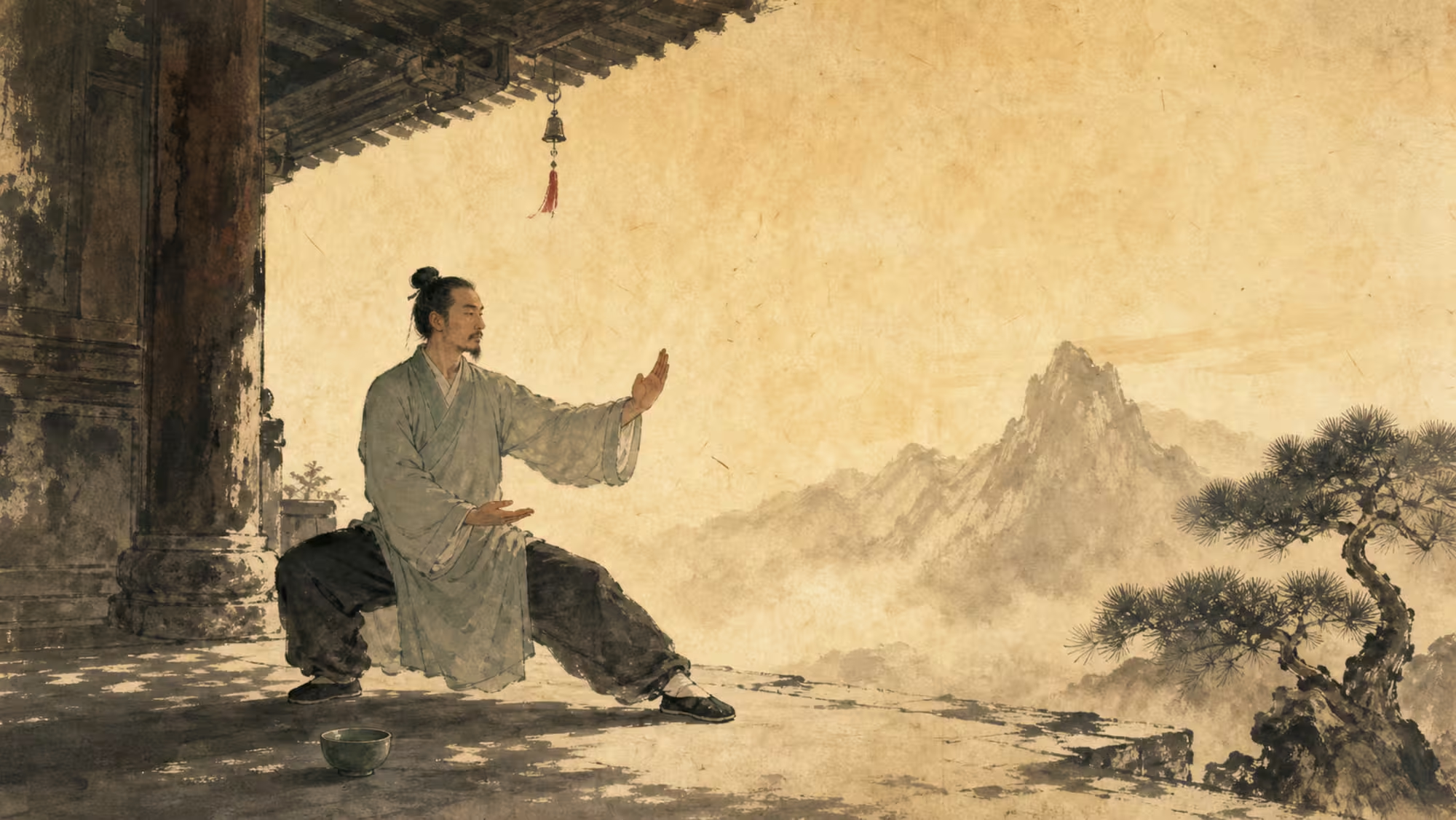
Summer has a way of turning ordinary practice decisions into visible ones.
A room that felt neutral in spring becomes heavy before the first movement begins. The floor warms under bare feet. Outdoor practice shifts from pleasant to exposed. A standing posture that seemed calm in April becomes a negotiation with sweat, pulse, insects, thirst, and the question of whether the body is settling or simply overheating.
This is not a small detail. Heat changes training.
At the end of June, that change is hard to ignore. Europe is moving through dangerous temperatures. Public-health agencies are repeating the old instructions that become new again every summer: train earlier or later, reduce intensity, drink water, rest, watch humidity, seek shade, stop when warning signs appear. At the same time, the wellness calendar is full of seasonal language. Summer Solstice Qigong events speak of peak yang and the Fire element. Outdoor classes lean into long evenings, gardens, parks, retreats, and the invitation to move with the season. San Fu dates for 2026 are now circulating for July and August, carrying another layer of Chinese seasonal-health culture into public view.
For Qigong and Taiji students, the useful question is not whether summer practice is good or bad. It is more precise than that: what does heat reveal about the way practice is being approached?
The answer is not found by romanticizing discomfort. It is also not found by stripping seasonal practice down to generic exercise advice. Qigong lives in a space where breath, posture, attention, traditional language, and ordinary physical conditions meet. In summer, that meeting becomes sharper.
Heat Is Not Just Background Weather
Many training mistakes begin with treating the environment as scenery.
In cooler months, this is easier to miss. A student can stand, walk slowly, hold postures, repeat a form, or practice breath regulation without feeling the room push back. The air may be dry or cold, the joints may take longer to open, but the body is not constantly trying to shed heat.
Summer changes the baseline. The same routine can produce a different effect because the body is already working. Heat does not wait politely outside the practice. It enters through the skin, the breath, the floor, the schedule, the clothing, and the student's idea of what counts as discipline.
This is why summer exposes the difference between steady training and performance of toughness.
There is a familiar temptation in practice culture: if discomfort appears, push through it. Sometimes that instinct is useful. A posture becomes honest only after the first wave of impatience passes. Slow stepping becomes meaningful only when the mind stops bargaining. Repetition has to outlast novelty.
But heat is not the same as boredom, restlessness, or mild muscular fatigue. It is a condition that changes the body's ability to regulate itself. Ignoring that fact is not deeper practice. It is poor listening.
Listening is one of the words internal arts use often enough that it can become decorative. In partner work, listening means feeling pressure, direction, timing, and intention through contact. In solo practice, it means noticing the body's organization before forcing a result. In summer, listening has a very plain meaning: is the practice becoming clearer, or is the body simply losing its ability to cope with the conditions?
The answer may require less drama than students expect. Move the session earlier. Shorten the standing time. Step into shade. Remove one layer. Practice slower without making the session longer. Take a break before the break becomes urgent. Let seasonal practice be seasonal, not heroic.
The Appeal of Fire Language
Seasonal language has its own pull.
Summer Solstice classes often describe the period as the height of yang. Fire-element workshops talk about warmth, joy, expansion, circulation, outward energy, and the heart. San Fu is presented as the hottest stretch of the year, a time when heat, yang, skin, sweat, and seasonal adjustment become part of Chinese health culture. These ideas can be beautiful when handled with care. They remind students that practice is not separate from daylight, weather, food, rest, clothing, and the human habit of living as if the body were not in a season.
The problem begins when metaphor becomes instruction too quickly.
Fire language can make people chase more heat when the useful lesson might be restraint. Peak yang can become an excuse to intensify a session at the exact moment conditions call for moderation. A seasonal class can feel more meaningful because it has ancient vocabulary around it, even if the practical choices are ordinary: find shade, soften the breath, keep the neck and shoulders loose, do not lock the knees, do not hold a posture past the point where attention collapses into strain.
Traditional language is not the enemy here. The weakness is literalism.
In practice, seasonal language should sharpen judgment, not replace it. If summer is associated with outward movement, brightness, warmth, and expansion, then the student can ask useful questions. Is the body becoming open or agitated? Is the breath settling or being pushed? Is sweat appearing as a normal response to effort and weather, or is the session sliding into dizziness and dullness? Does the form become more alive in the morning air, or is the afternoon sun flattening all sensitivity?
Those questions keep the tradition close to the body.
They also protect against another modern habit: turning every old seasonal idea into a health claim. San Fu, Fire element, summer yang, and heat-clearing language belong to complex cultural and medical histories. A blog post, a class listing, or a short video cannot turn them into individualized treatment advice. Students can respect the language without using it to diagnose themselves or promise outcomes.
For most practitioners, the safer and more useful approach is modest. Notice the season. Adapt the practice. Do not confuse symbolic heat with the actual heat accumulating in the body during training.
Why Qigong Feels Different in Heat
Qigong can seem gentle from the outside, which makes heat easier to underestimate.
A person running in the sun looks obviously exposed. A person lifting heavy weights in a hot garage looks obviously taxed. A person standing quietly, raising the arms, turning the waist, breathing slowly, or moving through a soft routine may look safe simply because the movement is not explosive.
But stillness is not absence of work. Slow movement is not absence of load. Breath attention is not a guarantee of regulation.
Standing practice, in particular, can become difficult in heat because the demand is quiet. The legs are active. The spine is organizing. The arms may be held away from the body. The mind is asked to stay present instead of chasing distraction. If the room is hot, sweat begins to change the experience. The student may interpret every sensation as energetic progress because Qigong language gives many names to internal feeling. Warmth, tingling, heaviness, pulsing, pressure, vibration, and emotional shifts can all become stories.
Some of those sensations may be normal. Some may be useful feedback. Some may be nothing more mysterious than heat, fatigue, dehydration, posture, expectation, or standing too long.
That distinction matters.
Summer practice asks students to become less enchanted by sensation. A warm current through the arms is not automatically a sign of achievement. Heavy legs are not automatically rootedness. A flushed face is not proof of internal fire being cultivated correctly. A racing mind is not always resistance. Sometimes the practice is simply too long for the conditions.
The skill is not to reject sensation. The skill is to place sensation in context.
What was the temperature? Was the student rested? Was there air movement? How long was the posture held? Was the breath natural or managed? Was the session done after coffee, after a heavy meal, after poor sleep, after a day of work, or in direct sun? Did clarity increase as practice continued, or did the student become dull, irritable, dizzy, or stubborn?
These are not glamorous questions. They are training questions.
The Summer Schedule Is Part of the Practice
One of the simplest summer adjustments is also one of the least romantic: change the time.
Traditional practice culture often values regularity, and rightly so. A daily session becomes a structure the mind can trust. But regularity does not require pretending that noon in July is the same as a spring morning. A student who refuses to adjust may be attached not to discipline but to the image of discipline.
Morning practice has a different quality in summer. The air is not yet loaded. The mind may be less crowded. The ground has not fully stored the day's heat. Even short sessions can feel clean if the student arrives before the day begins making demands.
Evening practice has its own character. The light is lower. The nervous system may need to downshift. The body may carry fatigue from the day. In some places the heat remains trapped in stone, pavement, rooms, and skin long after sunset. A session that works in the morning may be too much in the evening, not because the method changed, but because the day has already spent the body.
Indoor practice is not automatically easier. A closed room can become stagnant. A fan may help, but strong air across a sweaty body can also make a student tighten unconsciously. Air conditioning may make practice possible, but a cold room after intense outdoor heat can make the body feel strangely divided. The right answer is rarely a rule. It is a calibration.
This is where Qigong's ordinary virtues become practical: patience, attention, gradual change, and refusal to force a result.
The same applies to clothing and pace. Heavy fabric, tight waistbands, dark colors, and shoes that trap heat all shape the session. So does the decision to perform a full routine when a shorter one would be clearer. Summer rewards the student who can do less without becoming careless.
Cooling Down Without Making Practice Nervous
The phrase "cooling down" can mean two different things.
In general exercise language, it often means lowering intensity after effort. In seasonal wellness language, it can point toward cooling foods, cooling practices, or balancing heat. In Qigong practice, the most useful meaning may be simpler: end in a way that returns attention to the body without adding agitation.
That might mean standing quietly for a shorter time, not longer. It might mean walking slowly in shade instead of holding another posture. It might mean letting the arms rest at the sides and noticing the soles of the feet. It might mean drinking water and waiting before deciding whether more practice is needed.
What it should not mean is panic.
Summer wellness culture often swings between two extremes. One side chases heat as purification, intensity, detox, breakthrough, or proof of commitment. The other side becomes anxious about every sensation. Neither is especially useful for practice.
A steadier approach is available. Heat deserves respect. It does not need mythology. Practice deserves commitment. It does not need recklessness. Seasonal language deserves study. It does not need to become a treatment plan.
The student can hold all three truths at once.
A More Honest Kind of Seasonal Practice
The most useful summer practice may be the one that makes fewer claims.
It does not promise that a solstice class will transform the year. It does not turn San Fu into a universal prescription. It does not confuse sweating with cleansing, discomfort with depth, or a dramatic internal sensation with progress. It also does not reduce Qigong to a wellness accessory performed only when the weather is convenient.
Instead, it treats the season as part of the training field.
The sun is part of the session. So is humidity. So is timing. So is fatigue. So is the student's desire to finish the planned routine even after the body has stopped absorbing instruction. So is the humility to change the plan.
In that sense, summer is an excellent teacher because it gives immediate feedback. A careless session becomes obvious quickly. A tense breath becomes expensive. A locked posture heats the body faster than a living one. An ambitious schedule exposes itself. A student who can soften without collapsing, shorten without quitting, and listen without dramatizing sensation is learning something real.
The old seasonal vocabulary can still matter. Fire, yang, solstice, and San Fu are not empty words. They point toward a world in which practice belongs to weather, calendar, food, sleep, and conduct. But the vocabulary becomes useful only when it returns to the body in front of the student.
On a hot day, that body may need less ceremony and more shade.
It may need ten clear minutes instead of forty stubborn ones. It may need an early morning walk through a form, a few careful opening movements, or quiet standing that ends before the mind turns practice into a contest. It may need water. It may need rest. It may need the simple discipline of not using tradition as an excuse to ignore conditions.
The practice room in summer is not separate from the weather outside. The door is open, even when it is closed.