I could not do the splits. For years, despite training in Pencak Silat, Muay Thai, Hap Ki Do, and the Wudang internal arts, my hips refused to open. I stretched daily. I held positions until my legs trembled. I waited months for improvements that came in millimeters. Traditional flexibility training felt like negotiating with a locked door — I kept pushing, and my body kept pushing back harder.
Then I stopped pushing. I started listening. And within seven days, I had my full splits.
Not through willpower. Not through pain tolerance. Through understanding what was actually happening inside my nervous system — and learning to work with it instead of against it. That discovery changed how I train, how I teach, and what I believe is possible for the human body.
Today, when a student like Maria sits across from me on day three of her training — hips tight, face full of doubt, whispering "are you absolutely certain seven days is possible?" — I do not just reassure her. I tell her exactly what I am about to tell you.
You Are Not Fighting Tight Muscles
This is the single most important thing I can tell you: your muscles are not the problem. When you push into a deep stretch and hit a wall, that wall is not mechanical. It is your nervous system pulling an emergency brake.
Two sensory structures run the show. Muscle spindles, woven into the belly of every muscle, detect lengthening and fire a rapid signal back to the spinal cord. This triggers the stretch reflex (反射) — an automatic contraction of the very muscle being stretched. It is fast, powerful, and entirely unconscious. Meanwhile, Golgi tendon organs (GTOs) at the muscle-tendon junction detect tension and send an opposing signal: relax. When tension is high enough, GTOs trigger what is called autogenic inhibition (自体抑制) — a reflex reduction in the muscle's own contraction force.
These two systems live in constant tug-of-war. Every time I forced deeper into a split, I was amplifying the spindle alarm. My brain flagged the position as dangerous and contracted the very muscles I was trying to lengthen. For years, I was fighting my own protective reflexes without knowing it.
The question that changed everything: what if I could tip the balance?
The Art of Neurological Negotiation
The answer was proprioceptive neuromuscular facilitation (本体感觉神经肌肉促进法) — PNF. Originally developed for neurological rehabilitation, PNF uses deliberate muscle contractions within a stretched position to shift the conversation between these competing reflexes.
The classical explanation is that by contracting a muscle isometrically while it is lengthened, you generate high tension in the tendons, strongly activating the GTOs. The resulting inhibition temporarily overrides the stretch reflex, creating a window for deeper range.
I should be honest about the science here. That clean story is almost certainly an oversimplification. Newer research using electromyography shows that muscle activation does not always decrease after contraction — sometimes it increases. What the contemporary literature points toward is arguably more interesting: PNF appears to work primarily by modifying stretch tolerance — your nervous system's threshold for how much lengthening it will permit before generating resistance. Your brain learns, through repeated exposure under controlled tension, that these positions are survivable. It recalibrates the alarm.
Four mechanisms likely contribute: autogenic inhibition, reciprocal inhibition, stress relaxation of viscoelastic tissues, and gate control — where the sensory input from contraction temporarily overwhelms pain signaling. The honest answer is that all four play a role, with tolerance shifts doing the heavy lifting in the early days.
But here is what matters for practice: you are not mechanically unlocking a joint. You are earning your nervous system's trust. And that trust can be built remarkably fast.
The Protocol
Traditional PNF requires a partner. I needed something my students could practice alone. After years of experimentation, I built a solo system around three daily sessions.
Morning Activation (15 Minutes)
Three minutes of dynamic leg swings — front-to-back and side-to-side, emphasizing control rather than height. Two minutes in horse stance (马步) with pelvic tilts, waking up the deep hip stabilizers. Five minutes of hamstring pre-activation: standing forward fold pulses where you bend toward your toes, then actively engage your hamstrings to pull yourself back upright — building eccentric strength through the full range. Finally, five minutes of elevated lunges with active contractions to prepare the hip flexors.
Evening Deep Work (20 Minutes)
This is where the transformation happens. I call it the three-phase cycle.
Phase 1 — Passive Positioning (10 seconds). Move into your split position until you feel the first whisper of tension. Not pain. Not even strong discomfort. About a five out of ten. Your nervous system needs to register the position without perceiving a threat.
Phase 2 — Isometric Contraction (6 seconds). While holding this position, press your legs into the floor as if trying to stand up. Here is a crucial detail most programs get wrong: you do not need a maximal contraction. Research shows that roughly twenty percent of your maximum force held for just a few seconds is enough to trigger the neurological shift. Going harder does not help and may actually impair the response.
Phase 3 — Relaxation and Advancement (20 seconds). Release the contraction completely and immediately ease deeper. This is the window — your nervous system has just recalibrated its tolerance. Breathe slowly: inhale for four counts, exhale for eight. That extended exhale activates the parasympathetic nervous system, shifting your body from vigilance toward release.
Repeat four to five times. Twice daily.
Mid-Day Maintenance (5 Minutes)
Gentle mobility work to remind the nervous system that these new ranges still exist. Nothing aggressive — just a conversation to keep the channel open.
The Timeline — And What Is Actually Happening
Days 1–2 feel modest. You are establishing a baseline. But beneath the surface, neural recalibration has already begun. Research consistently shows that the greatest range-of-motion changes from PNF occur after the very first repetition. Your nervous system is starting to accept new information about what these positions mean.
Days 3–4 are where it gets interesting. This is exactly where Maria was — right at the edge. Stretch tolerance shifts markedly. Students can suddenly hold positions that were impossible forty-eight hours earlier. I have watched this happen hundreds of times, and it still amazes me. The body has not structurally changed in any meaningful way. The governing system has changed its policy.
Day 5 often brings a temporary plateau. The nervous system has adapted to the specific positions and loading patterns you have been using. This is normal — it is adaptation resistance, not a physical wall. The solution is variation: different split angles, altered contraction intensities, changed timing. Novel stimulus restarts the conversation.
Days 6–7 are integration and assessment. For many students, full or near-full splits become accessible. Movement feels fluid where it once felt forced.
David, a 35-year-old engineer who swore he had never been flexible a day in his life, hit his breakthrough on day four. "Master Ziji," he said, his eyes wide, "it is like my body just… let go." That is exactly what happened — not at the muscular level, but at the level of permission. His nervous system stopped saying no and started saying how far?
The Honest Truth About Anatomy
Now — and this matters — not everyone will achieve a 180-degree split. This is not a failure of will or technique. It is bone.
Your hip joint (髋关节) is a ball-and-socket with remarkable variation between individuals. The socket — the acetabulum (髋臼) — can be deep or shallow. Those with deeper sockets will find middle splits more challenging because the femur approaches the socket rim sooner. The angle of the femoral neck varies too: some people are naturally turned inward (anteversion), some outward (retroversion), and this shapes what your optimal split position actually looks like. Even the angle where the neck meets the shaft affects how much abduction the joint permits before bone approaches bone.
These structures never make direct contact in a healthy joint — they are separated by cartilage, labrum, and the active tension your nervous system maintains. But they define the boundaries of your unique range.
How to know if you are hitting structure rather than tightness: sharp, pinching pain deep in the hip crease (not the broad sensation of muscle stretch), immediate restriction that warming up does not change, or clicking and catching in the joint. If you feel these, your path is not blocked — it just requires modification. Adjust leg rotation, tilt the pelvis posteriorly, explore different angles. A mobile, pain-free 160-degree split is infinitely more valuable than forcing toward 180 with compensations that stress the labrum.
Know the limits, then practice within their wisdom.
When Progress Stalls
For stubborn hip flexors, I use what I call the Reciprocal Inhibition Amplifier. Lie on your back, one leg toward the ceiling with a strap around your foot. Instead of just pulling the leg toward you, actively try to lift it higher using your hip flexors while maintaining gentle traction. This exploits reciprocal inhibition: when one muscle group contracts, the nervous system reflexively reduces activation in its antagonist. The compound signal — active agonist contraction plus passive stretch on the target — can break through plateaus that simple stretching cannot.
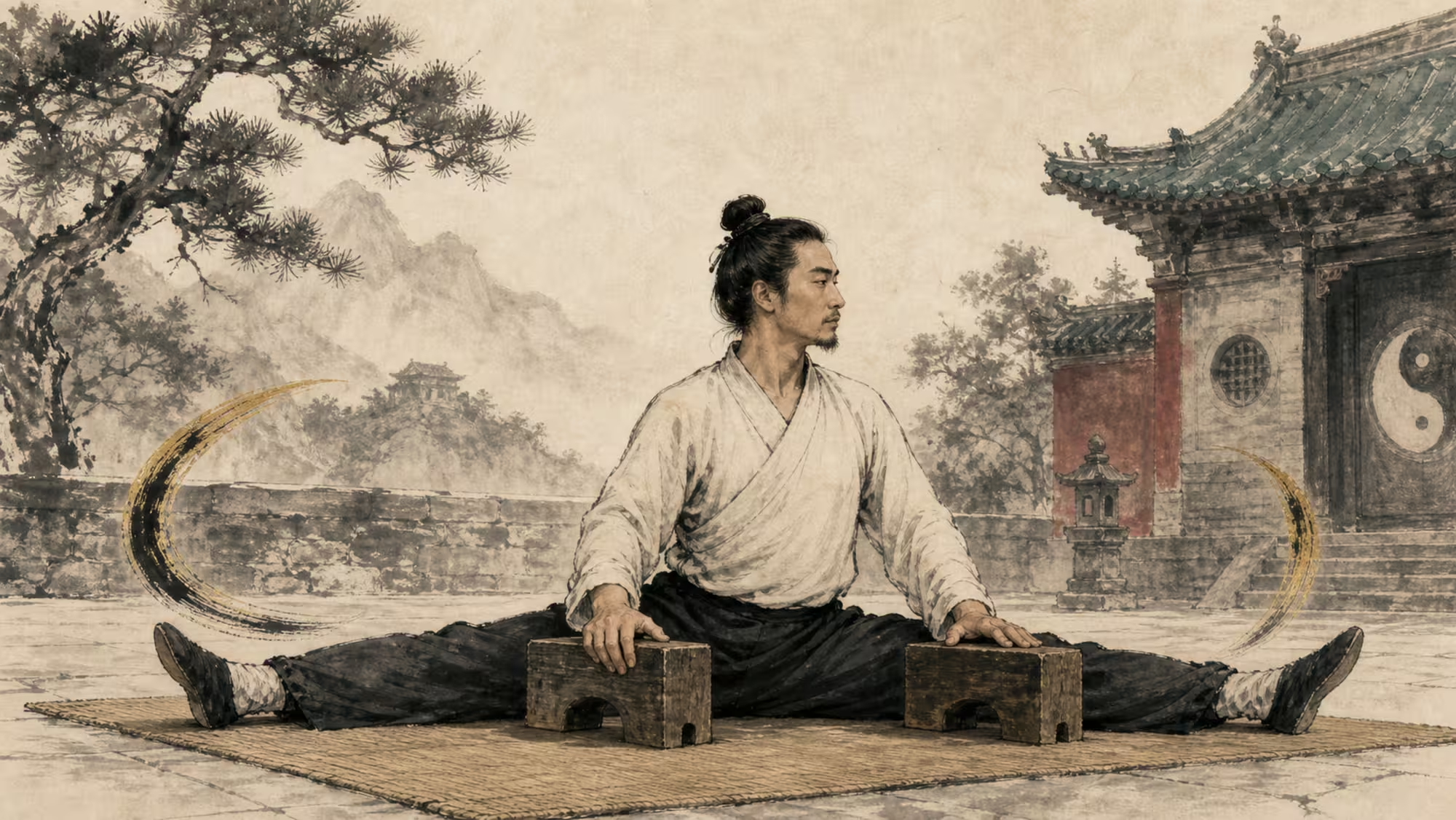
For complete stalls, reduce the threat. Use blocks or cushions to support your weight in the split position. Stop trying to go deeper. Focus entirely on breathing. Sometimes the most powerful intervention is simply making the position feel safe so your nervous system stops guarding it.
The Part Nobody Talks About
Flexibility is not just physical — it is profoundly mental. My autism gives me an advantage here. I hyperfocus on details that others miss, and I have learned to channel that into teaching students precise body awareness.
When Maria struggled with fear-based tension, I had her visualize her legs as streams of water, naturally flowing into the split position. This is not mysticism — it is a well-documented method for reducing anticipatory muscle guarding. When the brain rehearses a movement as safe before executing it, the protective reflexes arrive later and with less intensity.
The breathing protocol reinforces this. That four-count inhale and eight-count exhale is not arbitrary. The extended exhalation stimulates the vagus nerve and shifts autonomic balance toward parasympathetic dominance — the branch of your nervous system associated with rest and reduced muscle tone. You cannot force your way past a nervous system in fight-or-flight mode. You have to change the mode first.
Flexibility Without Strength Is Useless
As a martial artist and 16th generation lineage holder of the Sanfeng line (三丰派), I need to say this clearly: the splits are not about touching the ground. They are about having complete control and strength throughout the entire range. A true martial artist can kick from a split position, not just pose in one.
This is where the longer journey matters. The seven-day gains are neurological — and neurological gains are reversible. Research using direct sarcomere imaging in living humans has shown that structural muscle adaptation — the actual addition of contractile units within the fiber — requires weeks of consistent eccentric loading. One recent study documented serial sarcomere increases of up to 49 percent in the hamstrings after nine weeks of training. But those gains began reversing within three weeks of stopping.
The seven days open the door. What you build afterward determines whether it stays open.
I progress students through three stages. First, eccentric control — lowering slowly into splits over a count of ten, building strength in the lengthened position. This teaches the nervous system that these ranges are not just tolerable but controllable. Second, isometric holds at maximum depth with full muscular engagement, creating stability through mobility. Third, dynamic transitions — standing to splits and back without support. This is where flexibility becomes martial capacity.
Maintenance requires at minimum three sessions per week to hold gains. The students who succeed long-term understand what every Wudang practitioner knows instinctively: this is a practice, not a destination.
What Success Really Means
Maria achieved her full front split on day six. She cried — not from pain, but from the sudden, overwhelming realization that the limitation she had accepted for thirty years was never real. It was a policy, not a law. And policies can be changed.
David never reached 180 degrees. His hip anatomy did not allow it. But he gained 45 degrees of usable, strong, pain-free range — and for the first time in his adult life, he could touch his toes without bending his knees. He told me that mattered more than any split.
Both outcomes represent the same courage: to challenge a limitation you have been accepting without question, and to work with your body rather than against it.
When I achieved my own splits all those years ago, the deepest change was not in my hips. It was in what I believed was possible. Every student I have guided through this protocol since — hundreds of them — has experienced some version of the same shift. The range of motion is the visible result. The invisible one is larger: the realization that your body was never the obstacle. It was waiting for you to ask it the right question.
The journey of a thousand miles begins beneath your feet.
The question is not whether seven days is enough. It is whether you are ready to begin.