
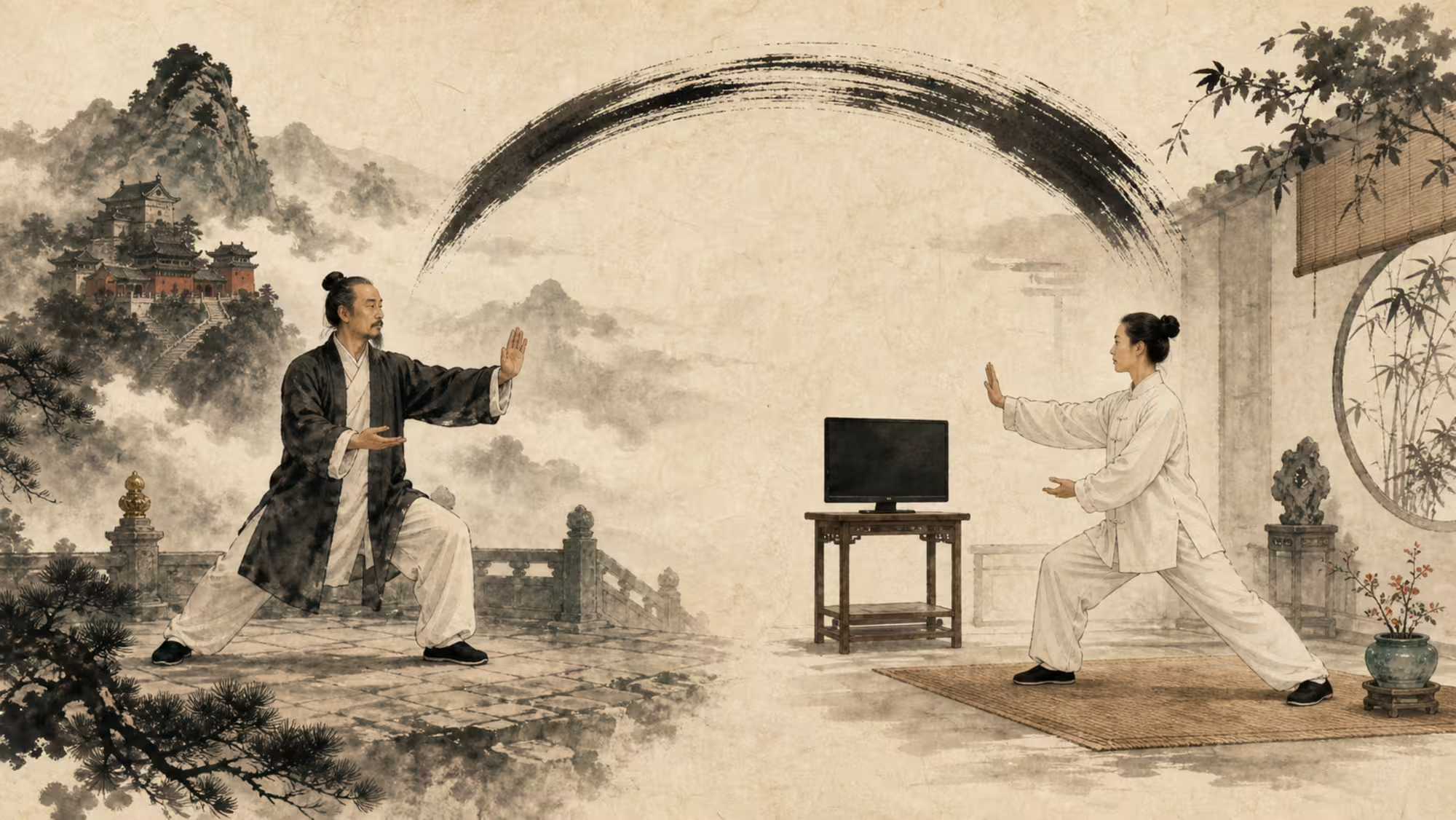
The question appears again and again now, usually in a practical tone rather than a rebellious one: there are no Taiji or Qigong classes nearby, so can the practice be learned online?
It is not a strange question anymore. A student in a rural town can open a phone and find more movement lessons than a city student could have found in an entire library a generation ago. There are livestreams, subscription libraries, recorded courses, short daily routines, apps, teacher training portals, video calls, hybrid workshops, and public clips that break one hand shape into five camera angles. The supply is no longer the problem.
The problem is deciding what kind of learning is actually happening.
Taiji and Qigong sit awkwardly in the online age because they are easy to show and difficult to transmit. A beginner can copy the outer shape of a movement from a screen within minutes. The weight shift, breath, alignment, intention, timing, and internal organization may take much longer. Sometimes the screen helps. Sometimes it hides the very thing the student needs to see.
This does not make online study useless. It makes it specific.
The New Distance Student
The current discussion around online practice is not only about convenience. Many beginners are not choosing between a good local teacher and a video library. They are choosing between some remote instruction and no instruction at all.
That changes the tone of the question. The old answer, "just find a teacher," can be correct and still unhelpful. A person may live two hours from the nearest class. The class may be focused only on health exercise when the student wants martial context, or only on performance choreography when the student needs basic body education. A local class may exist, but not in the style, language, schedule, or physical intensity the student can actually sustain.
Online learning grows in that gap.
The better online programs know this. They do not pretend a video is a master standing beside the student. They offer structure: what to practice first, how often to repeat it, what mistakes to watch for, when to move on, and how to ask questions. Some add livestream corrections, private video review, occasional seminars, or regional workshops. The strongest models treat distance learning as a bridge, not a replacement for every kind of contact.
The weakest models treat the screen as magic. They promise mastery through follow-along clips, sell secret methods without correction, or flatten Taiji and Qigong into a playlist of calming gestures. The student is left with motion, but not necessarily training.
That difference matters.
What Video Teaches Well
Video is good at repetition. This is its great strength.
A beginner can replay the same opening posture ten times. They can pause, compare, slow down, and return tomorrow without embarrassment. A teacher in a physical class cannot repeat one small transition forever for one student while everyone else waits. A recording can.
Video also helps with sequence memory. In Taiji forms, many beginners spend so much attention remembering what comes next that they cannot feel what is happening now. A clear recording reduces that burden. Once the student knows the order, there is more space to notice stance width, foot angle, shoulder tension, and whether the hands are leading the body instead of following it.
For Qigong, video can establish rhythm. It can show how slowly a movement breathes, how long a posture is held, how the body rises and sinks, and how a set is paced from beginning to end. A short daily recording can help a beginner build continuity before they have enough internal feeling to practice alone.
It also creates access to styles and teachers that geography would otherwise block. A sincere student can study basic vocabulary, compare approaches, and learn enough to ask better questions. For someone in an isolated place, that is not trivial. It may be the difference between waiting indefinitely and beginning.
But video teaches most safely when the student understands its limits.
What the Screen Cannot Correct
A camera sees the surface. A teacher sees the consequence.
The student may think the knee is aligned because it looks aligned from the front. A teacher standing nearby may see the weight collapsing into the inside edge of the foot. The student may copy a rounded arm shape while the shoulder is locked, the chest lifted, and the breath held. From one camera angle it looks close enough. In the body it is a different event.
This is where Taiji and Qigong differ from ordinary choreography. The outer path matters, but the quality inside the path matters more. Is the waist turning or are the arms swinging? Is the spine lengthening or stiffening? Is the stance alive or just low? Is the breath supporting the movement or being forced to match it?
These questions often require correction.
The problem is not that beginners are foolish. It is that early errors can feel normal. The body accepts familiar compensation as truth. If someone has spent years standing with one hip higher, twisting through the knee, gripping the lower back, or lifting the shoulders to breathe, the first practice months may simply decorate those habits unless someone interrupts them.
Remote teachers can catch some of this through video review, especially if the student films from several angles and receives specific feedback. But touch, pressure, timing, and partner contact still reveal things that video cannot. A teacher can adjust a shoulder with one hand and the student suddenly understands what "relax" never explained. A partner can push lightly into a posture and show that a beautiful shape has no root. A correction can be felt before it can be named.
That is why a serious distance student should not confuse access with completion.
Qigong Is Not Automatically Easier
Many people assume Qigong is safer to learn online than Taiji because it is slower, softer, and often simpler. Sometimes that is true. A basic health set with clear, moderate instructions can be a reasonable entry point for remote study. The movements are often repetitive, symmetrical, and less dependent on partner feedback.
But Qigong is also a place where vague language can become dangerous in a different way.
The internet is full of instructions about energy, sensations, heat, tingling, emotional release, visions, detox, trauma, and healing. Some students become anxious because they do not feel enough. Others become attached to sensation and chase it. Some interpret every unusual response as progress. Others push breathing or concentration too hard because the video makes the practice look gentle, so they assume more intensity must be better.
Good Qigong instruction keeps the student grounded. It gives ordinary checkpoints: breathe naturally, do not force sensation, stop if something feels wrong, keep the joints comfortable, let attention be steady rather than aggressive. It explains that quiet practice is still practice. It does not turn every feeling into a diagnosis or achievement.
This is another reason correction matters. In Qigong, the error may not be a visible knee angle. It may be an attitude: trying to manufacture an internal event instead of allowing the body to settle.
Taiji Needs Bodies
Taiji can begin online, but it cannot fully mature there if the goal includes martial understanding.
A form can be learned from a screen. Basic stepping can be learned. Postural ideas can be introduced. The student can build coordination, balance, patience, and a vocabulary of movement. None of that is fake.
But Taijiquan is not only a slow solo dance. Its body method was shaped by contact, pressure, angles, timing, and the question of what happens when another person does not cooperate. Even if a student practices mainly for health, the martial structure explains why the movements are organized as they are. Without that context, the form easily becomes decorative.
Partner work does not need to begin with hard sparring. It may begin with simple touch: feeling whether the body braces, whether the shoulder rises under pressure, whether the root disappears when someone changes direction, whether a turn comes from the waist or from the arms. Push hands, applications, and supervised drills give the form feedback.
Online instruction can prepare a student for that feedback. It can teach the route. It can build the habit of practice. It can make the first workshop less overwhelming. But at some point, if Taiji is to remain Taijiquan, another body has to enter the room.
A Better Way To Use Online Study
The most useful question is not "Can I learn online?" but "What should I use online learning for right now?"
For the first stage, online study can build daily contact. Choose one teacher or one coherent course and stay with it long enough to learn its language. Do not collect ten routines and practice none of them deeply. A beginner does not need endless variety. A beginner needs a reliable floor.
Use video to memorize the sequence, but do not stare at the screen forever. Watch, practice, then turn away and feel what remains. If the practice collapses as soon as the screen is gone, the body has not learned it yet. That is useful information.
Film yourself occasionally. Not every day, and not to become self-conscious, but to compare what you think you are doing with what is actually visible. Use front, side, and diagonal angles. Check the simple things first: feet, knees, hips, shoulders, head, breathing effort, and whether the movement looks rushed.
Write down questions. The questions are often more valuable than the answers at first. "Why does the right knee turn in?" "Why do the shoulders lift when the arms rise?" "Why does one movement feel calm and another feel irritating?" These questions can guide a video review, a livestream class, or a future in-person correction.
When possible, plan for contact. That might mean one workshop a year, a weekend seminar, a local teacher in a related internal art, or a small group of training partners willing to explore basic pressure drills carefully. The point is not to abandon online study. The point is to give it a body to answer to.
The Discipline Of Staying With One Thread
The real danger of online learning is not only bad instruction. It is endless switching.
The student begins with a beginner Qigong set, then finds a different teacher, then a Taiji form, then a breathing method, then a secret standing practice, then a mobility routine, then a video warning that everything else is wrong. After three months, the student has sampled many doors and entered none.
Traditional training is often less dramatic than the internet suggests. It asks for repetition before novelty. It asks the student to become sensitive to small changes. It asks for enough trust in a method that boredom can turn into observation.
That does not mean blind loyalty. If a teacher is unsafe, manipulative, medically irresponsible, or unable to explain basic practice boundaries, leave. But constant novelty is not discernment. Sometimes it is avoidance dressed as research.
A remote student needs a simple rule: choose carefully, then stay long enough for the practice to reveal whether it works.
When Distance Becomes Practice
There is something honest about the distance student's situation. Without the weekly atmosphere of a school, without classmates, without a teacher's eyes in the room, the student must discover whether practice can survive in ordinary life.
That is difficult, but not meaningless.
The room is quiet. The video ends. The phone screen goes dark. There is no one to impress and no one to correct the next repetition. The student stands again, checks the feet, softens the breath, and begins the same movement with a little more attention than yesterday.
Online learning can bring the instruction to that moment. It cannot replace what only correction, touch, community, and time can give. The mature student learns to use both truths without confusion.