What Daodejing 48 and Zhuangzi's Woodworker Tell Us About True Skill
You know a movement. You’ve practiced it often. But today, it’s supposed to be especially good.
So you monitor your hand. Then your shoulder. Then your breath. While correcting the shoulder, the neck tenses. While trying to calm the breath, you hold it for a moment. And at some point, the movement that felt familiar yesterday is full of small interruptions.
You’ve given it more attention. More intention. More effort.
Why has it become harder because of that?
This question leads to one of the most peculiar statements in the Daodejing. It concerns a point that we easily overlook when learning: We can acquire skills while simultaneously developing habits that prevent us from using them freely.
Some things we must learn. Some things we must let go of.
In Learning, Add; on the Path of Dao, Subtract
Chapter 48 of the Daodejing (道德經) begins with the line:
為學日益,為道日損。
Wéi xué rì yì, wéi dào rì sǔn.
"In learning, something is added daily. On the path of Dao, something is subtracted daily."
— Daodejing, Chapter 48; freely rendered
We immediately understand the first half. Those who learn will eventually know more terms, more movements, more connections. A skill is built. Something that was missing yesterday is present today.
The second half disrupts this familiar image. If development means being able to do more and more, why should something be reduced?
The chapter continues this reduction down to wú wéi (無為), the much-discussed "non-action." In the end, it expands the thought to governance. So it is about more than a method to relax while practicing: How much of our interference is appropriate at all? What happens when we constantly impose our intention on everything?
For practice, a precise distinction can be discovered within this. There is what the action needs. And there is what we additionally burden it with: impatience, self-presentation, fear of making a mistake, the desire to already possess the result before we have done the work.
Raising an arm requires coordination. It does not automatically require a clenched jaw.
Both can happen simultaneously. Only one of them helps the movement.
The Craftsman Who Became Still Before Work
In the Zhuangzi (莊子), Chapter 19, there is a story that makes this idea tangible. It is about the woodworker Qing, Zǐ Qìng (梓慶).
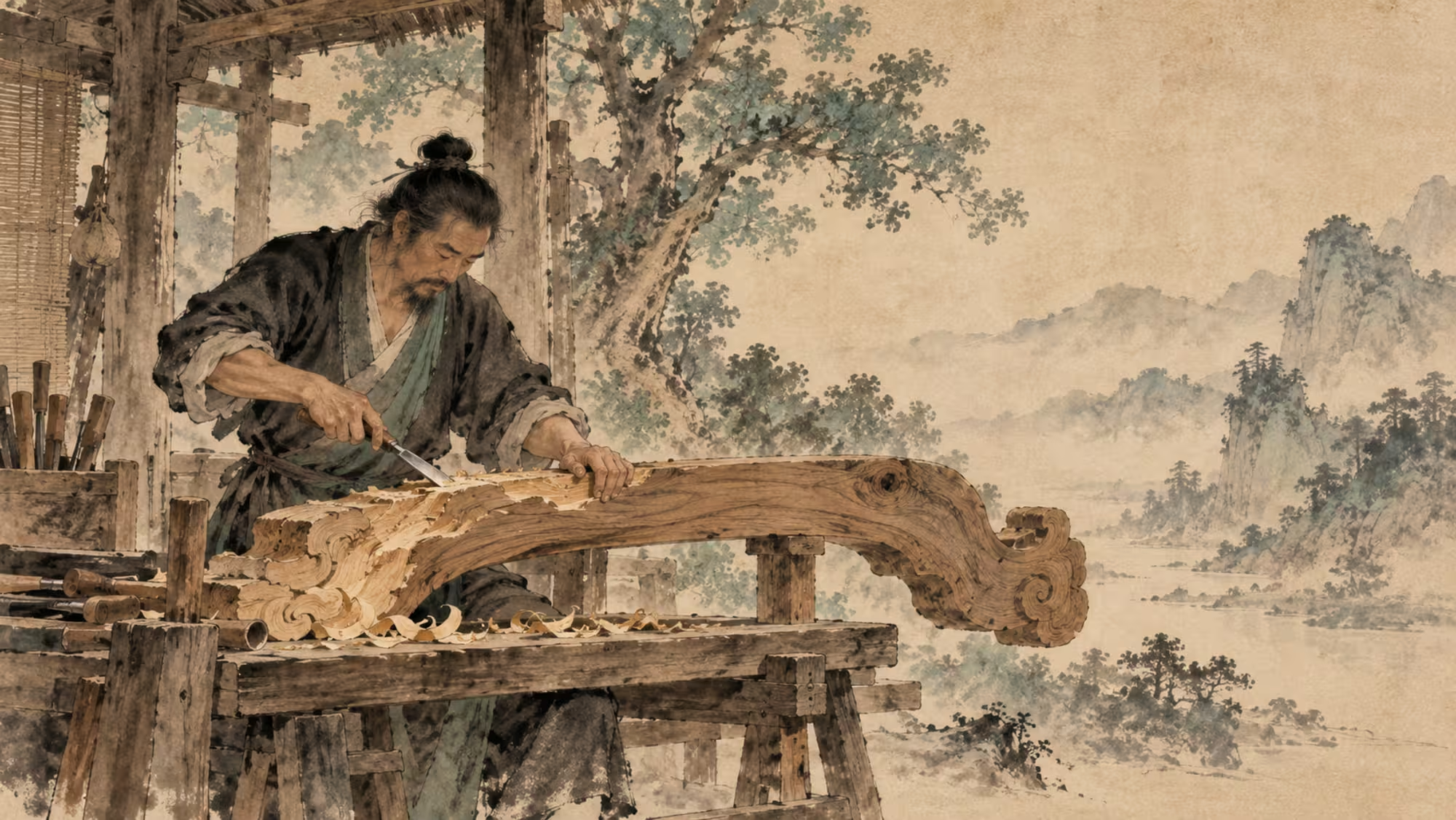
Qing crafts a wooden bell stand. He succeeds so extraordinarily that the onlookers believe supernatural forces must have been involved. The Duke of Lu asks him about his secret.
Qing then describes his preparation. Before he works, he collects himself through fasting. After three days, reward and rank no longer concern him. After five days, praise, criticism, and the question of his own skill lose their power. After seven days, he even forgets his limbs and his physical form.
Only then does he go into the forest.
There, he observes the natural characteristics of the trees. If he finds a suitable tree, he recognizes the potential of the piece within it. If he does not, he does not begin the work.
His skill meets the nature of the wood. This is how the story explains the work that appears to others like a miracle.
What Qing Lets Go Of
The story is part of the outer chapters of the transmitted Zhuangzi. This work evolved over a long period; therefore, we should not simply treat the narrative as a personal commentary by the historical Zhuangzi on Chapter 48. However, we can read both texts side by side. Their kinship then becomes clear.
In the story, Qing forgets a great many things. His ability to work with wood apparently is not among them. In the end, a carefully crafted piece emerges.
What disappears is his preoccupation with himself as someone who might be admired or criticized for this work.
This is a big difference.
As long as he thinks about the reward, the reward stands between him and the wood. As long as he thinks about the duke's judgment, the duke is, in a way, working with his hand. And as long as he wants to prove how skilled he is, every cut must also say something about him.
The wood becomes a stage for his self-image.
His focus gradually removes the audience from this stage. Only then can the nature of the tree come to the forefront.
For me, this is the true strength of the story: Qing becomes more attentive to what he is working with. His intention takes up less space. As a result, he can perceive more.
The Tree Does Not Need to Take Every Form
A part of the story that is often overlooked is particularly revealing: Qing only works when he finds suitable wood.
Even an excellent craftsman cannot make an unsuitable trunk suitable through sheer determination alone. Grain, growth, and shape are part of the task. They are already there before he applies his tools.
We often treat such conditions as if they were annoying obstacles. The body is supposed to be as flexible today as it is in our imagination. The conversation is supposed to lead exactly to the insight we have prepared. A free afternoon is supposed to fulfill all the plans we have made for it.
Then we encounter the real situation. The body is tired. The other person has a different question. The afternoon is getting shorter.
Qing's story suggests taking a closer look at this point. What is actually possible here? What form does the situation allow? Where am I working with its conditions, and where am I trying to bypass them?
The tree is not a mistake in the craftsman's plan. It is the material from which the work arises.
In Taiji: What Supports the Movement?
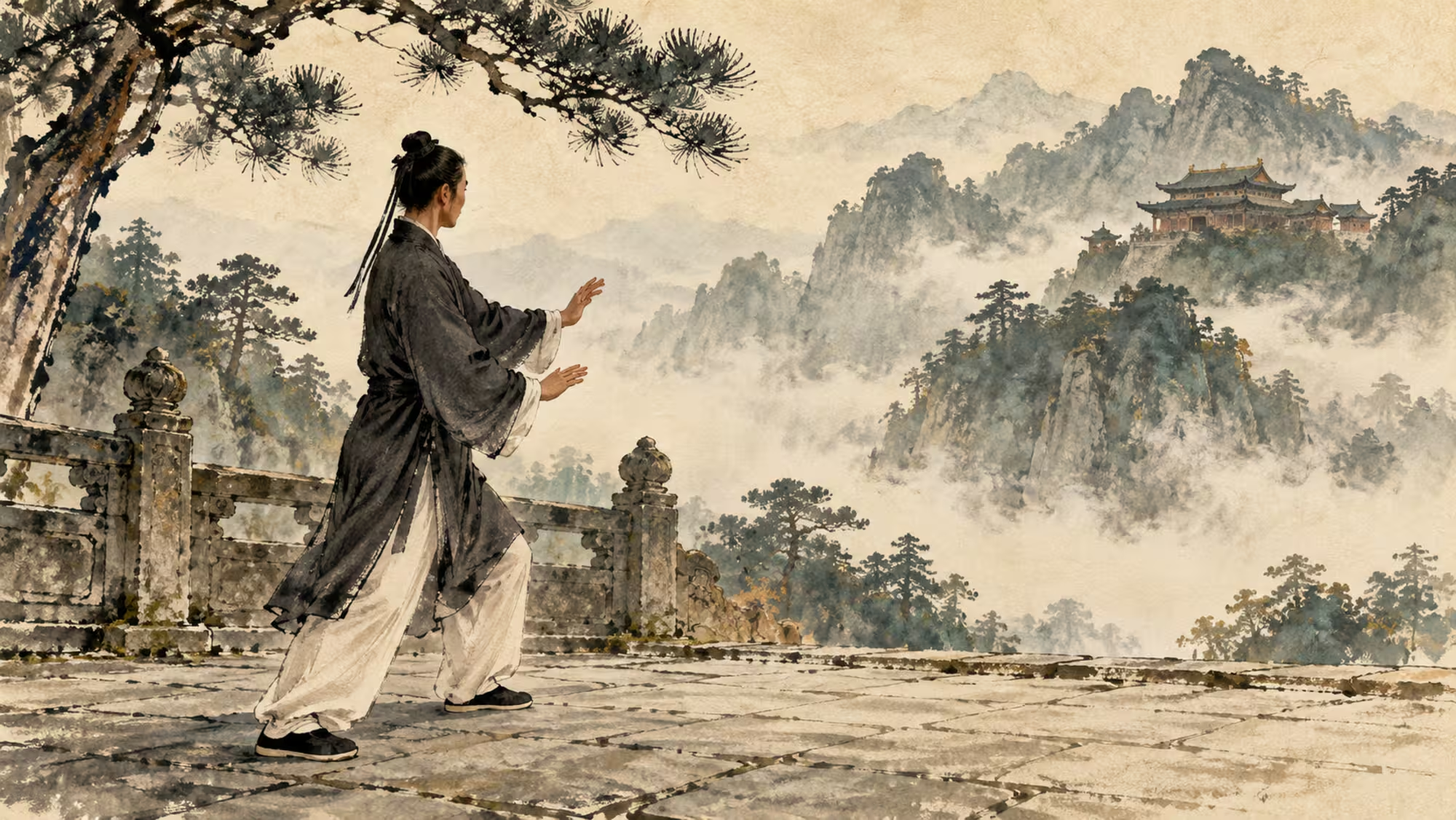
Take a simple movement from your form. Maybe you raise your arms, shift your weight, or turn from the center.
First, you need clear guidance. You must learn where the movement goes and how to maintain balance. Correction is valuable. Repetition is too. Addition has its place.
Over time, you can ask a second question: What am I doing simultaneously that the movement doesn’t need at all?
Perhaps you shrug your shoulders just before your hands rise. Maybe you hold your breath as soon as you focus. Maybe your upper body already leans forward, even though the weight is still on your back leg.
Then the next step might be to notice one of these extra actions and gently release it. Check if the movement becomes clearer and the stance remains stable.
This letting go requires precision. If you simply gave up all tension, what supports you would also disappear. Sōng (鬆), the release of unnecessary tension, proves itself by keeping the body mobile and connected.
This is how reduction becomes a challenging form of learning. You distinguish more precisely between essential work and additional effort.
In Conversation: Finding the Answer a Moment Later
The same pattern can be observed when someone is talking to you.
Perhaps you already know the topic. Even as the other person finishes their first sentence, your response forms. You recall a personal experience, find advice, and wait for the right moment to interject.
You are occupied. But how much of what is being said right now is still reaching you?
Here, letting go can be very concrete: Let the prepared sentence rest for a moment. Listen to the final part of the explanation as well. It might change everything you thought you had understood before.
Your knowledge is still available. You simply don't let it take over the conversation.
Qing goes into the forest once the thoughts about his reputation have quieted down. In a conversation, a similar space can arise when we, for a moment, refrain from needing to appear clever, helpful, or superior.
Then we more easily encounter the person who is actually sitting in front of us.
When Skill Becomes a Test
Imagine a student who practices a short sequence of movements smoothly on their own. As soon as someone watches, their rhythm changes.
They want to perform the first movement particularly cleanly. In doing so, they hold it a little too long. The next one starts too late. They notice, want to catch up, speed up, and lose the transition they actually mastered.
The sequence remains the same. Added to it is a second task: While practicing, they are supposed to judge themselves from an outside perspective.
Now they could try to control even more. Or they could set that extra task aside for one run-through and return their attention to something simple and familiar: feeling the ground, noticing the transition, letting the sequence flow through to the end.
This does not guarantee a perfect performance. But it makes clear what they are working on. Perhaps they need more practice. Perhaps the skill is already there, but the effort to prove it at every moment gets in the way.
These two situations require different responses.
A Small Exercise in Letting Go
For your next practice session, choose a movement that is already familiar to you. Perform it a few times within a comfortable range of motion.
Then, observe just one spot: your jaw, your shoulders, or the moment when your breath catches. Do not try to fix your entire body at once.
If you notice unnecessary tension there, release some of it. Repeat the movement. Does it remain stable? Does the transition become smoother? Can you still perceive your surroundings?
Compare the experience without immediately deriving a grand explanation from it.
Perhaps little will change today. Perhaps you will only notice how early you start trying to force a result. That, too, is a useful observation. You have recognized something you can continue working with.
The question for this round is:
What can I let go of without losing what supports the movement?
When the Wood Becomes Visible Again
We can collect many things: forms, concepts, corrections, ideas of what good practice should look like. Some of it is necessary. Some of it helps us for years.
But at some point, it is worth looking between the collected things. Which of them sharpens our perception? What occupies us so much that we overlook the concrete situation?
Daodejing 48 opens this question. The story of Qing gives it a form: A craftsman enters the forest after the thoughts of reward and judgment have grown quieter. In front of him stands a tree.
He sees its growth. Its shape. The possibilities that this wood offers.
Perhaps another step on the path begins right there: You bring your skill with you. And leave enough space to recognize what is before you.
Sources: Daodejing, Chapter 48 and Zhuangzi, Chapter 19, “Dá Shēng” (達生), the story of Woodworker Qing. The quotation is a free rendering of the original meaning; the story has been freely retold. The examples from training and everyday life are contemporary applications of this interpretation.