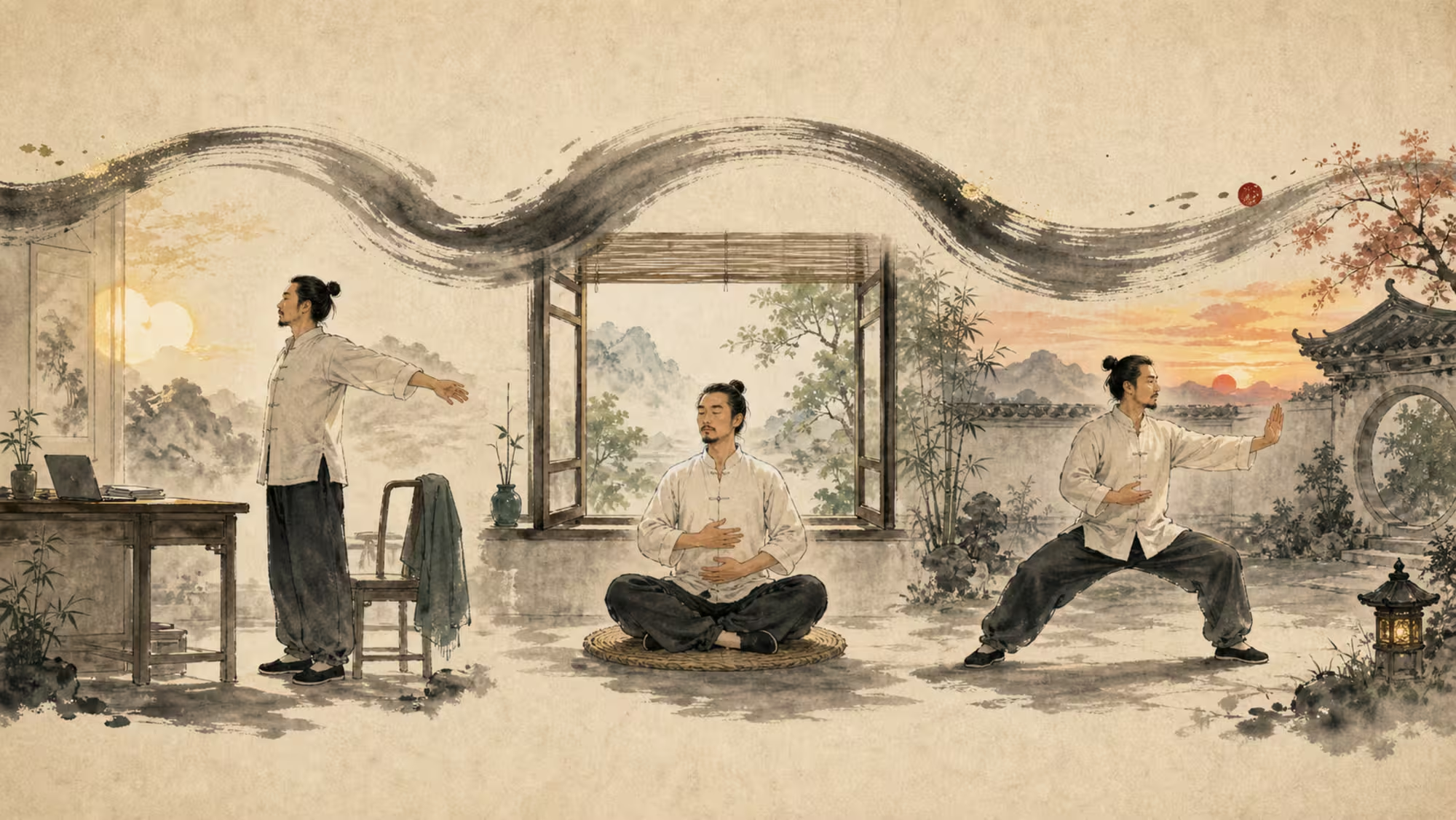
The phrase sounds like it was invented for a phone screen: movement snacks.
It is friendly, tiny, and almost impossible to dislike. A movement snack might be a minute of stair climbing between meetings, a few squats beside a desk, a short mobility sequence in the kitchen, or a slow shoulder roll before opening another tab. The cousin term is now appearing beside it: micro-breathwork. Thirty seconds before a meeting. Three slow exhales after a stressful call. A brief breathing reset in the car before walking into the house.
This language is everywhere in 2026 wellness media. Fitness editors are writing about snack-sized workouts. Breathwork organizations are talking about micro-dosing the breath. Reddit threads are full of people trying small daily interventions because the full routine has become too hard to protect. The tone is not heroic. It is tired, practical, slightly embarrassed by the old fantasy of perfect discipline.
That is what makes the trend interesting.
For years, online fitness sold transformation as a block of time: the class, the protocol, the challenge, the app, the morning routine that begins before sunrise and somehow requires a silent kitchen, expensive supplements, and no children asking for socks. Movement snacks are a rebellion against that. They admit the obvious: many people no longer have the clean hour. Some barely have ten minutes. The question is whether practice can survive after being cut into pieces.
For students of Taiji and Qigong, the answer is not as simple as yes or no.
The Return of the Small Bout
The movement snack trend is not only a social-media phrase. It sits on top of a growing research conversation about short bouts of activity used to interrupt long sitting. Recent reviews describe exercise snacks as brief periods of movement, often one to five minutes, repeated through the day. Some protocols use stairs. Some use bodyweight strength movements. Some use walking. In older-adult research, there is even work on Tai Chi snacking: short, simplified bouts of Tai Chi-based movement used as a home practice.
The evidence is still uneven. That matters. A two-minute burst is not a complete replacement for training, strength work, walking, sleep, or good medical care. The stronger claim is more modest and more useful: small bouts can reduce the friction of starting, interrupt sedentary time, and create enough repetition that movement stops feeling like a separate event.
That is already close to traditional practice logic.
The modern fitness mind often thinks in sessions. A session starts, lasts a measurable duration, and ends. Traditional internal training often thinks in accumulation. Standing becomes easier because it was repeated. Breath becomes quieter because attention returned to it again and again. The kua opens because it was not visited once a week, but listened to repeatedly in small, ordinary moments: standing in line, walking uphill, carrying bags, lowering into a stance, noticing the pelvis while brushing the teeth.
The internet has found a new word for something practice cultures have always known: the body changes through contact frequency.
Why the Trend Caught Fire
The appeal is partly psychological. A full workout can become a moral test. Miss it and the day feels failed. Miss enough days and the identity collapses: not disciplined, not athletic, not serious. A movement snack lowers the cost of re-entry. It gives the body a way back into motion before shame has time to build a wall around the idea.
That is why the trend is spreading through desk-work, burnout, and nervous-system conversations rather than only through fitness spaces. People are not just asking how to get fitter. They are asking how to stop feeling trapped in a chair, trapped in a screen, trapped in a body that only moves when a calendar permits it.
The same pattern is happening with the breath. Full breathwork sessions still exist, some calm and some intense. But the current cultural appetite is shifting toward smaller, lower-risk practices: a few slow breaths, extended exhale breathing, box breathing, humming, or short pauses built into the day. The language around this has changed too. It is less about mystical breakthrough and more about regulation, recovery, and returning to baseline.
There is a danger here. Once the wellness market discovers a small practice, it often inflates it into a cure. A breathing minute becomes a nervous-system reset. A few squats become a longevity protocol. A gentle movement video becomes a promise to heal trauma, fix posture, calm anxiety, burn fat, restore hormones, and unlock confidence before breakfast.
The useful version is quieter.
A small practice is not powerful because it is magical. It is powerful because it can be repeated.
What Qigong Students Should Notice
Qigong has always been vulnerable to being misunderstood as either too mystical or too easy. From the outside, a person lifting the arms slowly does not look like much is happening. The movement is simple. The breathing is not dramatic. The effort is hidden.
That is exactly why the movement snack trend is a useful mirror.
Short practice only works when attention is present. A distracted shoulder roll between emails is movement, but it is not yet Qigong. A slow exhale while scrolling is breathing, but not necessarily breath training. The missing ingredient is not time. It is quality.
A five-minute Qigong break can be more serious than a careless hour. It can also be nothing. The difference is whether the practitioner brings the body, breath, and intent into one field.
That does not require drama. It may mean standing with the feet rooted and noticing where the weight actually falls. It may mean letting the shoulders release before the arms rise. It may mean coordinating the breath without forcing it. It may mean feeling the spine lengthen without stiffening. It may mean stopping before the nervous system turns the exercise into another performance.
This is where traditional language remains sharper than trend language. A snack is consumed. A practice is cultivated.
The distinction matters because students can easily use the new trend in the wrong direction. If the day becomes a collection of random tricks, the body receives noise. If the day becomes a series of small returns to the same principles, the body receives instruction.
One minute of Wuji standing, repeated honestly, teaches more than ten unrelated hacks.
Taiji and the Problem of Broken Pieces
Taiji presents a different challenge. It is not only a collection of movements. It is continuity, relationship, timing, weight transfer, and listening. Cut it into pieces too aggressively and something essential disappears.
But that does not mean Taiji has no place in the movement snack conversation. It means the fragment has to preserve a principle.
A short Taiji snack might be five careful weight shifts, not five random gestures. It might be one silk-reeling pattern performed with attention to the waist. It might be opening and closing through the kua while the upper body learns not to interfere. It might be a few minutes of cloud-hand mechanics, not as choreography, but as a study of turning, sinking, and changing.
The question is not, "Can a form be reduced to three minutes?" The better question is, "Which principle can be touched cleanly in three minutes?"
That is a serious question. It rescues short practice from becoming shallow. A practitioner who has only a few minutes can still practice alignment, stepping, breath, release, listening, or intent. The movement is small. The standard does not have to be.
The risk is that the fitness internet will turn Taiji into decorative slow motion because slow movement photographs well. That already happens. The antidote is precision. Slow does not mean vague. Gentle does not mean empty. Accessible does not mean careless.
The Breathwork Boom Needs Restraint
Breathwork is having an especially loud year. It fits the moment perfectly: no equipment, no travel, no clothing change, no gym, no subscription required unless someone finds a way to sell one. It also produces sensations quickly, which makes it ideal for social media.
But breath is not a toy.
For Qigong and internal practice, this point is basic. The breath connects attention, pressure, posture, emotion, and rhythm. It can calm, but it can also agitate. It can clarify, but it can also become another object of control. Many online breathwork trends blur together very different methods: slow breathing, intense hyperventilation, retention, alternate nostril breathing, coherent breathing, sighing, humming, and performance-oriented respiratory drills.
Micro-breathwork is safest when it stays simple and nonviolent.
That might mean lengthening the exhale slightly. It might mean noticing whether the breath is high in the chest or able to settle lower. It might mean letting the breath become quiet during standing practice rather than imposing an aggressive count. It might mean using a few calm breaths to mark the transition from work to training, from training to rest, from screen to sleep.
The best short breath practices do not make the practitioner feel conquered by a technique. They make the next moment more available.
That is also why breath should not be separated too cleanly from posture. A collapsed chest changes breathing. A clenched jaw changes breathing. A locked knee changes breathing. A lifted shoulder changes breathing. Qigong understood this long before wellness media began using the phrase nervous-system regulation. The body is not a container for the breath. It is part of the breath.
The Desk Is the New Training Ground
One reason this trend deserves attention is that modern life has made ordinary movement rare.
Many students now train after long hours of sitting. The hips are quiet, the spine is compressed, the eyes are tired, and the nervous system has been fed a day of messages, tabs, calls, and interruptions. Then practice begins, and the body is expected to become present immediately.
Movement snacks can help if they are used as preparation rather than replacement.
A day with three or four small movement breaks is different from a day spent completely frozen until evening training. The joints arrive less surprised. The breath has already been touched. The legs remember they exist. The transition into practice becomes less violent.
This is especially relevant for older students, busy parents, remote workers, and anyone whose main obstacle is not motivation but fragmentation. The old ideal of the uninterrupted training block is beautiful. It is also unavailable to many people on many days. A good tradition should be strong enough to enter real life without becoming fake.
The key is to keep the thread.
If the morning includes three minutes of standing, the afternoon includes a few deliberate weight shifts, and the evening includes form practice, those pieces can speak to each other. If each piece has the same principle inside it, the day becomes less scattered. The practice is not only located in the official training time. It begins to leak into posture, walking, waiting, breathing, and attention.
That is when small practice stops being a compromise.
When Small Becomes Too Small
There is still a limit.
Some things require duration. Standing practice changes character after the easy minutes are over. Forms reveal problems only after repetition. Strength needs progressive loading. Flexibility needs enough time for the nervous system to trust the range. Meditation often begins only after the first wave of restlessness has burned itself out.
The danger of the snack metaphor is that it can make depth seem unnecessary. It can flatter impatience. It can turn practice into a lifestyle accessory: a little breath here, a little mobility there, enough to feel productive but never enough to be changed.
Traditional training is not built on convenience alone. It asks for return, and sometimes return means staying longer than the mind prefers.
So the intelligent use of movement snacks is not to replace deeper practice. It is to protect the relationship with practice on days when the deeper session is threatened. It is the bridge, not the temple. It keeps the body in conversation until there is time to sit down properly, stand properly, train properly, and be corrected properly.
That distinction separates students from consumers.
Consumers collect techniques. Students refine principles.
The Quiet Test
The trend will probably get louder before it disappears into the next label. Apps will package it. Influencers will rename it. Research headlines will simplify it. Comment sections will argue over whether two minutes "counts."
The more useful test is quieter.
After a small practice, does the body listen better? Does the breath become less forced? Does the next training session begin with less resistance? Does the student become more honest about daily posture, daily tension, daily distraction? Does a short movement break point back toward deeper practice, or does it become an excuse to avoid it?
There is nothing wrong with small. Seeds are small. Adjustments are small. A shift of weight from one foot to another is small until it changes the whole form.
The problem is not small practice. The problem is forgetting what it is for.
Somewhere between a meeting and the next message, a person stands up, places both feet on the floor, softens the knees, lets the shoulders drop, and takes one unforced breath. No app opens. No streak is recorded. The movement is too plain to post. For a few seconds, the body is no longer an object being managed from the outside.
That may be the part of the trend worth keeping.