
The newest Taiji image traveling through the public internet is not a spectacular fajin clip, a medical headline, or another short video promising balance in ten minutes.
It is a park.
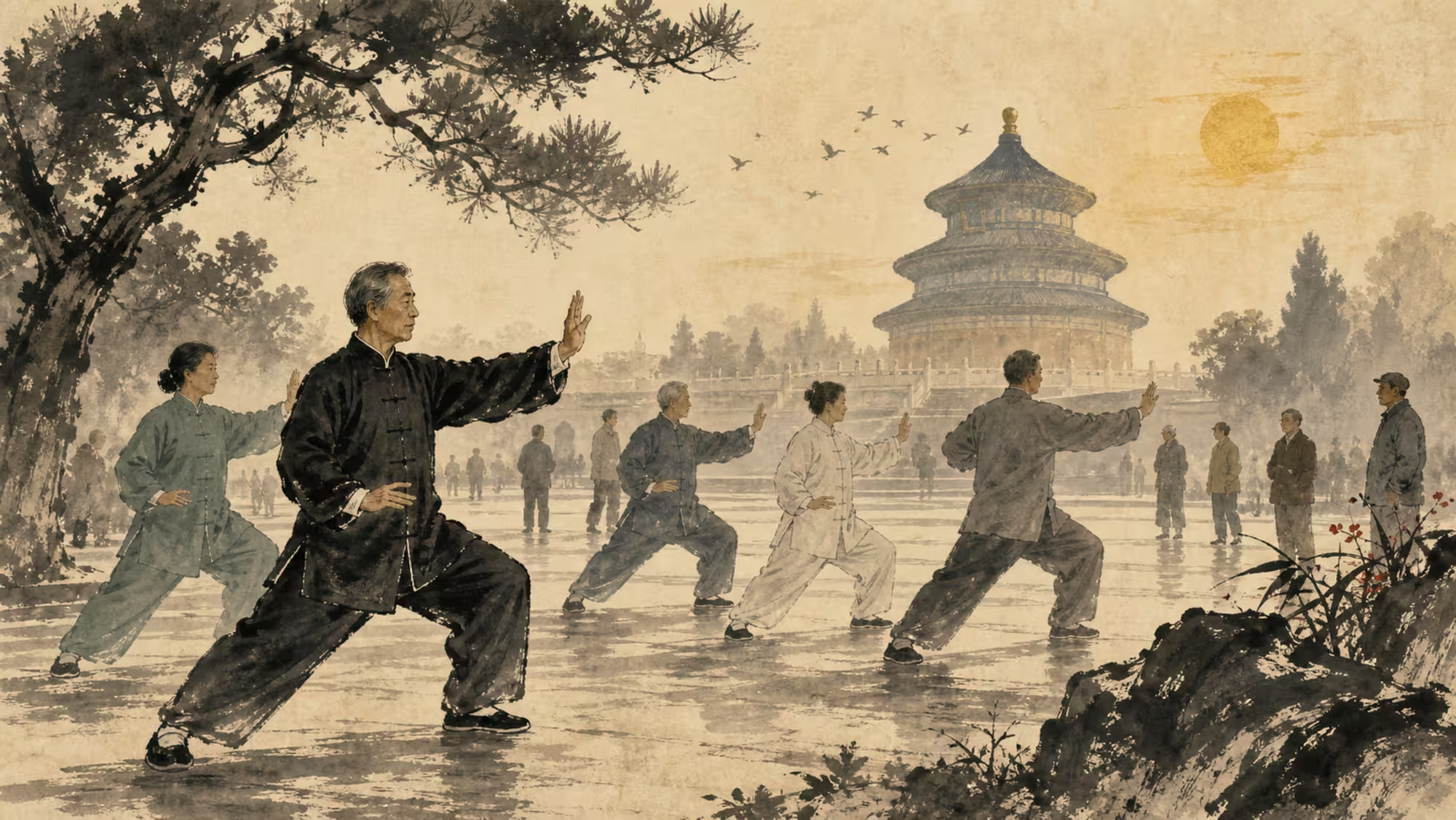
In mid-July, a widely syndicated report from Beijing put morning Taiji at the Temple of Heaven back in front of general readers. The details were ordinary in the way real practice is often ordinary: retirees arriving before the heat of the day, small groups forming under trees, a leader correcting basic movements, newcomers learning a 24-posture routine, older practitioners moving through sword and fan sets, music playing quietly nearby, bodies repeating sequences that have already been repeated thousands of times.
For people outside that culture, the scene can look like a postcard: mist, trees, slow arms, elderly bodies, ancient China made accessible for a camera. For students of Taiji and Qigong, it should raise a more practical question. What does this kind of public group practice teach that the modern feed cannot?
The question matters because Taiji is now pulled in several directions at once. It is a martial art, a health practice, a cultural emblem, a research subject, a tourism product, a rehabilitation tool, a social-media aesthetic, and a beginner-friendly promise attached to countless online classes. Each frame shows something true. Each frame also leaves something out.
The park frame leaves less out than it first appears to.
The Group Before the Explanation
Online, Taiji often arrives as explanation first. A student sees a clip about the waist, a post about qi, a medical article, a debate over authenticity, a teacher advertising a course, or a beginner asking which video to follow. Before the body has done much, the mind is already surrounded by claims.
In a park group, the order is different. A person sees bodies moving, then joins, then copies. The explanation comes later, or in fragments. A leader adjusts an arm. Someone demonstrates the path of a step. The group repeats the same section again. The correction is not always elaborate. It does not need to be. The body is being placed inside a rhythm before it is asked to understand everything.
That rhythm is easy to underestimate.
Many beginners assume that practice is a private transaction between the student and the instruction. Watch the lesson, understand the principle, repeat it correctly, advance. But traditional training often depends on a wider ecology: time of day, location, seniors and juniors, visible standards, unglamorous repetition, and a shared expectation that people return tomorrow.
The park supplies that ecology without making a theory of it. The same path through the form is practiced while the city wakes around it. A new member does not only learn where the hand goes. They learn when the group begins, where people stand, how much talking happens, how long the body is expected to stay attentive, and what kind of seriousness can exist without drama.
This is why the public image of older practitioners is more important than it may seem. Their value is not that age automatically proves wisdom. Age does not do that. Their value is continuity. A younger or newer student can see what years of returning to a simple practice look like when those years have become normal life rather than a personal project announced every few weeks.
In a feed, practice must compete for attention. In a park, attention is shaped by arrival.
Correction Without Performance
The current online Taiji landscape gives students access to more material than any previous generation could have imagined. That access is useful. It also creates a strange imbalance. There are endless demonstrations, but not enough correction.
Demonstration is clean. Correction is specific. Demonstration says, "This is the shape." Correction says, "Your weight is not where you think it is." Demonstration shows the cloud hand. Correction notices that the shoulder lifted before the waist turned. Demonstration makes slow movement look continuous. Correction reveals where the body is faking continuity by smoothing over collapse, stiffness, or hesitation.
The Beijing park model, at least in its ideal form, keeps demonstration and correction close together. A leader teaches basic movements. Progress is reviewed. A student learns one set, then moves to another when ready. The point is not that every park group is deep, or that every public teacher has high-level skill. Public practice can be shallow, mechanical, performative, or mostly social. But even an ordinary group can remind students that Taiji is not absorbed by watching a body from the outside. Someone has to notice what the student's own body is doing.
That noticing changes the meaning of repetition.
Without correction, repetition can preserve mistakes. A student may become fluent in the wrong tension. The knees may learn to drift, the lower back to brace, the shoulders to carry the arms, the eyes to glaze over while the body performs "relaxation." After enough repetitions, the movement feels familiar, and familiarity is mistaken for skill.
With correction, repetition becomes more alive. The same posture is no longer the same posture. It becomes a test. Can the weight settle without dullness? Can the spine lengthen without stiffness? Can the arm rise without taking the shoulder with it? Can the step arrive before the mind has already rushed to the next movement?
This is the quiet discipline that a park scene can hide from the casual viewer. The forms look slow, but the work is not passive. A body is being repeatedly asked to give up unnecessary effort without losing structure.
Public Space Changes the Practice
The Temple of Heaven is not just a picturesque backdrop. It is a public space with cultural memory. It was built around imperial ritual and the relation between heaven, earth, season, and human order. Today it is also a park, a tourist site, a place where people exercise, talk, rest, and move through the ordinary maintenance of daily life.
Taiji fits that contradiction. It carries philosophical language and martial history, but it survives through ordinary bodies doing ordinary work. The public setting keeps those two realities in contact.
Training in a private room can become self-absorbed. Training online can become abstract. Training for a camera can become theatrical. Public practice adds friction. The practitioner is visible, but not necessarily performing. There are other people nearby. The ground may be uneven. The weather changes. Someone arrives late. A speaker crackles. A passerby watches for three seconds and moves on. The form continues anyway.
That kind of space teaches a useful modesty. The practice is important, but the world does not stop for it. A student has to find attention inside conditions that are not perfectly arranged.
This matters for Qigong as much as Taiji. Many modern wellness settings treat calm as something produced by careful isolation: the right room, the right music, the right light, the right language. Those can help. But traditional practice often asks for a steadier skill. Can attention remain available when the environment is alive? Can breathing soften without shutting the world out? Can movement become clear without needing everything around it to become quiet?
Morning park practice answers by example. The group does not wait for the perfect environment. It makes a container inside the environment.
The Tourist Version and the Training Version
There is another reason the current attention is useful. The same places that hold living public practice are also packaged for visitors. Around the Temple of Heaven, Taiji can appear as a tour activity: a cultural taste added to a day of sightseeing, tea, architecture, and photographs.
That is not automatically wrong. A visitor may learn something from a single guided session. A first encounter can open a door. Many students begin with an image, a short class, or an unexpected moment of beauty.
The danger is confusing the doorway with the house.
A tourist lesson must compress. It has to be approachable, memorable, and safe enough for strangers with unknown bodies and limited time. It can teach a few gestures, a few cultural ideas, a sense of rhythm. It cannot transmit the slow accumulation that makes Taiji training meaningful: the weekly correction, the repeated return, the way a teacher notices the same fault in a new disguise, the way a student's own body becomes less able to hide from itself.
The internet often creates the same compression. A principle becomes a caption. A posture becomes a screenshot. A form becomes a playlist. A tradition becomes a brand category. The public park scene is useful because it resists that compression by being stubbornly repetitive. It shows Taiji not as an experience to consume, but as a habit people organize themselves around.
For students, this distinction is practical. A short exposure can inspire practice. It cannot replace practice. A clip can point toward a principle. It cannot confirm that the principle has entered the body. A beautiful setting can support attention. It cannot do the work on behalf of the student.
What Students Can Take From It
Most students will not train every morning in a Beijing park. Many will practice in apartments, small studios, rented halls, gardens, gyms, or through a screen because that is what life allows. The point is not to romanticize one place. The point is to notice what the place is doing well and borrow the lesson.
The first lesson is regularity. Park practice has a schedule. It does not depend entirely on mood. A student training alone can recreate a small version of that by choosing a repeatable time and protecting it from negotiation. The time does not need to be long. It needs to become real.
The second lesson is visible standard. In a group, the body is measured against other bodies. Not competitively, but relationally. A student sees how a more experienced person steps, turns, waits, settles, and begins again. Alone, that standard has to be built deliberately through good instruction, occasional feedback, video review, and honest comparison between what was intended and what happened.
The third lesson is correction. This is the one most easily lost. A student can practice gently and still practice vaguely. The body needs questions. Where is the weight? What initiates the movement? Is the breath leading, following, or being forced? Did the knee turn because the waist turned, or did the knee twist by itself? Is the arm connected to the back, or merely lifted into the right picture?
The fourth lesson is social continuity. Practice shared with others becomes harder to abandon quietly. The group does not need to be large. Two people meeting regularly can create more discipline than a hundred saved videos. A teacher, a training partner, or a small class gives the practice a witness. That witness is not there to judge the student's worth. It is there to keep the practice from dissolving into intention.
The fifth lesson is humility. Public Taiji is full of different levels. Some bodies move with depth. Some move for health and companionship. Some are just beginning. Some have habits that a stricter teacher would correct immediately. The mixed field is part of the reality. A serious student can respect the social value of public practice without pretending every public version is technically complete.
That balance is important. Cynicism protects nothing. Romance clarifies nothing. The useful response is to look carefully.
A Practice That Keeps Returning
The striking thing about the renewed attention on Beijing park Taiji is not that the practice is exotic. It is that it is still there.
In an age of remote lessons, short-form clips, health headlines, and algorithmic wellness, people are still gathering in the morning to repeat slow movements under trees. Some are there for health. Some for beauty. Some for companionship. Some because they once saw a group and thought it looked good. Some because the practice has become part of how the day begins.
That is not a small thing.
For students, the lesson is not to copy the surface of the scene. It is to study the conditions that allow practice to mature: a time, a place, a group, a standard, correction, repetition, and enough patience for the ordinary to become deep.
The camera can catch the raised arm, the lowered hand, the sword, the fan, the trees, the old stones, the morning light. It cannot catch the more demanding part: the decision to return the next day, stand in the same imperfect body, and let the first movement begin again before the city has fully woken.