Push hands is back in the uncomfortable place where Taiji becomes visible to people who do not already agree on what they are seeing.
In June, clips and recaps from the London Competition for Traditional Tai Chi Chuan circulated beside recent footage from the Can-Am International Martial Arts Championships and other 2026 push-hands events. Some videos showed fixed-step exchanges, where two people begin from contact and try to uproot each other without giving up the feet. Others showed moving-step rounds, where the action can open into trips, throws, catches, sudden changes of angle, and all the untidy details that appear when two bodies are trying to take balance from each other in real time.
The online reaction followed a familiar pattern. One viewer sees Taiji. Another sees wrestling. A third sees bad wrestling. Someone else asks where the softness went. A competitor replies that upright grappling looks like upright grappling because balance, contact, timing, and pressure are not stage props. Then the argument begins again: if push hands looks rough, has it lost Taiji, or has Taiji finally been put under enough pressure for its public image to crack?
That argument is useful because it exposes a problem students often meet quietly in their own training. Solo form can look refined while the body remains untested. Partner work can look practical while the method beneath it collapses into pushing, bracing, and scrambling. The hard part is not choosing one over the other. The hard part is keeping the method alive when another person is no longer cooperating.
Push hands sits at that awkward threshold. It is not only a game, not only a sensitivity drill, not only a competition format, not only a bridge toward fighting. Depending on the school, rule set, partner, and intention, it can become any of those. That flexibility is why it travels so easily through Taiji culture, and also why people talk past one another when a clip appears online.
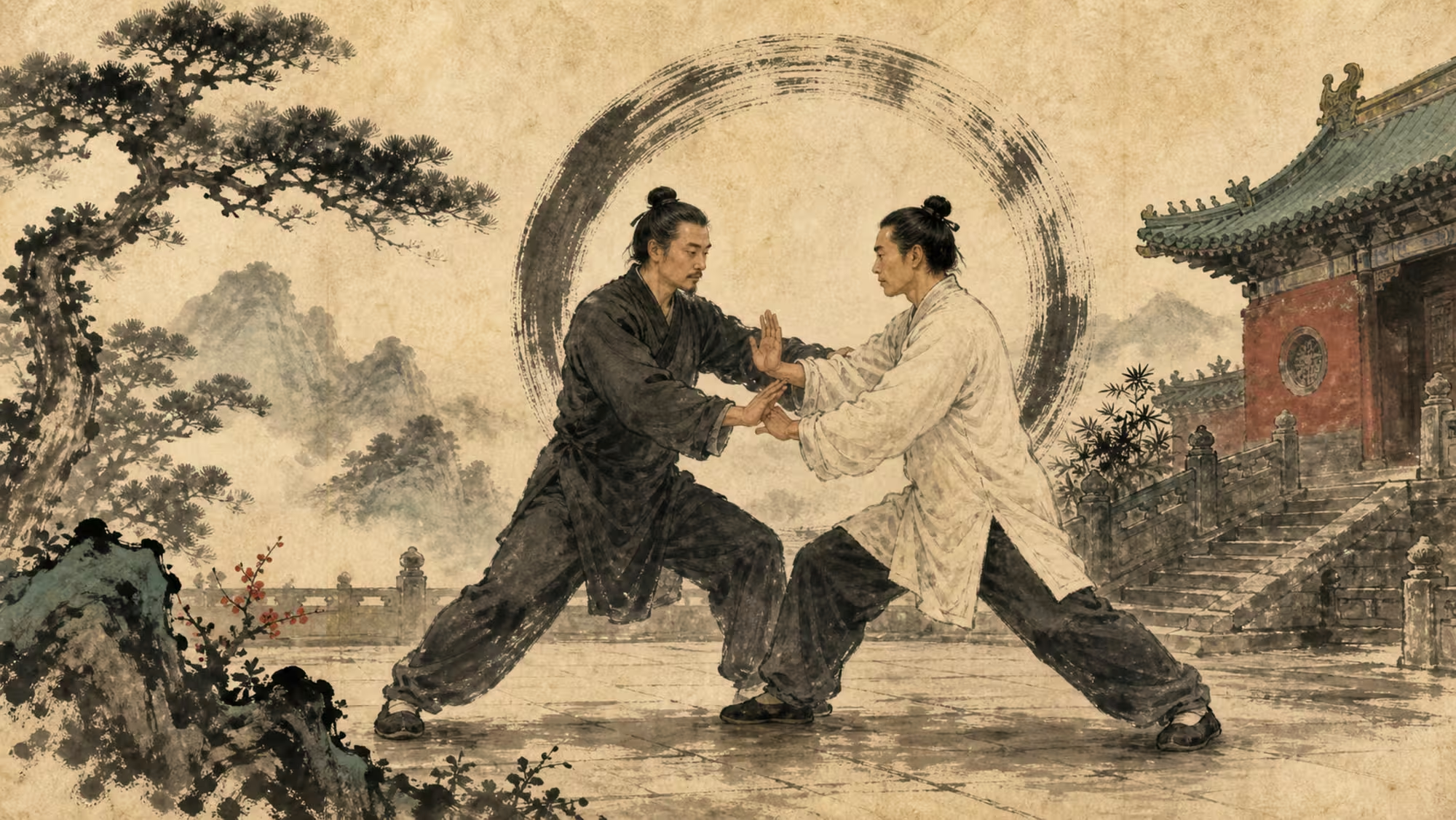
In a quiet class setting, push hands often begins as a contract. Two partners agree to stay within a narrow range. They keep contact, listen through the arms, soften unnecessary tension, and learn how the center reveals itself before the feet move. The aim is not to defeat the partner immediately. The aim is to discover where the body resists, where it collapses, where it leans, where the shoulders take over, where the breath lifts, and where intention arrives before structure can support it.
This slow version can look almost uneventful. A small shift in the kua changes the partner's line. A hand that was heavy becomes empty. A person who expected a push suddenly finds the floor missing under their own intention. To an outside viewer, almost nothing has happened. To the person receiving it, the lesson can be precise and memorable.
Competition changes the weather.
Under a clock, with judges watching and a point available, the body usually reaches first for its oldest habits. It pushes harder. It braces. It grabs. It lowers the head. It stiffens the chest. It tries to win the exchange before it understands the exchange. This does not mean competition is useless. It means competition reveals what has actually been trained, not what the practitioner hoped had been trained.
That is why current push-hands debate matters. The question is not whether a clean demonstration looks more elegant than a contested match. It usually will. The question is whether the qualities trained in quiet practice can survive the increase in pressure.
For Taiji students, this is a more productive question than asking whether a clip is pure or impure. Purity is easy to protect in a controlled environment. A partner who gives the right kind of force, at the right speed, with the right level of cooperation, can help a student feel an important principle. That is valuable. But the principle remains fragile until it can tolerate surprise.
The opposite mistake is just as common. A student watches competitive push hands and concludes that any roughness proves realism. It does not. A person can win a round through strength, aggression, weight, timing, athletic instinct, or familiarity with the rules while still abandoning the body method that made the training Taiji in the first place. Pressure alone does not refine. It amplifies.
This is where the phrase "looks like wrestling" becomes less an insult than a diagnostic. Push hands and wrestling both deal with balance, leverage, timing, space, and the problem of another person's structure. When two evenly matched people are trying to uproot each other, the exchange may naturally resemble other forms of stand-up grappling. Bodies under pressure are not obligated to preserve a viewer's romantic image of an internal art.
Still, Taiji has its own questions inside that contact. Can force be received without the chest hardening? Can the back stay broad while the arms remain alive? Can the legs issue without the upper body lunging? Can softness remain connected rather than collapsing? Can the practitioner borrow the partner's intention instead of simply meeting it with more effort? Can the mind stay wide enough to notice the moment before the shove becomes inevitable?
These are not decorative details. They are the training.
The recent clips are also timely because push hands is becoming more publicly organized again. A large group event in Chongqing set a 2026 record for simultaneous Tai Chi push-hands pairs. North American competition footage from spring and early summer has given viewers fixed-step and moving-step examples to study. London events have put traditional forms, weapons, and push hands into the same public frame. A late-June UK pushing-hands exchange is being advertised not as a performance but as a place for practitioners from different styles to meet, rotate partners, and practice in a friendly competitive setting.
This public visibility changes how beginners encounter the practice. Someone who first sees Taiji through slow solo form may imagine push hands as a gentle extension of the same softness. Someone who first sees a competition clip may imagine it as a rough balance game with Chinese terminology attached. Both impressions are incomplete.
The better frame is progression.
At the beginning, partner work should give the nervous system enough safety to listen. If every contact becomes a contest, the student learns to protect rather than feel. Shoulders rise, breath tightens, and the arms become shields. The partner's force is no longer information; it is a threat. In that state, the body may become stronger, but it does not necessarily become more intelligent.
Later, the same student needs honest pressure. If every partner remains polite forever, the body learns a laboratory version of relaxation. It can feel rooted until someone changes rhythm. It can feel centered until someone refuses to follow the expected line. It can feel soft until the other person is heavier, faster, awkward, or simply unconcerned with making the exercise beautiful.
The art lives between those errors. Too much pressure too early burns in compensations. Too little pressure too long preserves illusions.
A useful push-hands progression therefore needs clear agreements. What is being trained in this round? Fixed-step rooting? Yielding without retreating? Listening through one arm? Maintaining central equilibrium during a turn? Recovering after being uprooted? Entering without crashing? Neutralizing a push without making the face, jaw, and shoulders do the work? A round without a clear purpose becomes a personality test. A round with a clear purpose becomes study.
Competition rules can help or distort that study. Fixed-step formats make foot movement visible by turning it into a penalty. Moving-step formats allow more of the body to appear but can reward habits that drift toward general grappling. Short rounds create urgency. Boundaries create tactics. Weight classes change the feel of the exchange. Judges must convert messy human contact into points. None of this is neutral. Every rule set teaches the body what to value.
That is not a reason to avoid rules. It is a reason to understand them.
When students watch current push-hands footage, the most useful practice is to look below the result. Do not only ask who won. Watch the first moment of contact. Does either person lean before pressure arrives? Do the elbows float away from the ribs? Does one shoulder climb before an attack? Does the spine stay available during retreat? When a throw or uproot happens, was it created by timing and structure, or by a desperate burst of effort? After a point, does the winner recover balance cleanly, or fall into the success?
The answers will not always be flattering. That is the point.
Good partner work should make training more honest without making it crude. It should expose weakness without turning every session into a domination ritual. It should let students test rooting, yielding, issuing, and recovery against another person's timing. It should also keep enough discipline that sensitivity does not disappear under the excuse of realism.
The current online argument around push hands often sounds like a fight over identity: Is this still Taiji, or is it wrestling? A better question is more demanding: what quality is present under pressure?
If the answer is only strength, then the practice has narrowed. If the answer is only cooperative softness, then the practice has become fragile. If the answer includes structure, listening, timing, adaptability, and the ability to remain relaxed while something is actually at stake, then the roughness of the exchange may be less embarrassing than educational.
There is a particular moment in many push-hands clips when the public argument falls away. Two people touch. For a second, neither has committed. The feet are waiting, the spine is deciding, the hands are listening, and the next mistake has not yet happened. Then one body leans a little too far, one shoulder hardens, one hip disconnects, one person borrows the error, and the room suddenly knows what the body had been hiding.