
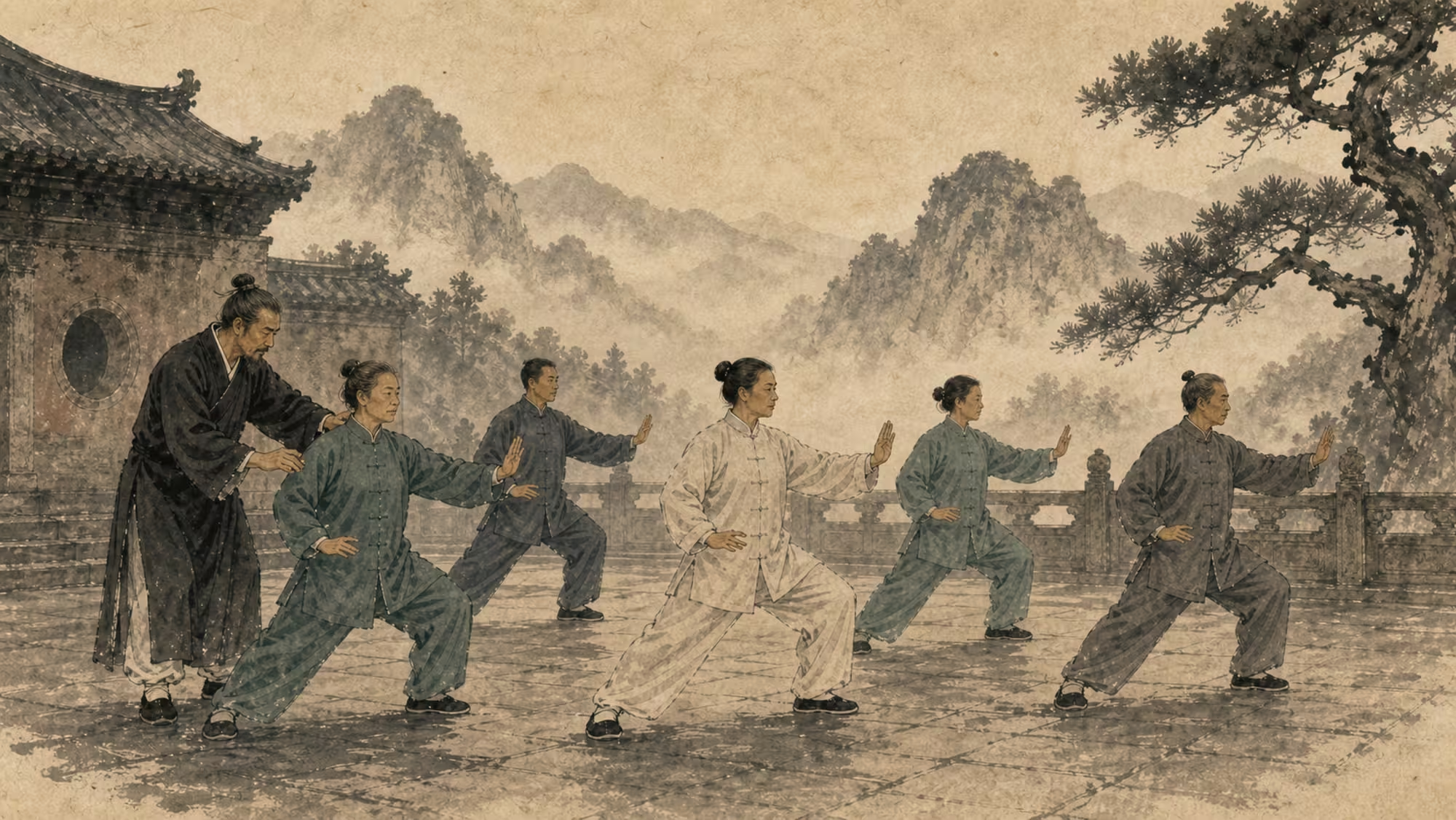
The retreat has become one of the wellness internet's favorite shapes for serious practice.
It appears as a long weekend in the desert, a week in a European city, a mountain center with silence between meals, a beach listing that puts Tai Chi beside spa treatments, sound healing, detox language, and airport transfers. It promises the one thing daily life often refuses to give: uninterrupted time. No commute between work and training. No phone vibrating beside the mat. No half-remembered sequence squeezed into the last minutes of the day. Just practice, food, rest, and the hope that leaving home will make the body listen differently.
For Qigong and Taiji students, that promise is not trivial. Intensive practice can matter. A good retreat can let repetition accumulate. A teacher can see patterns that are invisible in a weekly class. A group can create enough rhythm that the nervous student stops performing and starts practicing. Travel can also help a student understand that these arts are not merely exercises but cultures of movement, language, etiquette, correction, and time.
But the current retreat boom has brought an old question into a new public form: how does a student seek depth without turning Chinese practice into scenery?
In a recent Qigong forum discussion, a beginner asked whether retreats exist without cultural appropriation. The thread was small, but the tension was larger than the post. Some replies pushed back against overthinking, asking whether the student was really afraid of appropriation, weak teaching, exotic costume, or simply choosing the wrong place. Others made a more careful distinction: the problem is not that a teacher outside China studies or transmits Qigong; the problem is when a practice is lifted out of its context, made to fit a marketable Western wellness script, and sold back with the difficult parts removed.
That distinction matters. Without it, the conversation collapses into two unhelpful positions. One side treats every cross-cultural practice as suspicious. The other treats every concern about culture as needless guilt. Neither position helps a student decide where to train.
The useful question is more concrete: what is being practiced, who is teaching it, what kind of relationship do they have to what they teach, and what happens after the retreat ends?
The Retreat Market Is Not One Thing
Current retreat listings show how wide the category has become. Some programs advertise daily form practice, Qigong sessions, meditation, and quiet repetition under teachers with a named lineage. Others place Tai Chi or Qigong inside a general wellness package where the practice sits beside yoga, spa treatments, juice detoxes, sound baths, nature walks, or emotional reset language. Some are serious but accessible. Some are clearly designed as holidays. Some are probably useful for rest but thin as training. Some use traditional terms with care. Some use them as atmosphere.
This variety does not make the whole field false. It does mean the word retreat is no longer specific enough.
A student searching for a retreat should first separate three different offers.
One is a practice intensive. Its center is training. The schedule usually makes that obvious: repeated classes, form correction, standing work, partner drills where appropriate, clear levels, and time for questions. Rest exists, but rest supports practice.
Another is a wellness holiday. It may still include good movement sessions, but the main product is restoration. The language will emphasize relaxation, nature, food, gentle activity, and feeling better. There is nothing wrong with this, as long as it is not mistaken for deep instruction.
The third is a cultural package. This may include temples, tea, calligraphy, medicine, mountain imagery, philosophical language, or scenic gestures toward tradition. It can be meaningful when handled with knowledge and respect. It can become hollow when culture is used as decoration around a shallow exercise program.
Much confusion comes from buying one thing while imagining another. A tired person may need a quiet holiday. A beginner may need a clean introduction. A committed student may need correction. Those are different needs. None becomes more authentic because the brochure uses older words.
Appropriation Is Not Solved by Costume
The retreat question often becomes visual. Does the teacher wear robes? Are there Chinese characters on the poster? Is there a mountain in the background? Is the room arranged like a temple? Are the terms translated, untranslated, or surrounded by mystical language?
Visual signs can reveal something, but they can also distract. A plain room with careful correction may carry more respect than an ornate room full of borrowed symbols. A teacher in ordinary clothes may have trained for decades. A teacher dressed in tradition may be doing so appropriately, theatrically, or commercially. The surface does not decide the matter.
Cultural respect is more visible in relationships and explanations.
Does the teacher name the practice clearly, or is everything blended into a vague energy flow? Do they distinguish Qigong from Taiji, meditation, Daoist ritual, medical theory, and general stretching? Do they explain what they know and what they do not know? Do they acknowledge teachers, texts, communities, or training lines without turning lineage into a sales weapon? Do they avoid pretending that a weekend can transmit what normally requires years?
These are not academic questions. They shape the body of the student. If a teacher cannot say where a method comes from or what it is for, the student cannot know how to practice it. If a retreat promises emotional healing, medical transformation, rapid energy awakening, and ancient secrets in the same paragraph, the student is being asked to trust a fog.
The opposite problem is also real. A teacher may be so careful about terms that the retreat becomes a museum talk. The student leaves with vocabulary but no practice. Respect for culture should deepen training, not replace it.
The Beginner's Anxiety Is Understandable
A beginner looking at the retreat market has reason to hesitate. The listings are polished. The prices can be high. Many programs use similar language: vitality, balance, calm, reset, flow, energy, transformation. Some teachers emphasize health. Some emphasize tradition. Some emphasize lifestyle. Some emphasize personal experience. Without enough practice background, it is hard to tell the difference between a good simplification and a hollow one.
This is where the recent public discussion becomes useful. The student asking about appropriation was not only asking a political question. They were asking how to enter a practice without being foolish.
That anxiety should not be mocked. It should be refined.
The first refinement is to stop looking for a retreat that is perfectly innocent. Practice travels through people. Every transmission has adaptation in it. Taiji and Qigong have moved through families, temples, parks, universities, hospitals, diaspora communities, martial schools, public-health programs, and online platforms. A practice can change setting without becoming fake.
The second refinement is to stop treating access as proof. A retreat that is expensive, remote, foreign, or full does not automatically offer depth. Scarcity can be a marketing device. So can difficulty. So can the promise of hidden knowledge.
The third refinement is to ask whether the retreat strengthens daily practice when the student returns home. This is the quiet test many glossy programs avoid. If a retreat creates a beautiful week and no clearer way to stand, breathe, step, repeat, and self-correct afterward, it may have been pleasant without becoming training.
Better Questions Before Booking
Before choosing a retreat, students can ask practical questions that cut through most of the fog.
What exactly will be taught? A named form, a set of exercises, standing practice, breathing methods, partner work, theory, meditation, seasonal practice, or a general flow class are not interchangeable. Specificity is a sign of care.
How much practice happens each day? A retreat with one gentle morning session and many optional wellness activities may be valuable, but it should not be sold as intensive training.
Who is the teacher, and how do they describe their training? The answer does not have to be dramatic. It should be clear. A serious teacher can usually explain who shaped their work, what they are authorized or qualified to teach, and where their limits are.
What level is expected? Mixed-level retreats can work, but only when the structure supports beginners without wasting experienced students. If every level is promised the same transformation, the promise is probably too broad.
How are health claims handled? Qigong and Taiji may support wellbeing, balance, attention, mobility, and stress regulation for many people. That does not make a retreat a cure. Responsible teachers know the difference between practice context and medical advice.
What cultural elements are present, and why? Tea, calligraphy, Daoist language, Chinese medicine, bowing, uniforms, or temple imagery should have a reason beyond mood. Students do not need to interrogate every object in the room, but they can listen for whether the teacher treats culture as living context or as decoration.
What will the student practice afterward? A good retreat should leave behind a sequence, principle, standing method, correction, or rhythm that can survive ordinary life. The aftereffect matters more than the photograph.
These questions do not guarantee a perfect choice. They do make the student harder to fool.
Depth Is Often Less Spectacular Than the Brochure
The funny thing about a good retreat is that its most important moments may not look special.
A teacher adjusts one shoulder. A student realizes the knee has been drifting for three years. A group repeats the opening movement until the room becomes quieter. Someone who came for energy discovers that they cannot relax the jaw. Someone who came for tradition discovers that etiquette is not ornament but attention. Someone who came for a reset discovers that the practice begins to matter only when the retreat schedule ends.
These are not easy moments to market. They are too small, too plain, too resistant to the language of transformation. Yet they are often where authenticity becomes practical. Not as a certificate, costume, origin story, or perfect cultural answer, but as a relationship between method, teacher, student, and time.
The retreat market will keep expanding because the need is real. Modern life fragments attention, and people are hungry for concentrated practice. Qigong and Taiji offer something the retreat format can genuinely support: repetition without hurry, movement without aggression, quiet without collapse, and a way of training that becomes clearer when the day is organized around it.
The risk is also real. When the market grows, the language gets easier to copy. Tradition becomes aesthetic. Health becomes promise. Culture becomes flavor. A student may arrive hoping for depth and receive only a beautiful schedule.
The answer is not suspicion of every retreat. It is better literacy.
Choose the place where the practice is named clearly. Choose the teacher who can explain the method without inflating it. Choose the schedule that gives enough time to repeat. Choose the cultural frame that feels responsible rather than decorative. Choose the retreat that sends the student home with something small enough to practice the next morning.
The most honest retreat may be the one that does not pretend to change a life in a week. It simply clears a few days, gathers bodies in a room, and asks everyone to return to the same movement until the borrowed scenery falls away and the work itself becomes visible.