
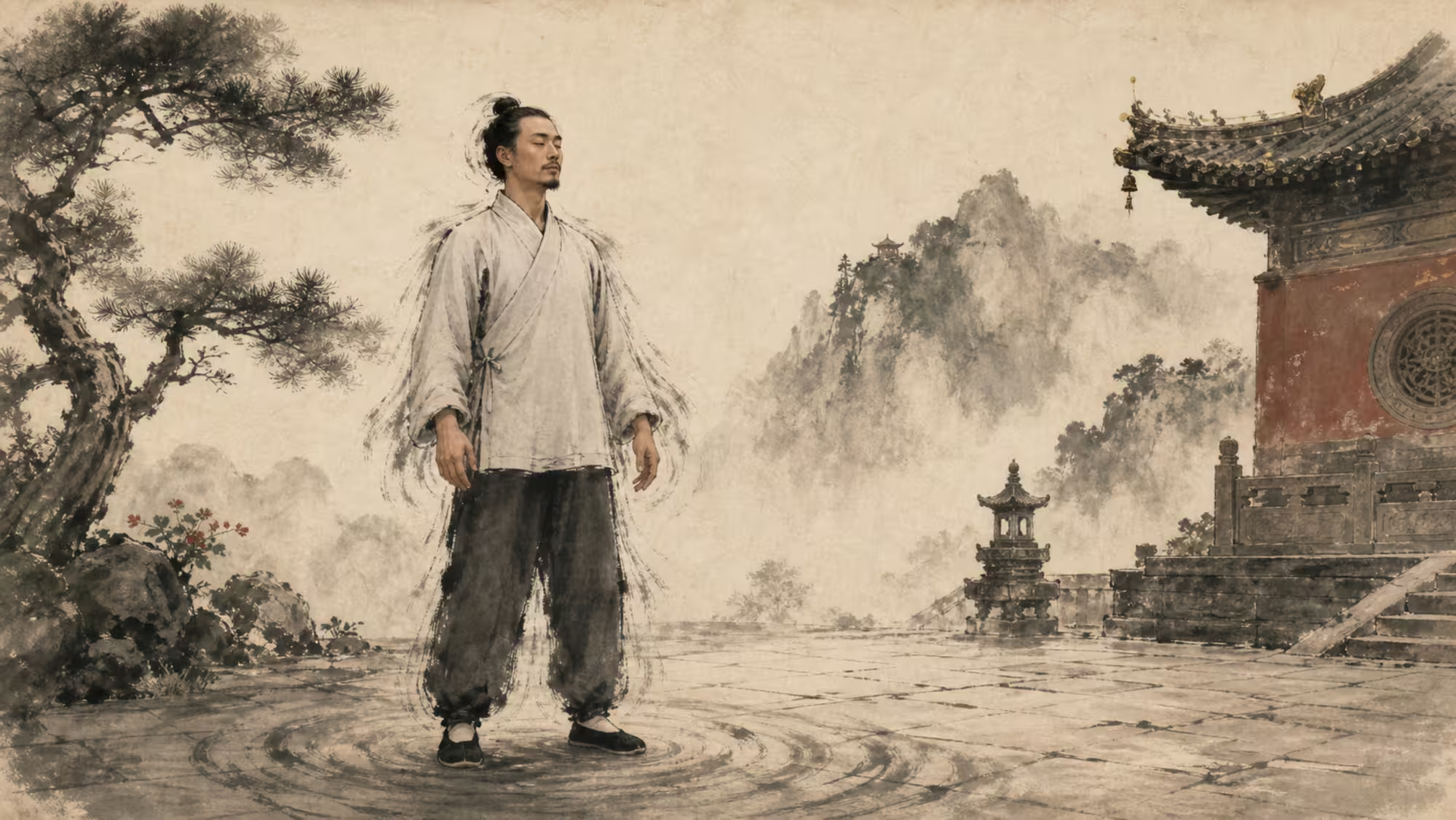
The body looks least dignified at the exact moment the internet decides it has found a new path to release.
In current wellness videos and discussion threads, people are standing barefoot in bedrooms, bending their knees, loosening their arms, and letting the body bounce until it begins to tremble. Some call it somatic shaking. Some call it neurogenic tremoring. Some connect it to trauma release. In Qigong spaces, the same movement appears under older language: shaking out stagnation, loosening the joints, waking up the circulation, preparing the body before a form, or allowing spontaneous movement to arise after standing.
The scene is easy to misunderstand because it is visually simple. There is no complex choreography, no long sequence to memorize, no obvious display of martial skill. The instruction can sound almost childish: stand, soften the knees, let the shoulders drop, shake. That simplicity is part of why the practice travels so easily online. A viewer can copy it in one minute. A teacher can explain it in a short clip. A stressed office worker can try it without changing clothes.
It is also why the claims around it expand so quickly.
By early summer 2026, shaking had become one of the louder subtopics inside the wider nervous-system regulation trend. Wellness articles were explaining somatic exercises as body-based tools for stress. Event listings were offering shaking and meditation sessions. Reddit discussions were asking whether shaking Qigong is the same thing as TRE, whether it can release trauma, whether it is just voluntary movement, and why a few minutes of trembling can leave the body feeling warm, strange, relaxed, or charged. Qigong practitioners were answering from experience, caution, enthusiasm, skepticism, and confusion.
For students of Taiji and Qigong, that public confusion is worth paying attention to. Shaking is not new. But the online frame around it is new enough to change how beginners approach it. When a practice is packaged as a fast release, people tend to chase the sensation. When it is placed inside training, the question changes. The point is not how dramatic the trembling becomes. The point is what remains when the trembling stops.
A Small Movement With Too Many Promises
The strongest version of the shaking trend begins with a believable observation: the body often holds more tension than a person notices. Shoulders creep upward. The jaw grips. The lower back braces. The breath becomes thin. The legs lock. The body can look still while working very hard to defend itself from ordinary pressure.
Shaking interrupts that pattern in a direct way. It asks the muscles to stop presenting a polished surface. It allows the arms to hang, the knees to pulse, the heels to respond to the floor, the skin and connective tissue to receive vibration, and the breath to find a less controlled rhythm. Afterward, many people report warmth, tingling, a softer face, quieter breathing, or a sudden awareness of how tightly they had been holding themselves.
None of that needs to be dismissed. A simple movement can be useful. A short shake before Qigong can make the joints feel less armored. It can expose unnecessary effort. It can help a beginner notice the difference between held stillness and living stillness. It can make standing practice less like a statue contest and more like an inquiry into tone.
The problem begins when a useful doorway is described as a complete house.
Online, shaking is often sold in the language of discharge, trauma release, nervous-system reset, emotional clearing, lymphatic movement, fascia unwinding, energy activation, or vagus-nerve regulation. Some of those words point toward real experiences. Some are loose metaphors. Some are stronger than the evidence behind them. Some are harmless until they invite people to push through sensations they do not understand.
Internal arts training has its own way of handling this problem. It rarely treats one sensation as proof of progress. A warm palm is interesting, but not enough. A trembling leg is information, but not the goal. A sudden emotional wave may matter, but it is not automatically wisdom. The body can release, compensate, dramatize, fatigue, or protect itself in ways that feel similar from the inside.
That is why structure matters.
Voluntary Shaking Is Not the Same as Tremor
One of the more useful questions appearing in current discussions is whether shaking Qigong is the same as neurogenic tremoring or TRE. The answer depends on what is actually happening.
Voluntary shaking is movement the practitioner starts on purpose. The knees bounce. The arms loosen. The shoulders drop. The torso vibrates because the person is allowing or producing the motion. It can be gentle or vigorous. It can be playful. It can be used as a warm-up, a reset, or a way to loosen the surface layers of tension before slower practice.
Involuntary tremor is different. It arises without being driven in the same conscious way. In standing practice, a beginner's thighs may begin to shake because the muscles are working near fatigue or because the nervous system is searching for stability. In deeper release practices, tremoring may be invited through specific positions and then allowed to continue with careful boundaries. In meditation or Qigong, spontaneous movement can sometimes appear as the body reorganizes under attention.
These experiences can overlap, but they should not be collapsed into one thing. A person deliberately bouncing for one minute is not necessarily doing trauma therapy. A leg trembling in a stance is not automatically energetic awakening. A wave of involuntary movement is not automatically a sign to continue indefinitely.
The distinction matters because each situation asks for a different kind of responsibility.
Voluntary shaking can usually stay simple. Keep the knees soft, the movement easy, the jaw loose, and the attention broad. Do not whip the joints. Do not force the neck. Do not turn the practice into a performance. Let the shaking be small enough that the breath remains available.
Involuntary tremor asks for more care. If it appears during standing, the first question is not mystical; it is practical. Is the stance too low? Are the knees collapsing? Is the lower back braced? Is the person holding the breath? Is the trembling a useful exposure of excess tension, or just fatigue? If emotional material, panic, dizziness, dissociation, or a loss of orientation appears, the right answer is not to be heroic. Stop, open the eyes, feel the room, walk slowly, and seek skilled guidance where needed.
The mature practitioner does not worship intensity. Training improves the ability to notice intensity without being ruled by it.
Where Qigong Gives the Trend a Better Container
Qigong has room for shaking because Qigong is not only form. It includes posture, breath, intent, self-massage, standing, opening and closing, stillness, and sometimes spontaneous movement. In many classes, shaking appears at the beginning, not as the main event. The body is invited to drop some noise before quieter listening begins.
That order is important.
If shaking is used as preparation, it can soften the threshold into practice. The shoulders lose their office shape. The wrists and fingers wake up. The soles of the feet become more noticeable. The practitioner can feel where the body is clinging to yesterday's effort. After a short period, the shaking fades, and the person stands. This is where the real test begins.
Can the body become still without becoming rigid?
Can the breath settle without being squeezed into a technique?
Can the knees stay alive without bouncing?
Can the spine lengthen without the chest becoming proud?
Can the attention remain inside the body after the interesting sensation has passed?
These questions are more useful than asking whether shaking "worked." A practice works when it leaves the practitioner more available for the next layer of training. If shaking makes the body loud, scattered, overheated, or hungry for stronger sensation, it may be entertainment wearing practice clothes. If it helps reveal unnecessary holding and then disappears into standing, walking, silk-reeling, form, or quiet breathing, it has served its purpose.
Taiji offers the same correction from another angle. The art does not reward random looseness. A loose body that cannot maintain alignment collapses. A relaxed shoulder that disconnects from the back is not song. A soft step that has no root is just weakness with gentle music. The old training problem is precise: release what is unnecessary without losing structure.
Shaking can help a student feel the first half of that sentence. It can loosen unnecessary effort. It cannot replace the second half. Structure still has to be trained.
The Appeal of the Instant Reset
The wider culture around shaking is shaped by fatigue. People are tired of sitting still in front of screens, tired of being told to breathe deeply while their bodies still feel braced, tired of wellness routines that require equipment, subscriptions, or a new identity. Shaking promises something immediate and democratic. Stand up. Move. Feel different.
That promise is not trivial. A practice that begins in the body can reach people who are alienated by formal meditation. For some, sitting quietly makes the mind louder. For others, slow breathing feels controlling or claustrophobic. Shaking gives the nervous system movement before asking for stillness. It lets the body speak in a rougher dialect.
But the instant reset is also the place where the trend can become shallow.
The body may feel different after one minute because movement changes circulation, attention, muscle tone, breathing, and arousal. That does not mean a deep pattern has been resolved. It does not mean the practitioner has understood the source of the tension. It does not mean stronger shaking will produce stronger healing. In some cases, more intensity can disturb the very regulation people are seeking.
Traditional practice is slower because it is trying to change more than a momentary state. It asks the practitioner to return often enough that the body stops needing drama to become aware of itself. Over time, the useful question is not "Can this make something happen?" but "Can this help train a more reliable way of being in the body?"
That is a quieter promise. It is also harder to sell.
How to Read the Sensations
Shaking often produces sensations that feel significant. Heat in the palms. Buzzing in the legs. A wave through the ribs. A sudden laugh. A tiredness that was hidden beneath restlessness. A sense that the skin has become more awake. In Qigong language, some practitioners may describe this as qi moving. In somatic language, it may be described as discharge or regulation. In ordinary training language, it may simply be the body shifting state.
The label matters less than the student's conduct afterward.
Do not use sensation as a scoreboard. A person who feels little may still be practicing well. A person who feels a lot may be overexciting the system, chasing novelty, or finally noticing what was already there. Sensation is data, not rank.
Do not confuse shaking with softness. The body can shake while remaining internally braced. The shoulders can flap while the diaphragm is still guarded. The knees can bounce while the feet remain absent. Real release is often less dramatic than the movement that announces it.
Do not make trauma claims casually. Public wellness language often uses trauma as a large umbrella for stress, memory, emotion, and bodily tension. Serious trauma work requires more care than a short clip can provide. Shaking may be useful for ordinary tension, but people with a history of severe trauma, panic, seizures, joint instability, injury, or mental-health vulnerability may need professional guidance or a different approach. A blog trend should not become a private experiment in overwhelm.
Do not skip the return. The end of shaking matters as much as the shaking itself. Stop gradually. Stand. Feel the feet. Let the hands rest. Let the eyes register the room. Notice whether the breath is easier or more agitated. Then move into something structured: Wuji standing, a simple opening and closing movement, slow stepping, or the beginning of a form. The return tells the truth.
The Old Lesson Inside the New Trend
What makes the shaking trend useful is not that it has discovered a secret. It has made an old training issue visible in a modern language.
Many beginners think relaxation means doing less. Then they enter a posture and discover that the body does not know how to do less without falling apart. The chest sinks too much. The pelvis tucks too hard. The knees lock or wobble. The shoulders either grip or disconnect. The face tries to look calm while the thighs complain.
Shaking can expose that contradiction quickly. It shows how much stiffness is being used to create a fake sense of control. It also shows how easily looseness becomes chaos when there is no center.
That is why the best use of shaking may be modest. It is not the whole practice. It is a threshold practice. It clears the doorway. It reminds the body that movement does not have to be polished before it is honest. It lets the practitioner feel the difference between holding and inhabiting. Then it asks to be integrated into something less spectacular.
A student who shakes for a minute and then stands for five may learn more than a student who shakes for twenty and calls the intensity progress. A student who lets the arms tremble and then practices one slow weight shift may discover where release meets root. A student who notices fear, excitement, or agitation and chooses to stop may be training judgment, which is also part of practice.
The online version of shaking often ends at the visible moment: the bounce, the tremor, the claim of release. Internal training begins to become interesting after that moment passes. The body is quiet again. The feet are on the floor. The shoulders have no performance left. Something has loosened, or perhaps nothing has. The next movement will show which is true.