The internet has found another way to make stillness look productive.
In one corner, exercise videos are explaining wall sits, planks, handgrip holds, and other isometric work as time-efficient training. The language is modern, measurable, and health-coded: minutes, sets, blood pressure, muscle recruitment, convenience. In another corner, Qigong beginners are asking what to do with Zhan Zhuang, whether standing meditation should come before movement practice, how long to hold the arms, whether sensations mean progress, and how to avoid mixing too many methods into confusion.
The overlap is not exact. A wall sit is not Zhan Zhuang. A plank is not standing like a tree. A fitness protocol designed for one measurable outcome is not the same as an internal arts practice designed to reorganize posture, attention, breath, and the body's relationship with gravity. Still, the timing is useful. Public attention has turned toward a simple idea that internal practice has never abandoned: not moving can be work.
That idea is easy to flatten. Standing still can look like doing nothing. It can also look like a toughness test, a wellness hack, or a mystical posture waiting to produce special sensations. None of those frames is reliable enough. The more useful question is quieter and more demanding: what changes when the body is asked to stay, breathe, and stop escaping itself?
The New Respect for Static Work
Static exercise has become easier to explain in public because it fits the current demand for low-friction health habits. A person can hold a wall sit at home. A handgrip device fits in a drawer. A plank needs no gym membership. The exercise is visible, countable, and short enough for social media.
Recent research interest has helped that visibility. In 2026, exercise physiology papers continued examining isometric wall squats, handgrip training, and acute responses to static holds. These studies belong to clinical and fitness contexts, not to Qigong instruction. They involve protocols, participant criteria, intensities, blood pressure measurement, and safety assumptions that do not automatically transfer to every student. Their value for internal arts students is not that they prove ancient practice right. That is too easy, and usually too careless.
Their value is that they make a basic training fact harder to dismiss. The body does not need visible motion to be under load. A fixed position can recruit muscles, challenge breathing habits, reveal asymmetry, and expose how quickly the mind looks for escape. Stillness is not empty just because the outside shape is stable.
This is where the modern isometric conversation and standing practice begin to touch. Both ask the body to remain in a shape. Both make time visible. Both can become uncomfortable faster than expected. Both punish vague attention. But they part ways at the reason for staying.
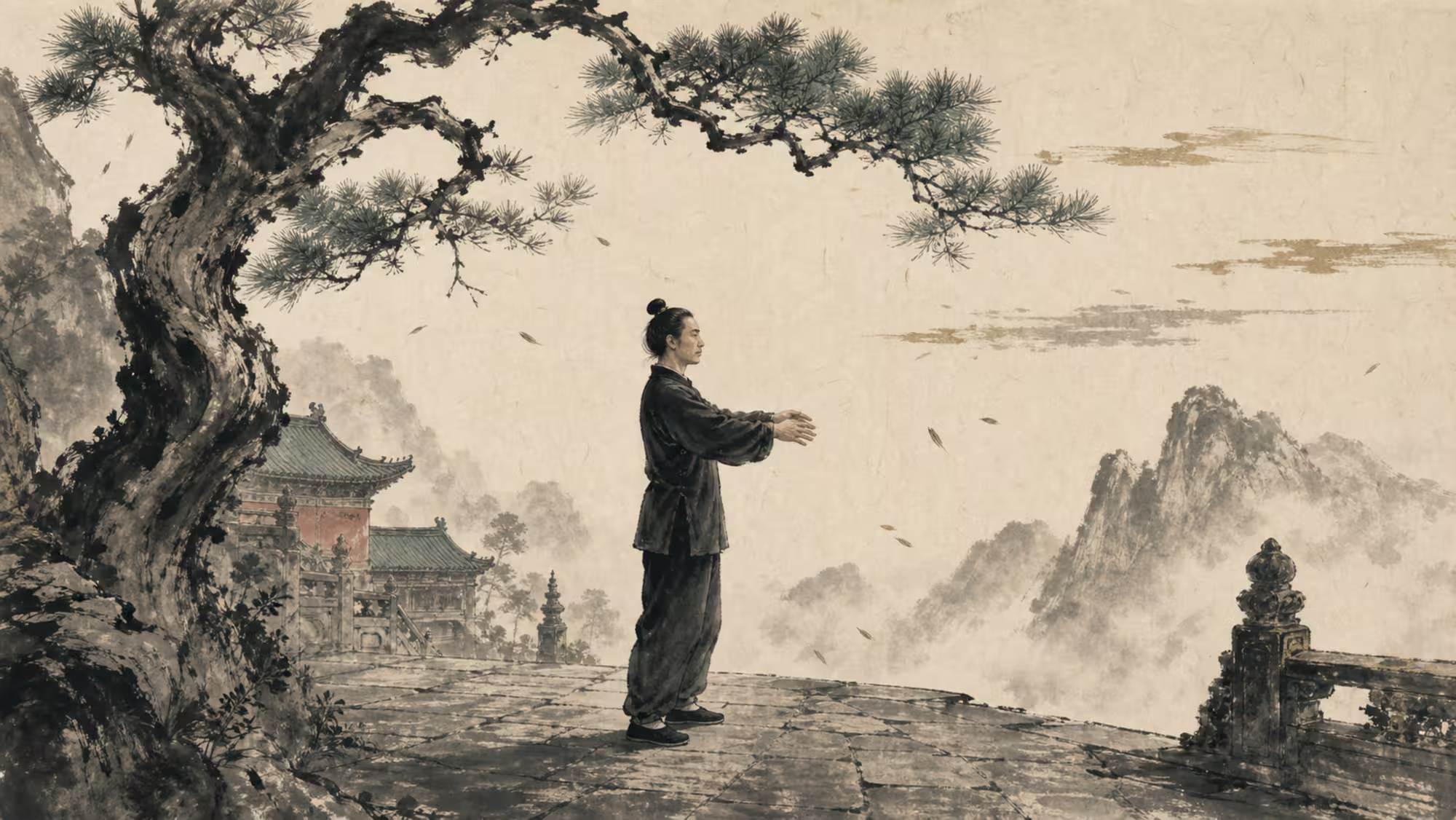
In a wall sit, the task is usually clear: hold a chosen angle, maintain effort, complete the interval. In Zhan Zhuang, the task is harder to reduce. The posture is not only endured. It is listened through. The knees bend, but not as a squat contest. The arms lift or settle, but not as a shoulder endurance challenge. The spine lengthens, the chest softens, the pelvis finds its place, the soles meet the floor, and the breath is asked not to become a weapon against discomfort.
The outside observer sees a person standing. The practitioner meets a room full of habits.
Why Beginners Misread Standing
Current online Qigong discussions show a recurring beginner problem: people know standing matters, but they do not always know what kind of mattering it has.
Some ask how long they should stand. Some ask whether to add movement afterward. Some ask whether the body will self-correct over time. Some report warmth, pressure, magnet-like feelings, shaking, fatigue, lightness, or emotional shifts. The answers vary because methods vary, teachers vary, and bodies vary. But underneath the variety is a stable confusion: a simple posture does not mean a simple practice.
Beginners often misread standing in two opposite ways. The first is to make it too small. Standing becomes a waiting room before the "real" practice begins: the form, the sequence, the sword, the visible movement. In that frame, Zhan Zhuang is just a warm-up, a test of patience, or a way to calm down.
The second mistake is to make it too large too quickly. Standing becomes the master key for every problem. Sensations become evidence. Longer time becomes proof. Discomfort becomes virtue. A person stands harder, longer, and with more ambition, while the shoulders grip, the breath tightens, the knees complain, and the mind learns endurance without release.
Neither mistake helps much. Standing is not a passive prelude, but it is also not an invitation to force. Its practical value sits in the middle. It gives the body fewer places to hide.
In movement, compensation can travel. A shoulder lifts during a transition. A hip avoids load by rushing through a step. The breath catches during a turn, but the next posture arrives before the habit is fully noticed. In standing, the body has less cover. The same small errors repeat under a steady light. The right foot may carry more weight. The lower back may harden. The throat may close. The arms may be held by the neck instead of supported through the back. The eyes may become dull, or the attention may float away into fantasy.
The posture has not failed when these things appear. It has started reporting.
Stillness Is Not Stiffness
The phrase "standing still" can mislead because the visible body is not the whole practice. Good standing is quiet, but not dead. It is stable, but not frozen. It asks for structure without locking the structure into a statue.
This distinction matters because modern fitness culture often uses stillness as a way to measure tolerance. Hold the plank. Hold the squat. Hold the line. The clock becomes judge and audience. That can be useful in its own context, but internal practice needs a different standard. A student can hold a posture for a long time while deepening exactly the habits the practice is meant to reveal.
If the shoulders rise and stay risen, the student has trained rising shoulders. If the jaw clamps, the student has trained a clamped jaw. If the knees collapse inward under fatigue, the student has trained collapse. If the breath is held to survive discomfort, the student has trained survival breathing. Duration alone does not purify these errors.
Zhan Zhuang works best when stillness remains adjustable. The adjustment may be almost invisible: a tiny release at the kua, a softening behind the sternum, a clearer line from elbow to wrist, a shift from gripping the floor with the toes to resting weight through the whole foot. Sometimes the useful correction is not to stand longer, but to stand with less drama.
That is why the language of song, or releasing and sinking, matters more than the language of endurance. Release does not mean collapse. Sinking does not mean heaviness. It means unnecessary tension is asked to stop pretending to be structure. The body learns which effort is actually needed and which effort is only habit wearing a serious face.
The training is physical, but it is also diagnostic. Standing shows the difference between stability and bracing, between attention and fixation, between warmth and fantasy, between quiet strength and stubbornness.
Health Claims Need a Narrow Door
The current isometric exercise wave is partly driven by health language, especially around blood pressure. That makes the trend visible, but it also makes it risky to translate casually into Qigong claims.
It is fair to say that isometric exercise is being studied seriously and that static holds can have meaningful physiological effects. It is not fair to tell every student that standing practice will lower blood pressure, treat a condition, fix digestion, regulate the nervous system, or replace medical care. Those claims require specific evidence, specific populations, and specific safeguards.
Standing practice also differs from standardized isometric protocols. In a study, the angle, intensity, timing, rest period, participant screening, and outcome measures may be controlled. In a living room, a beginner may be guessing. One person stands gently with natural breathing. Another fights through strain with the knees pushed forward and the face held tight. A third has a health condition, an injury history, or a level of fatigue that changes the meaning of the same instruction.
For students, the responsible lesson is not to import medical promises into Zhan Zhuang. It is to respect that stillness is powerful enough to deserve care. Static work can be demanding. It can raise effort quickly. It can reveal weakness, imbalance, agitation, and impatience. It should be approached with enough humility to stop, adjust, rest, or seek qualified guidance when the body is clearly asking for it.
The tradition does not need inflated claims. Its value is already strong when described plainly. Standing can build familiarity with alignment. It can teach the difference between relaxation and collapse. It can make breath habits visible. It can train attention under mild stress. It can prepare the body for Taiji and Qigong movement by making weight, center, and unnecessary effort harder to ignore.
Those are not small things.
The Bridge Back to Movement
One useful feature of recent Qigong discussions is that many beginners do not ask about standing in isolation. They ask what to pair it with. Should standing come before Baduanjin? Should it be followed by movement? Should it replace sequences? Should a beginner choose one thing and repeat it, or build a mixed practice?
The best answer depends on the method, teacher, body, and purpose. But the question itself points in the right direction. Standing should not become a private monument to seriousness. It should feed the rest of practice.
After standing, movement often becomes more honest. A step shows whether the weight was really settled or merely parked. A turn shows whether the waist can move without the shoulders taking over. A simple arm circle shows whether the chest can stay soft. A form section shows whether stillness created clearer connection or just tired legs.
This is where the static trend can learn from internal arts. The point is not only to hold. The point is to carry the quality of holding into change. Standing gives the body a reference. Movement tests whether the reference survives.
A student who stands with care may discover that the first step afterward feels louder. The floor is more present. The breath is less eager. The shoulders reveal themselves sooner. The knees report more clearly. The body has not become magical. It has become harder to fool.
That is also why standing practice resists the usual internet promise of instant transformation. Its most useful effects are often undramatic. A student stops over-lifting the chest. A stance becomes less collapsed. A transition no longer feels like falling from one leg to the other. The hands stop floating without support. The mind notices the first impulse to quit before the body turns it into a story.
These are small changes, but they are the kind that practice can actually use.
What the Trend Gets Right
The current attention around static training gets one important thing right: stillness can be active. It can be measured, felt, studied, and trained. It does not belong only to monks, athletes, physical therapists, or social media routines. It belongs wherever the body is willing to meet time without immediately converting it into motion.
For internal arts students, the opportunity is to accept the renewed respect for stillness without shrinking standing practice into a wall-sit cousin. Zhan Zhuang is not valuable because it resembles a modern fitness trend. It is valuable because it gives a different answer to the same public hunger. People want efficient practice, nervous-system language, better posture, calmer attention, stronger legs, and something they can do without equipment. Standing offers a doorway into all of those concerns, but it does not remain useful if it is sold as a shortcut.
The old practice asks for a slower bargain. Stand, but do not merely endure. Relax, but do not collapse. Attend, but do not chase sensation. Adjust, but do not fidget away every difficulty. Stop before ambition turns the body into an argument.
The internet may keep moving on to the next efficient hold, the next research headline, the next short video promising large returns from a small habit. Standing practice will still be there after the screen changes: feet on the floor, knees soft, shoulders negotiating with gravity, breath finding out whether stillness is actually quiet.