
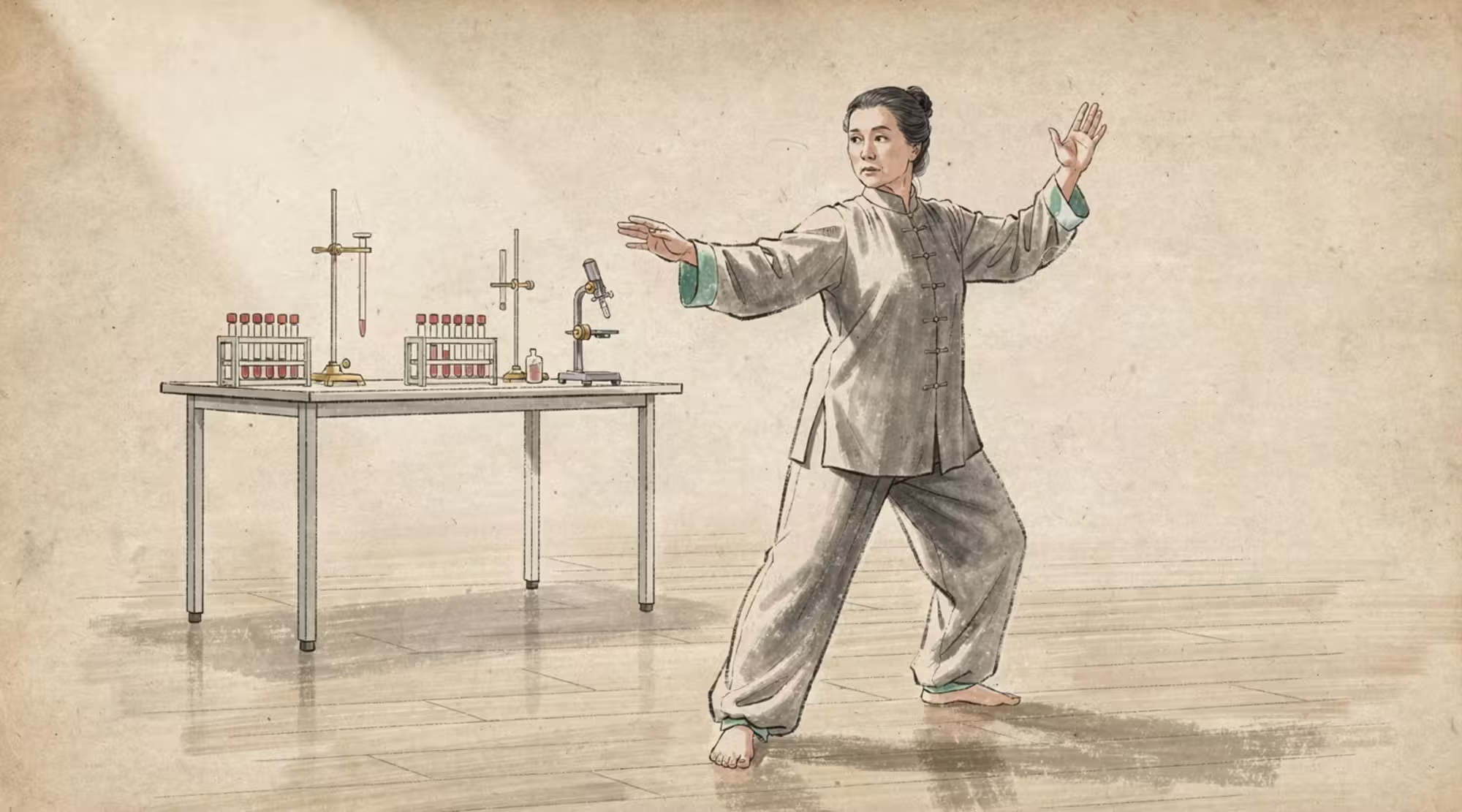
Four Tai Chi sessions, ten days, two blood draws, and a laboratory panel filled with names most practitioners will never use in class. That combination is almost designed for an irresistible headline: researchers have found what Tai Chi does inside the body.
The actual story is more interesting—and much less certain.
A pilot study published at the end of August examined changes in circulating lipid mediators after a short course of Yang-style 24-form Tai Chi. Sixteen postmenopausal women completed four one-hour sessions on non-consecutive days. Blood was collected before the first session and immediately after the fourth. Several measured compounds changed, leading the researchers to describe a possible shift in lipid signaling that deserves further investigation.
This is timely research, but it is not a verdict on inflammation, pain, mood, or longevity. For students of internal arts, its best lesson may be how to remain curious without letting a laboratory result outrun its design.
What the Study Actually Asked
The researchers were not testing whether beginners could master a form in ten days. They were asking a narrower biological question: can a brief Tai Chi intervention coincide with detectable changes in certain compounds circulating in blood?
The compounds included oxylipins and endocannabinoids or related molecules. Oxylipins are lipid mediators made from fatty acids. They participate in many biological processes, but individual compounds cannot be sorted neatly into “good” and “bad” categories without context. Their concentration can be influenced by diet, tissue activity, medication, sample handling, exercise, and other conditions.
The intervention itself was substantial. Each session included a warm-up, approximately 45 minutes of the Yang-style 24-form, and a cool-down. The form was repeated several times under an experienced instructor. That is different from trying three movements beside a desk or following a five-minute clip once before breakfast.
After the fourth session, the investigators found changes in some measured lipid mediators. The effects on the endocannabinoid-related compounds were described as modest, while differences in some oxylipins were more noticeable. The authors treated the findings as exploratory and called for longer, larger studies.
That final point matters. A pilot study asks whether a question is worth pursuing and whether a method appears workable. It is an opening move, not checkmate.
A Changed Marker Is Not Yet a Changed Life
Biomarkers are appealing because they seem to turn invisible processes into numbers. A balance test can wobble. A questionnaire can depend on memory. A vial of blood appears harder, cleaner, and more objective.
Measurement may be precise while interpretation remains uncertain.
A circulating compound can change without producing a meaningful difference in how someone moves, feels, sleeps, or functions. A marker associated with one pathway may come from several tissues. A sample taken immediately after the final class cannot show whether a difference persists the next morning, the next week, or after practice stops.
The study also had no inactive comparison group. Without one, it cannot separate the effects of Tai Chi from the passage of time, repeated testing, recent meals, expectations, ordinary day-to-day variation, or the general effects of taking part in supervised physical activity. The participants were not fasting, which is particularly relevant when the measurements arise from fatty-acid metabolism. The investigators acknowledged this limitation.
There were only sixteen participants, all postmenopausal women. That does not make the study unimportant. It defines the population the results describe. It does not establish that the same pattern would appear in men, younger adults, experienced practitioners, people with different health conditions, or a larger and more diverse group.
These details are not objections added by hostile outsiders. They are part of reading the study on its own terms.
Why Early Results Travel So Quickly
Tai Chi occupies an unusual cultural position. It is a martial art, a movement practice, a form of cultural inheritance, and a frequent subject of health research. Each community brings different hopes to the same result.
A laboratory finding can therefore be recruited into several stories at once. One person sees scientific confirmation of traditional Qì theory. Another sees a low-cost public-health intervention. A third sees evidence that gentle movement can replace more demanding exercise. A critic sees only another small mind-body study.
None of those reactions is contained in a changed blood marker.
The pressure to translate research into a familiar story is strongest when the mechanism sounds sophisticated. Terms such as metabolomics, endocannabinoids, and lipid mediators carry authority. They can make a preliminary association feel like an explanation. Once an explanation appears, a benefit is often assumed. Then the benefit becomes a recommendation.
The chain can run from “a compound changed” to “Tai Chi reduces inflammation” to “this practice treats a condition” in the space of a social-media caption. Every step adds certainty that the original experiment did not supply.
Traditional language can be misused in the same way. The study did not measure Qì (气), confirm meridians, or identify a biochemical equivalent of internal power. Mapping a newly measured molecule onto an old concept may sound respectful, but it usually flattens both the science and the tradition.
The Most Useful Detail Is the Training Dose
Students may learn more from the intervention schedule than from the names of the molecules.
The participants did four structured sessions within ten days. Each class lasted an hour. Most of the working period involved repeated performance of the same 24-form rather than constant novelty. An experienced instructor guided the sessions. The short duration was balanced by concentration and repetition.
This is recognizable training logic. A practice becomes legible to the nervous system when it is encountered repeatedly enough for comparison. The second round reveals what the first round concealed. By the fourth or fifth repetition, excess effort becomes easier to notice. Instructions that seemed abstract begin to connect with sensations of timing, weight transfer, and coordination.
That does not mean four sessions are sufficient for meaningful Taijiquan skill. The study was not designed to test skill acquisition. It does show that “short term” need not mean casual. Ten calendar days can contain a serious dose of attentive work.
This distinction matters in online training culture. A person may claim to have practiced for a month while completing six scattered sessions, each built around different material. Another may work with one short sequence four times a week and accumulate far more useful exposure. Duration on the calendar and density of practice are not the same thing.
Evidence Is a Landscape, Not a Headline
The new study sits within a much larger body of Tai Chi and Qigong research. A recent evidence map found systematic reviews ranging from higher-certainty conclusions in a small number of health areas to a great deal of low- or very-low-certainty evidence. Reporting of adverse events was also inconsistent across parts of the literature.
That mixed landscape is normal. Research does not advance by producing one final answer for an entire practice. Different studies examine different populations, styles, teachers, session lengths, comparison groups, and outcomes. “Tai Chi” may mean a standardized 24-form class in one paper, seated adaptations in another, and a combined breathing-and-mobility program in a third.
When those interventions are treated as interchangeable, conclusions become blurrier. The same is true when balance, pain, blood pressure, mood, and molecular markers are gathered beneath a single claim that Tai Chi “works.” Works for what, compared with what, for whom, and at what dose?
A careful reader keeps those questions attached to every result.
Larger randomized trials can test whether an effect differs from a comparison condition. Repeated measurements can show whether it lasts. Preregistered outcomes reduce the temptation to emphasize whichever result happened to move. Detailed descriptions of the practice help teachers and researchers understand what was actually delivered. Replication reveals whether the pattern survives a new group and a new setting.
The pilot study provides a reason to continue that process. It does not allow anyone to skip it.
What Practitioners Can Take Into the Training Room
The first practical lesson is not to chase biomarkers. A student cannot feel an oxylipin, and attempting to interpret warmth, tingling, calm, or fatigue as proof of a particular molecular change creates false precision. Sensations can guide adjustments in effort and posture, but they are not home laboratory results.
The second lesson is to describe practice accurately. Record the form or exercise, minutes practiced, level of effort, and whether instruction was live or recorded. Note sleep, unusual stress, soreness, and interruptions. This modest training log will not reproduce a clinical study, but it can reveal whether “Tai Chi is not working” actually means that practice has been too irregular to evaluate.
The third lesson is to repeat before adding. The research sessions returned to the same form several times. Students can borrow that structure without copying the intensity. A short section performed three attentive times may teach more than three unrelated videos. On each repetition, choose one observation: foot pressure, knee direction, breath holding, shoulder tension, or continuity through a turn.
The fourth lesson is to keep health decisions separate from enthusiasm about research. A new paper is not a reason to change medication, ignore symptoms, or substitute a movement class for appropriate care. Tai Chi can be practiced as a martial and movement discipline without being burdened with promises it cannot safely carry.
Finally, allow research to sharpen questions rather than settle identity. The value of a practice does not rise or fall with one panel of blood markers. Taijiquan already offers concrete fields of study: balance during transition, coordinated turning, sensitivity to pressure, regulated effort, memory, and disciplined attention. These can be trained directly.
A Ten-Day Practice Question
The study leaves practitioners with a useful experiment that requires no claims about metabolism.
Choose one familiar section of a form. Practice it on four non-consecutive days within the next ten days. Keep the session length realistic and unchanged. Before each session, note one simple feature: steadiness, unnecessary tension, or continuity. Afterward, record one sentence about what became clearer.
Do not add a new sequence halfway through. Do not search for an extraordinary sensation. Do not decide in advance that the experiment must prove a benefit.
At the end of ten days, ask a training question rather than a medical one: did repeated, structured contact make the movement easier to observe and correct?
That is a modest question. It is also the kind from which durable practice grows.