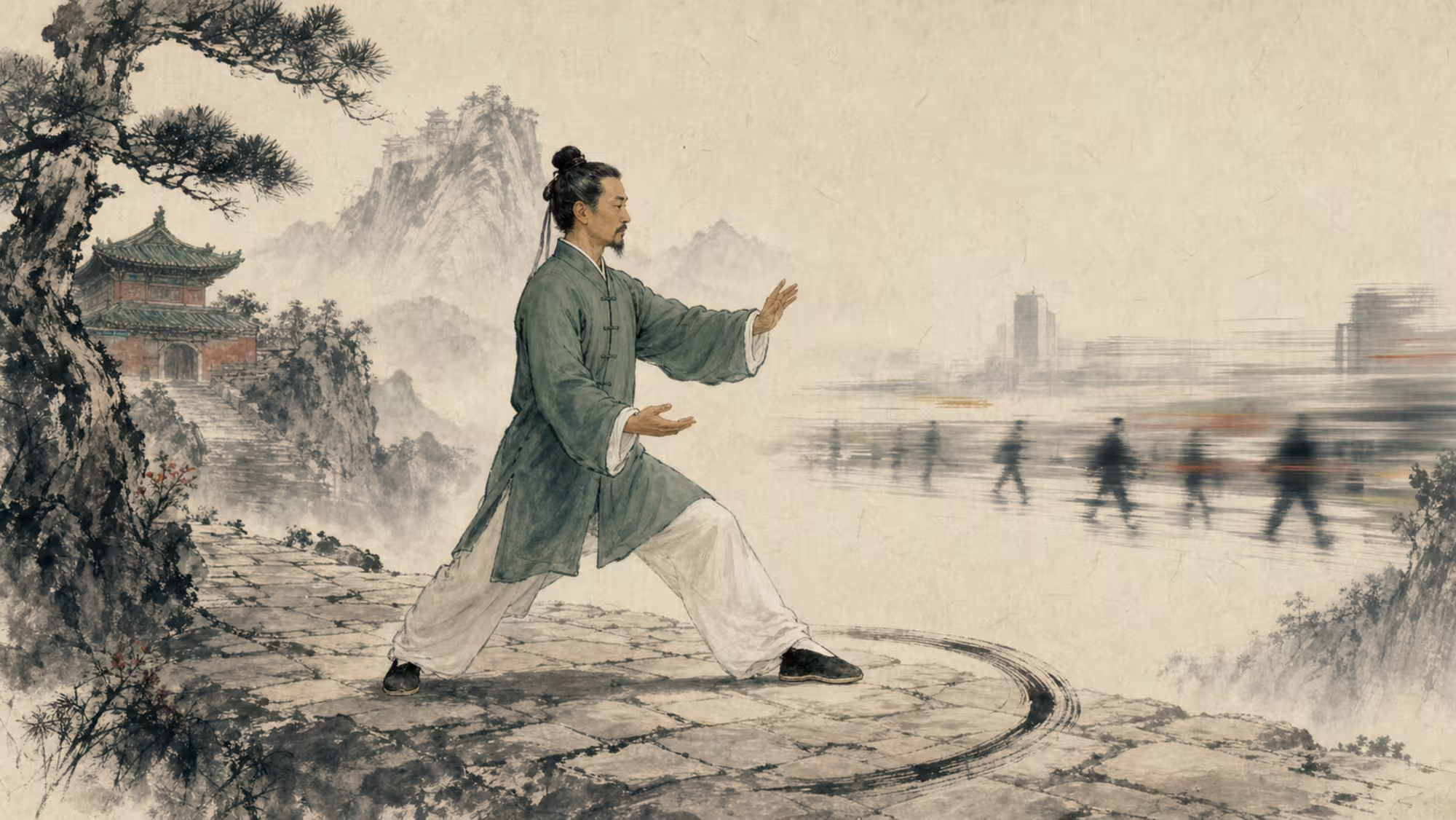
The internet has found another way to make stillness look urgent.
This time the phrase is Tai Chi Walking. It appears in wellness articles, social media clips, YouTube-facing workshops, product listings, short programs for seniors, weight-loss promises, and Reddit threads asking why so many nearly identical plans seem to have appeared at once. Some versions are careful. Some are shallow. Some are obviously built for advertising rather than practice.
The speed of the trend is the first irony. Tai Chi Walking, when it is treated as training rather than content, is slow enough to expose nearly everything a student would rather hide. A rushed step can conceal poor balance. An ordinary walk can disguise a collapsed hip, a stiff lower back, or the habit of falling onto the front foot. Slow stepping removes that cover. It asks whether the body can transfer weight without panic, whether the knee can soften without wobbling, and whether the mind can stay with a movement after novelty has disappeared.
That is why the current attention is not useless. A trend can be noisy and still point toward something real. For students of Taiji and Qigong, Tai Chi Walking is worth examining because it sits at the meeting point of several questions that now dominate public discussion around practice: balance, aging, mobility, nervous-system regulation, online instruction, cultural translation, and the difference between a genuine training method and a wellness label.
The phrase may be new to many people encountering it through a feed, but the training idea is not new. Slow stepping has long been a way to study Zhong Ding (中定), central equilibrium; Xu Shi (虚实), empty and full; and the relationship between the feet, hips, spine, breath, and attention. In many Taiji schools, a student meets these ideas before the form becomes beautiful. The step is not decoration. It is the floor-level grammar of the art.
The Problem With Calling It Walking
The ordinary word "walking" makes the practice sound easier than it is. Because it is so familiar, it feels beneath analysis. A person can walk across a room while thinking about an email, a conversation, a shopping list, or a memory from ten years ago.
Tai Chi Walking interrupts that automatic confidence. The student lifts the foot slowly. The standing leg has to receive the whole body. The pelvis cannot swing wildly to escape the work. The toes cannot claw. The knee cannot collapse inward. The breath cannot become held hostage by concentration. The lifted foot has to land with enough softness to feel the ground and enough clarity to know where weight has not yet arrived.
Then comes the uncomfortable part: the student must wait.
In ordinary walking, weight transfer happens quickly. In Tai Chi Walking, the transfer becomes visible. The back foot does not abandon its job too early. The front foot does not become heavy before the structure is ready. The body has to pass through the middle without tipping. This is where the old language of empty and full becomes practical rather than mystical. Empty does not mean absent. Full does not mean tense. The two sides of the body communicate through a changing relationship, and the step becomes a moving scale.
This is also where many online demonstrations become misleading. If the instruction is only "walk slowly and breathe," the student may become calm, and calm has value. But Taiji training asks for more than slowness. It asks for organization. The waist, hips, knees, ankles, feet, shoulders, elbows, hands, breath, and gaze are not separate ornaments placed on top of a walk. They are part of one changing body.
Slow movement is not automatically internal movement. It becomes internal when attention, structure, breath, and intention are trained together.
Why It Is Trending Now
The current Tai Chi Walking wave is not happening in isolation. It belongs to a larger 2026 wellness pattern: people are looking for movement that feels sustainable, low-impact, measurable enough to trust, and gentle enough to begin without special equipment. Running remains popular. Strength training remains important. But the public language around fitness has shifted toward longevity, balance, mobility, posture, nervous-system regulation, and practices that can be done at home.
Tai Chi Walking fits that mood almost too perfectly. It photographs well. It needs little space. It can be introduced in a few sentences. It gives older beginners a doorway into movement without the intimidating atmosphere of performance fitness. It also gives younger people a way to talk about mindfulness without sitting still.
Those strengths explain the appeal. They also explain the danger.
When a practice becomes a trend, it is often reduced to the easiest promise that can travel through an algorithm. A slow step becomes a fat-loss hack. A balance drill becomes a 28-day transformation. A martial training method becomes a soft lifestyle product. A serious art becomes a mood.
None of this means the doorway is false. A person who first sees Tai Chi Walking in a shallow video may still become curious enough to find real instruction. A senior who begins with a simple stepping drill may discover that balance can be trained with patience instead of fear. A runner who tries slow stepping may notice how much their normal stride depends on momentum. The problem is not accessibility. The problem is pretending that accessibility removes the need for depth.
Good beginner practice should be simple. It should not be dishonest.
The Step as a Diagnostic
For a Taiji or Qigong student, the most useful way to approach Tai Chi Walking is as a diagnostic tool.
A diagnostic tool does not flatter the practitioner. It reveals. Five minutes of slow stepping can show whether the ankles are alive or rigid, whether the knees can follow the toes, whether the hips release or grip, whether the spine remains suspended, whether the shoulders tense when the lower body becomes uncertain, and whether the breath stays smooth when attention sharpens.
This is why slow stepping can feel more demanding than it looks. The difficulty is not cardiovascular. It is neurological, structural, and attentional. The student is not trying to win a contest against fatigue. The student is trying to notice the exact moment the body chooses compensation over alignment.
One common compensation is speed. When balance becomes unstable, the foot rushes to the ground. Another is stiffness. The standing leg locks because the student wants certainty. Another is collapse. The chest caves, the head drops, or the pelvis sinks without support.
Tai Chi Walking gives these habits nowhere to hide.
The practice can be done in a hallway, on a quiet path, or beside a chair for support if needed. The external setting matters less than the quality of attention. A useful step begins before the foot moves. The student stands long enough to feel where the weight actually is. The crown lifts without strain. The shoulders soften. The lower abdomen settles. The foot that will move becomes light because the standing side has accepted responsibility, not because the body has leaned away.
When the foot touches down, it does not instantly claim the body's weight. The contact is exploratory. Heel, sole, ball, toes: each part of the foot gives information. The transfer happens gradually. The body learns that a step is not a fall interrupted by the floor. It is a conversation with the ground.
That conversation is the training.
Empty and Full Are Not Ideas
Many students first meet Xu Shi, empty and full, as a concept. It sounds elegant. It can be explained quickly: one side bears weight, the other is free; one side expresses, the other supports; one quality changes into the other. But a concept does not keep a person upright on one leg.
Tai Chi Walking makes the concept physical.
When the back leg is full, the front leg should not pretend to be ready before it is ready. When the front foot lands, it is not yet full simply because it has touched the ground. In the middle of the transfer, both legs participate, but not in the same way. At the end of the transfer, the old full side has become empty enough to step, yet it still carries memory and connection.
This changing relationship matters beyond walking. In form practice, unclear empty and full makes turns heavy, kicks unstable, and transitions muddy. In push hands, unclear empty and full makes a student easy to uproot. In Qigong, unclear empty and full can turn soft movement into vague swaying. In daily life, the same pattern appears as clumsiness, rushing, bracing, or the inability to feel where the body actually is.
The slow step trains perception before it trains performance.
That order is easy to miss online. Performance travels well. Perception does not. A video can show a graceful person moving through mist or sunlight. It cannot easily show the small corrections happening inside the foot, the release around the hip socket, the quiet adjustment of the spine, or the decision not to rush when the body feels exposed.
The most important part of Tai Chi Walking may be the least visible part.
Breath Without Fantasy
Public explanations of Tai Chi Walking often mention breath, sometimes in ways that are helpful and sometimes in ways that become decorative. Breath can calm attention. Breath can reveal tension. Breath can coordinate rhythm. Breath can stop the student from turning concentration into strain.
But breath should not be used to cover poor structure.
If a student inhales grandly while lifting the chest and disconnecting the ribs from the pelvis, the movement may feel meaningful while the body becomes less integrated. If a student exhales dramatically and collapses, softness has become leakage. If the breath is forced into a rigid pattern before the step is understood, the student may obey the breathing count while missing the actual weight transfer.
A better beginning is quieter: let the breath remain smooth enough that the body can listen. If the breath stops, the step is too ambitious, too tense, or too mentally crowded. If the breath becomes theatrical, attention may have moved away from the feet and into performance. The breath should support the step, not decorate it.
This is where Tai Chi Walking connects naturally with Qigong. Both practices ask the student to reduce unnecessary effort without becoming limp. Both value continuity. Both become more honest when the breath, posture, and attention are treated as one field rather than three separate tasks.
In that sense, the trend is pointing toward something useful. Many people are tired of movement that treats the body as a machine to punish or optimize. They are looking for practices that feel integrated. Tai Chi and Qigong have long offered that possibility. The challenge is to keep the integration real.
A Beginner-Friendly Practice Still Needs Standards
There is a temptation to protect beginners from standards. The intention is usually kind. Nobody wants to discourage someone who is older, stiff, injured, anxious, unfit, or new to movement. But removing standards entirely does not make a practice accessible. It makes it vague.
A beginner does not need advanced martial application on the first day. A beginner does not need obscure terminology, low stances, or a teacher correcting every inch of the body at once. A beginner does need honesty. The step should be slower than habit. The weight should transfer clearly. The knees should be cared for. The breath should not be forced. The body should not be promised impossible results in a few weeks.
This kind of honesty is protective. It allows a student to begin gently without being misled. It also prevents the common disappointment that follows inflated claims. If Tai Chi Walking is sold as effortless transformation, real practice will feel like failure. If it is introduced as a simple doorway into balance, attention, and coordination, the same difficulty becomes meaningful.
The difference is not small.
A student who expects entertainment asks, "Did this impress me today?" A student who expects practice asks, "What did this reveal today?" Tai Chi Walking is built for the second question.
What to Notice in the Next Slow Step
The next time Tai Chi Walking appears on a screen, it may be useful to look past the promise and watch the details.
Does the person demonstrate a clear shift from one leg to the other, or are they simply drifting? Do the knees track safely, or do they twist under the weight? Does the upper body remain connected to the lower body, or do the arms perform calmness while the legs do something unrelated? Is the instruction honest about limits, or does it promise fast weight loss, instant strength, or a transformation that no slow walk can responsibly guarantee?
For personal practice, the questions can be even simpler. Can the foot become empty without the shoulders lifting? Can the standing leg stay alive without locking? Can the front foot touch the ground before it takes weight? Can the breath remain natural when the transfer becomes slow? Can attention stay with one step long enough for the step to become interesting?
That last question may be the hardest one.
The trend will move quickly, because trends always do. It will produce useful introductions, clumsy explanations, serious workshops, copied content, and a few people who discover that a slow step is not boring. The ground gives feedback. The body answers honestly. The mind either stays or escapes.
For a practice that now travels through feeds, ads, articles, and recommendation engines, Tai Chi Walking still returns to a plain scene: one person standing, one foot lightening, one foot receiving the whole body, and a step slow enough that nothing important can be skipped.