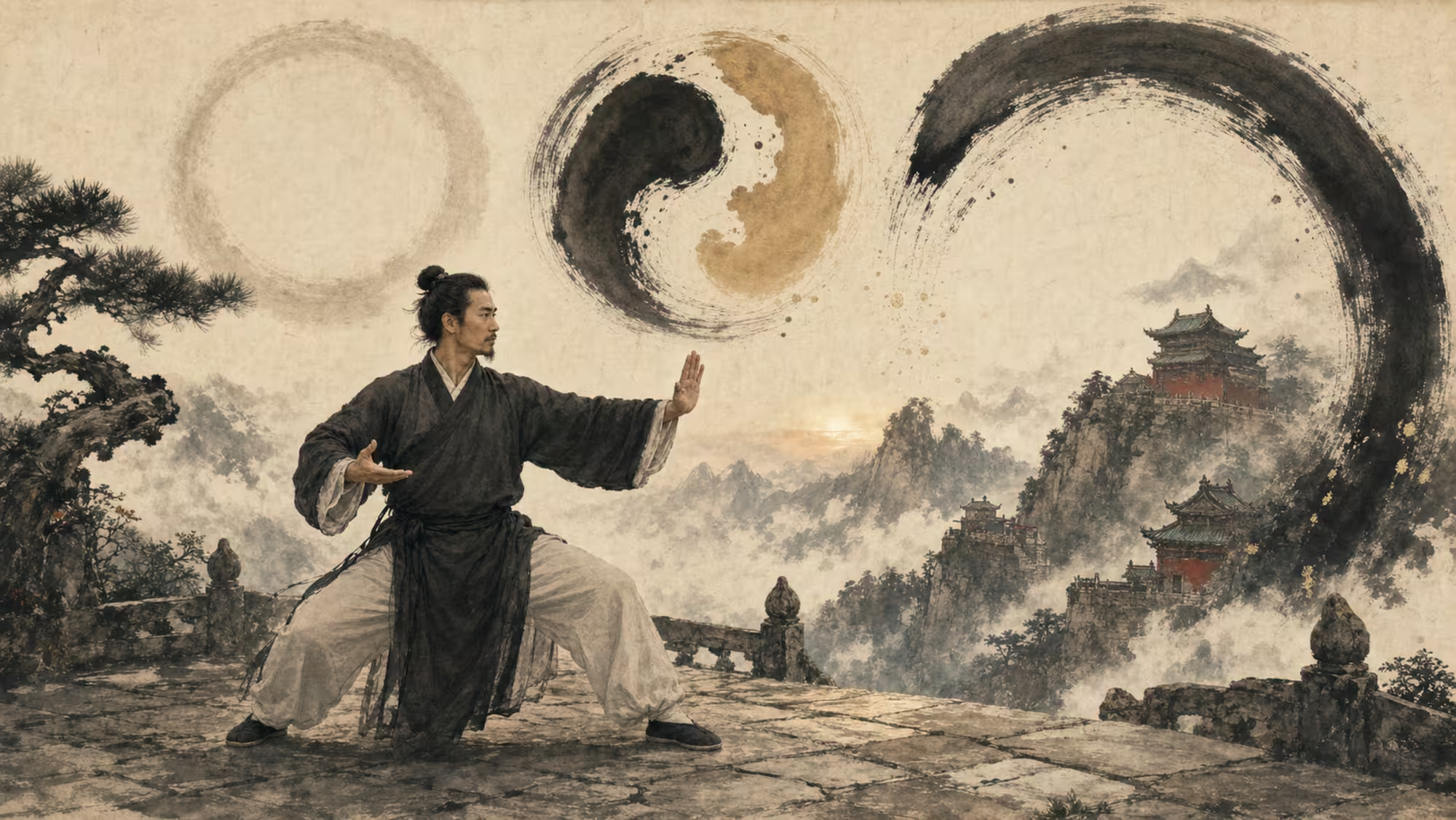
There is a form in the Wudang system that most practitioners never hear about. It does not appear in tournament circuits. It has no viral video following. For centuries, it existed only in the bodies and memories of Wudang Daoists who passed it from teacher to student without ever writing it down.
That form is Tàihé Quán (太和拳) — the Supreme Harmony Fist.
I want to share what this form is and why I consider it one of the most remarkable pieces of our tradition. Not because it is flashy or complex — it is neither. But because in 25 movements, it tells the entire story of creation and return that sits at the heart of Daoist practice.
The Name Behind the Name
To understand Tàihé Quán, you first need to understand the name. Tàihé (太和) means "Supreme Harmony," and it is not an arbitrary title. Wudang Mountain itself was historically called Tàihé Shān (太和山) — the Mountain of Supreme Harmony. The golden temple at the summit, where Zhēnwǔ (真武, the True Warrior deity) is enshrined, is called Tàihé Gōng (太和宫) — the Palace of Supreme Harmony. The name runs through the mountain like a vein through stone.
In Daoist cosmology, Tàihé describes a very specific state: the condition of primordial unity that exists before the Tàijí (太极) differentiation of Yīn and Yáng. Where Tàijí describes two forces already in dynamic interplay, Tàihé describes the moment before that — when all forces remain undisturbed and whole.
This is not just philosophy. It is the blueprint of the form.
A Form Born in Secrecy
Tàihé Quán has always been classified as běnshān quán (本山拳) — a "native mountain fist." This designation means it was created on Wudang Mountain, for Wudang Mountain, and for generations it stayed there. Unlike Tàijí 28 or Bā Duàn Jīn, which were eventually adapted for public teaching, Tàihé Quán was bound by monastic discipline. The Daoist precepts governing its transmission were strict: even within the mountain's religious community, the form was only passed to students who had been carefully selected. And it was only ever transmitted body to body — through physical demonstration and correction, never through written diagrams or manuals.
This is why Tàihé Quán is sometimes called a "partially lost form" within the Sānfēngpài (三丰派) system. What survives are the branches that teachers chose to preserve in living bodies rather than on paper. In the Quánzhēn Lóngmén (全真龙门) branch of Wudang Daoism, a 22-movement version was preserved and eventually documented. The version within our Sānfēng lineage contains 25 movements.
The difference is not a contradiction. It reflects the reality of how oral traditions work across centuries and across branches of the same mountain.
The Cosmological Arc
What makes Tàihé Quán structurally unique is that its movement sequence does not simply reference Daoist cosmology — it traces it. From the first posture to the last, the form walks the practitioner through the entire creation-and-return cycle that Daoist philosophy describes.
The form opens in Wújí (无极) — Primordial Stillness. You stand. Nothing moves. This is not a warm-up. It is the void before existence. The first three movements carry you from this formless state through the emergence of Tàijí, the first stirring of polarity, and into Huái Bào Tài Jí (怀抱太极) — Embrace the Supreme Ultimate — where the arms form a sphere holding the newly born interplay of Yīn and Yáng.
The middle section develops this polarity into increasing complexity. Xuán Zhuǎn Qián Kūn (旋转乾坤) — Rotate Heaven and Earth — introduces spiraling force. Fēn Liǎngyí (分两仪) — Separate into Yīn and Yáng — makes the division explicit. Yīn Yáng Shǒu (阴阳手) trains the hands to express opposite qualities simultaneously: one soft and receiving, the other firm and directing.
Then comes Tiān Rén Hé Yī (天人合一) — Heaven and Human Become One. This is the moment of vertical alignment where the practitioner becomes a conduit between earth and sky. If Tàihé Quán has a philosophical center of gravity, this is it: the point where the boundary between self and cosmos dissolves.
Animals on the Mountain
The middle-to-late section of the form shifts into animal expressions. But these are not the stylized animal forms you might know from Shàolín or even from other Wudang sets. Each animal in Tàihé Quán represents a specific energetic state drawn directly from Wudang Mountain's own landscape and mythology.
Shīzi Fēng (狮子峰) — Lion Peak — is named after an actual peak on the mountain. The posture embodies the lion's alert authority. Hēi Hǔ Xún Shān (黑虎巡山) — Black Tiger Patrols the Mountain — references one of Wudang's legendary "living eight views," a description of the tiger energy that was said to be visible to cultivated observers on the mountain itself. Yín Shé Pán Liǔ (银蛇盘柳) — Silver Snake Coils Around the Willow — captures the snake's capacity for sudden release from stored coil.
Even Hǎi Mǎ Tǔ Wù (海马吐雾) — Sea Horse Exhales Mist — and Léi Huǒ Liàn Diàn (雷火炼殿) — Thunder and Fire Temper the Palace — are not abstract images. They are drawn from the natural phenomena witnessed at Wudang's summit: sea-horse shaped ridgeline formations dissolving into mountain cloud, and the legendary lightning strikes on the Golden Hall that Daoists interpreted as the refinement of Heaven's energy.
This is a form that does not merely borrow from nature. It was built from the specific mountain where it was practiced.
The Return
The final movements reverse the cosmological process. Where the opening moved from unity toward differentiation, the closing gathers everything back.
Wǔ Lóng Pěng Shèng (五龙捧圣) — Five Dragons Support the Immortal — activates five energetic pathways corresponding to the Wǔxíng (五行), the Five Phases. Bāguà Zhuǎn Yùn Diàn (八卦转运殿) traces the Eight Trigrams in a walking pattern, synthesizing all the energies that were differentiated through the form. Then Hé Tài Jí (合太极) — Gather the Supreme Ultimate — reverses the opening embrace, pulling cultivated energy back into the center.
The form ends in standing stillness. But this is not the same stillness as the beginning. The opening was empty potential. The closing is integrated fullness. The practitioner has traveled the entire arc — from nothing, through everything, back to a unity that now contains the experience of differentiation.
This is the Nèidān (内丹) principle in physical form: creation unfolds outward, cultivation returns inward.
Three Depths
Within the tradition, Tàihé Quán is understood to operate on three levels:
Form Level — Xíngshì Céng (形式层). Learning the correct external movements. Getting the transitions right. Understanding where each posture begins and ends.
Energy Level — Néngliàng Céng (能量层). Beginning to feel the internal substance behind the shapes. The movements stop being exercise and start becoming cultivation.
Spirit Level — Shényì Céng (神意层). The form becomes a vehicle for Nèidān practice. Movement is no longer physical expression — it is a gateway.
A Wudang saying captures the patience this requires: "Ten years to understand the form, ten years to refine the energy, ten years to liberate the spirit."
Most people hear that and assume it is poetic exaggeration. It is not. If anything, it is conservative. The old Daoists who transmitted Tàihé Quán described it this way: practice it a hundred times and you notice a hundred differences. Practice it a thousand times and you arrive at a thousand new understandings. Practice it ten thousand times and you begin to transform.
Why It Matters Now
Tàihé Quán bridges two positions in the Sānfēngpài curriculum. It takes the foundational Tàijí principles — the continuous unified flow of Yīn and Yáng — and begins separating them into the deployable martial forces of the Liǎngyí (两仪) system. This makes it a direct preparation for Liǎngyíquán (两仪拳), also known as Xuánwǔquán (玄武拳), which is the quintessential Wudang combat form.
But its significance goes beyond curriculum placement. In an era where martial arts forms are increasingly optimized for performance scores and audience appeal, Tàihé Quán remains stubbornly itself: 25 movements that look simple, feel vast, and resist being reduced to spectacle.
The old training maxim applies perfectly here:
"Not in knowing a thousand moves, but in truly understanding one." (不在千招会,只在一招通)
Tàihé Quán asks you to understand one thing — the cycle of emergence and return — and to practice it until the understanding is no longer intellectual but physical, energetic, and finally spiritual.
That is what Supreme Harmony means. Not the absence of differentiation, but the integration of everything that was differentiated — brought back together in a body that has walked the full arc.
Stand still. Begin. Return.