The calendar is starting to carry Taiji in a new way.
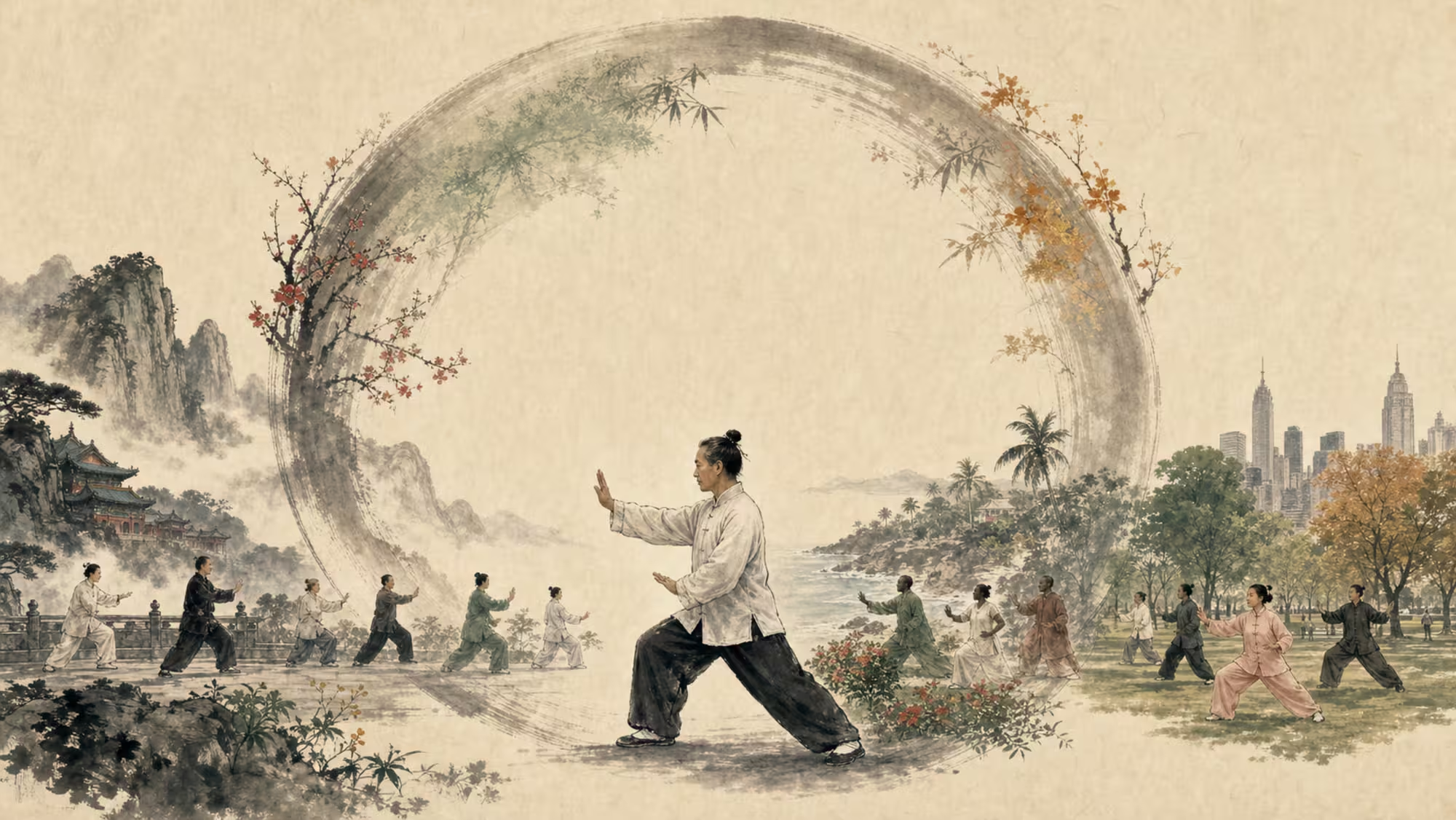
This spring, two public dates appeared close together. On March 21, 2026, the first International Taijiquan Day was observed after UNESCO recognition. A few weeks later, on April 25, World Tai Chi & Qigong Day filled parks, community centers, livestreams, event pages, and YouTube uploads with the older language of one world practicing in sequence. By late May, the traces were still visible online: recap clips, local announcements, event recordings, celebratory posts, and the familiar mixture of sincere practice, public health language, cultural diplomacy, and social-media compression.
For many people, this will be the first way they meet Taiji. Not through a teacher correcting a shoulder. Not through months of standing, stepping, and repeating a small section of form until the hip finally stops fighting the knee. Not through partner work, lineage history, or the slow discovery that softness is not limpness. They will meet it as a date on a calendar, a public gathering, a wellness video, or a banner phrase that makes the art sound accessible to everyone.
That is not automatically a problem. Public days matter. They tell people that a practice exists. They give beginners a low-pressure doorway. They give older practitioners a chance to step outside private training circles and show the art without secrecy. They give cities, libraries, health groups, cultural organizations, and community teachers a simple reason to gather. A person who might never search for a Taiji class may notice a group moving slowly in a park and become curious.
The problem begins when the public image becomes the whole thing.
Taiji has always had a double life in modern culture. It is a martial art, a health practice, a cultural symbol, a moving meditation, a performance form, a social activity, a research subject, and a retirement-park stereotype, depending on who is looking. A global calendar intensifies that double life. The same gesture can be framed as heritage, exercise, mindfulness, diplomacy, rehabilitation, martial training, or scenic content. The slow hand, seen from a distance, accepts almost any label.
Students of internal arts have to learn how to read that visibility without becoming cynical about it.
A Public Date Is Not the Same as a Practice
The strongest public-day image is usually the group image. Dozens of people in a square. A line of practitioners in white or black silk uniforms. A teacher at the front. Arms rising together. The camera pulls back, and the message becomes obvious: harmony, health, culture, peace, continuity.
It is a powerful image because Taiji is visually suited to collective display. The tempo is readable. The shapes are distinctive. A crowd can move without looking chaotic. Unlike combat sports, it does not need a ring or visible impact to communicate something. Unlike seated meditation, it gives the camera movement. Unlike ordinary fitness, it carries an aesthetic memory of Chinese martial culture even when the viewer knows very little about the art.
But display has a cost. Public Taiji often has to be legible from far away. The big shape becomes more important than the hidden process. The audience sees hands, sleeves, posture, and synchronization. It cannot easily see whether the weight has actually changed, whether the kua has opened, whether the lower back has softened, whether the breath has settled, whether the elbows are heavy, whether the feet are alive, or whether the movement is being driven by habit and imitation.
A calendar event can celebrate Taiji. It cannot certify Taiji.
That distinction matters for students because public recognition can create a strange impatience. Once a practice is recognized by institutions, shared by major accounts, or repeated under official slogans, it can seem already understood. The art appears to have arrived. It has a day. It has videos. It has health language. It has international approval. It has a hashtag. What remains, from the outside, is participation.
From the inside, almost everything remains.
The day after a celebration, the real work still has the same plain demands. Can the student stand without bracing? Can the knees soften without collapsing inward? Can the shoulders stop performing calmness and actually release? Can the eyes stay present without staring? Can the form be repeated when no one is watching? Can a step be slow because the body is organized, not because the student is pretending to be serene?
Public recognition may bring people to the door. It does not walk through the door for them.
Why the Calendar Moment Is Still Useful
It would be easy to dismiss global Taiji days as ceremony. That would miss something important.
The current moment shows that Taiji and Qigong are no longer sitting at the edge of public health and cultural conversation. They are being folded into official heritage language, wellness programming, community aging initiatives, online education, and general movement culture. That does not mean every claim made about them is careful. It does mean more students will arrive with expectations shaped by public events rather than traditional training rooms.
Some will come because they saw health claims. Some will come because they want stress relief. Some will come because the movements look gentle enough to try. Some will come through Chinese cultural interest. Some will come through martial arts. Some will arrive after seeing large public demonstrations and thinking Taiji is mostly choreography.
That range of entry points changes the teaching problem. A modern student may not need to be convinced that Taiji exists. They may need to be taught that Taiji is not exhausted by its public image.
This is where the calendar becomes useful. A public day can be treated as a beginning, not an achievement. It can invite a question: if the whole world can see the outer shape, what is the inner work that cannot be seen in a clip?
That question is more valuable than another slogan about ancient wisdom. It leads back to basics. Weight transfer. Alignment. Breath. Listening. Song, the quality often translated as release or relaxation, but never meaning collapse. Ting, listening or sensing, not only with the ear but through contact, timing, and attention. Zhong ding, central equilibrium, not as a poetic idea but as the body staying organized under change.
These terms do not become more real because an institution recognizes a date. They also do not become less real because a beginner first meets them through a public event. The serious question is whether the first encounter leads toward practice or stays at the level of atmosphere.
The Risk of Being Too Easy to Like
Taiji is easy to praise from a distance. It looks calm. It looks inclusive. It looks low impact. It can be presented as safe, ancient, graceful, peaceful, and therapeutic. These are attractive words, especially in a culture tired of intensity and speed.
The attraction is understandable. Many people are looking for ways to move without punishment. They want a practice that does not require youth, aggression, expensive equipment, or competitive identity. Taiji and Qigong can offer that doorway. A public calendar day makes the doorway more visible.
But a practice that is easy to like can also be easy to misunderstand.
When Taiji is reduced to calm movement, the martial intelligence disappears. When it is reduced to health exercise, the training method disappears. When it is reduced to heritage, the body disappears. When it is reduced to choreography, the listening disappears. When it is reduced to a public performance, the private difficulty disappears.
The slow tempo is often the first thing outsiders notice, but slowness is not the essence. Slowness is a tool. It gives the nervous system time to notice. It gives the joints time to reveal compensations. It gives the mind fewer excuses. It exposes transitions that speed can hide. A slow form performed without internal change is still only a slow form. A small correction performed with attention can be more important than a beautiful public sequence.
This is why students should be careful with the word gentle. Taiji can be gentle in the sense that it does not need forceful impact to train deeply. It is not gentle in the sense of being vague, easy, or undemanding. Standing can be uncomfortable. Slow stepping can be humbling. Releasing the shoulder can take longer than learning a long choreography. Partner work can reveal tension that solo form politely concealed for years.
The public calendar likes the visible form. Training likes the repeated correction.
Two Kinds of Togetherness
World Tai Chi & Qigong Day has long carried the idea of synchronized practice across time zones. One group begins, then another, then another, as the day moves around the planet. The image is simple and appealing: a wave of practice passing from place to place.
International Taijiquan Day adds a different kind of togetherness. It places Taiji inside official cultural recognition. The practice becomes part of a global conversation about heritage, health, and intercultural exchange. The focus is not only that people practice together, but that Taiji is worthy of being named, preserved, and shared.
Both forms of togetherness are real. Both are incomplete.
A group event can create encouragement. It can also let a student hide inside the group. Official recognition can protect visibility. It can also freeze a living art into a symbol. A public demonstration can inspire. It can also teach the viewer to value what photographs well.
Traditional practice asks for a smaller, less dramatic togetherness. The student stands with the teacher's correction. The body learns to connect upper and lower, inside and outside, intention and movement. The breath learns to stay with the step. The mind learns not to abandon a posture when it becomes boring. In partner practice, one person's excess tension becomes information for another. In a class, the group helps maintain rhythm, but the work still happens one body at a time.
That kind of togetherness rarely becomes a viral image. It is too ordinary. A teacher says to lower the elbow again. Someone adjusts a foot by a few centimeters. A beginner discovers that turning the waist is not the same as swinging the arms. A senior practitioner repeats the opening movement as if it has not been solved.
This is the scale where Taiji survives after the calendar moves on.
What Students Can Do With the Moment
The practical response is not to reject public Taiji days. It is to use them correctly.
When a public event appears, students can ask what it is good for. It may be good for inviting a friend. It may be good for seeing different communities practice. It may be good for noticing how many ways the same art can be framed. It may be good for remembering that private training belongs to a larger human field. It may be good for honoring teachers and practitioners who kept the art visible when it was not fashionable.
Then students can ask what the event cannot do. It cannot replace correction. It cannot test structure. It cannot make a form internally connected. It cannot turn a slogan into embodied skill. It cannot decide whether a teacher is good. It cannot resolve the difference between Taiji as performance, Taiji as health exercise, and Taiji as martial art.
That second question keeps the calendar honest.
The useful attitude is neither suspicion nor enthusiasm. It is clarity. Public recognition is a lamp, not the path. It lights up the fact that Taiji is being seen. It does not show how deeply it is being practiced.
For beginners, that clarity prevents disappointment. A first public event may feel beautiful, but the next step may be repetitive, quiet, and technically precise. That is not a loss of magic. It is where the practice starts to become real. For experienced students, the same clarity prevents pride. Recognition does not mean the art has been secured. Every generation still has to transmit method, not just image.
The most honest celebration of Taiji may happen after the public celebration is over. The livestream ends. The park empties. The recap clip stops circulating. The official date passes into next year's calendar. Someone returns to a small room, stands with both feet on the floor, raises the arms slowly, notices the shoulders rising, lets them drop, and begins again.