Taiji is learning a new kind of paperwork.
In late April, China's education authorities released the 2026 undergraduate major catalog. The list carried the expected language of the moment: artificial intelligence, robotics, energy, digital culture, brain-machine technology, biomanufacturing. Hidden among those future-facing names was something older and slower: Taijiquan.
By May, Chinese media and Henan Polytechnic University were describing the new Taijiquan undergraduate major as a formal program for autumn 2026 enrollment. The university's own program introduction placed the art inside a four-year educational frame: theory, culture, technique, traditional boxing and weapons, push hands, English, communication, traditional health cultivation, foundations of Chinese medicine, and even artificial intelligence and Taiji. At almost the same time, university wushu was preparing for a June international student competition in Brazil, where Taijiquan and Taijijian sit beside other taolu events under a global sport structure.
For anyone who has spent time inside Taiji practice, the news is both unsurprising and strange.
It is unsurprising because Taiji has been moving through institutions for a long time. It has been standardized, researched, performed, taught in universities, used in public health programs, placed in competitions, named as cultural heritage, and folded into international demonstrations. The idea that a university would study Taiji is not new.
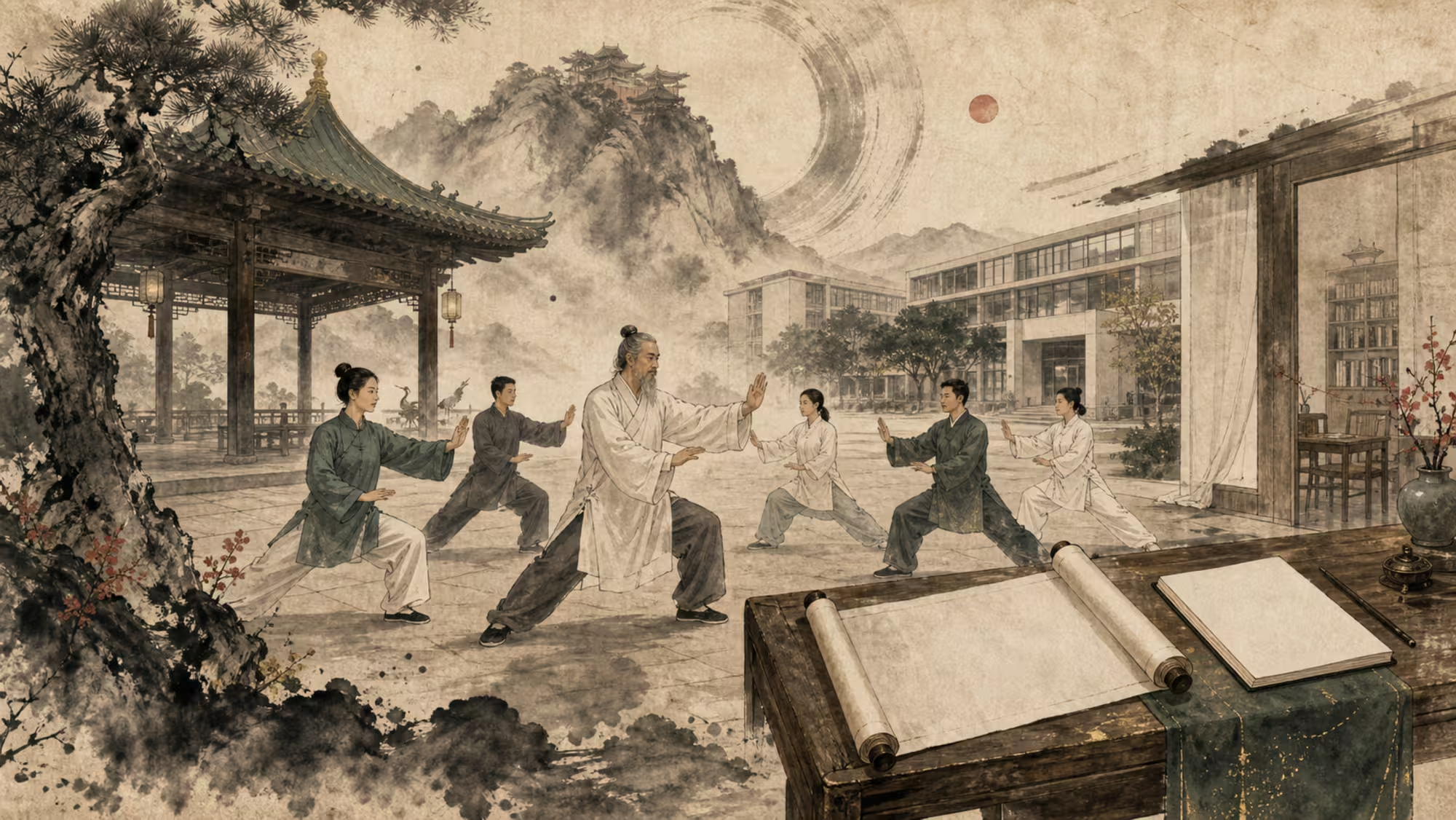
It is strange because a dedicated undergraduate major changes the public shape of the art. A practice once learned through family lines, village networks, temple settings, private teachers, state sport systems, community parks, and small local schools now appears as a degree pathway. It can be listed next to other majors. It can produce graduates. It can become a credential.
That is where students should pay attention.
A Credential Is Not the Body
The internet discussion around the new major immediately found the pressure point. Some practitioners saw validation. If Taiji can be studied with serious history, theory, language, health context, and movement training, perhaps the art gains a more stable public home. Others saw danger. If Taiji becomes a university product, who decides what counts? Which style becomes official? Does a syllabus flatten what used to require years of correction? Can a graduate with a degree appear more authoritative than a practitioner with deeper skill?
These are not cynical questions. They are practical questions about transmission.
Taiji contains several kinds of knowledge that do not behave the same way. Historical knowledge can be read, compared, cited, and argued. Cultural knowledge can be taught through texts, language, ritual context, regional history, and philosophy. Health and sport knowledge can be organized through anatomy, physiology, pedagogy, testing, and research design. Performance knowledge can be trained through standards, routines, judging criteria, and visible technical benchmarks.
Embodied skill is less cooperative.
A student can write a good paper on song, the quality often translated as relaxation or release, and still raise the shoulders in the first movement. A student can identify peng, lu, ji, and an in classical language and still push from the arms. A student can describe central equilibrium and still lose the center when someone touches them. A student can memorize a history of Chen, Yang, Wu, Wu/Hao, Sun, Zhaobao, competition routines, and modern simplifications, yet still turn the waist as a shape rather than as a connected movement through the body.
This does not make academic study useless. It makes the border clear.
A university can preserve documents, compare lineages, train teachers in pedagogy, give students language tools, build research literacy, and stop some of the vagueness that surrounds traditional arts in the public market. It can also reward what can be tested, written, standardized, and displayed. The body must still answer questions that no transcript can settle.
Can the student stand without bracing?
Can the feet remain alive in a slow turn?
Can the elbow become heavy without deadening the hand?
Can intention lead without the face tightening into effort?
Can the body stay organized when another person changes the pressure?
These questions are not anti-intellectual. They are the practical exam Taiji has always given.
Why Universities Want Taiji Now
The timing makes sense. Taiji sits at the intersection of several modern priorities. It is cultural heritage. It is a health and aging practice. It belongs to Chinese martial culture. It travels well internationally. It can be taught through language programs, tourism, wellness, sport, performance, and digital media. It has research visibility. It carries philosophical vocabulary that can be translated into public culture. It looks graceful on camera.
For a university, that combination is attractive. A Taiji major can be more than a sports degree. It can be presented as an interdisciplinary program: physical training, traditional culture, teaching method, health promotion, international communication, media, tourism, and technology. Henan Polytechnic University's program description points in exactly that direction. It does not imagine graduates only as athletes. It imagines people who can teach, communicate, work in wellness and cultural industries, translate Taiji for international audiences, and participate in digital cultural production.
That ambition is understandable. Public Taiji already lives in those fields. A beginner may meet it through a health article, a short video, a university club, a cultural festival, a competition clip, a rehabilitation program, or a travel advertisement. The practice has become too visible to remain only in private rooms.
The serious question is not whether institutions should touch Taiji. They already do. The question is what kind of touch they will have.
An institution can protect a practice by documenting it carefully, paying teachers, supporting research, training translators, creating stable career paths, and resisting the kind of commercial exaggeration that turns every old movement into a miracle cure. It can make students read more deeply than social media requires. It can force a future teacher to understand history, safety, communication, and responsibility.
An institution can also simplify a practice until it fits the timetable.
Four years is a long time for an undergraduate degree. It is not a long time in internal arts. In four years, a diligent student can learn forms, build discipline, understand basic theory, gain teaching tools, and improve the body significantly. Four years may be enough to create a serious beginner with a wide map. It is not enough to guarantee internal skill, teaching maturity, or the kind of embodied judgment that comes from decades of correction.
That does not make the degree fake. It means the degree should be read correctly.
The Old Tension Between Standard and Transmission
Taiji has always needed standards. Without standards, the art dissolves into private feeling. Anyone can claim anything. A teacher can hide poor method behind mystical language. A student can mistake sensation for progress. A school can preserve a name while losing the training logic.
Standards help. They ask whether posture is coherent, whether movements are recognizable, whether terminology is used responsibly, whether a teacher understands the difference between a health class, a martial class, a performance routine, and therapeutic claims. They make public teaching less dependent on charisma.
But Taiji also suffers when standards become too external.
A routine can be clean and empty. A posture can be low and disconnected. A performance can be beautiful while the joints are forced. A competition can reward amplitude, synchronization, difficulty, and expression while the quieter qualities of listening, release, root, and issuing power remain secondary. A classroom can cover the vocabulary of internal training without putting the student under enough correction to embody it.
This is the old tension between standard and transmission. A standard tells the group what can be named, measured, and compared. Transmission changes a particular body.
The new university setting will have to live inside that tension. It may do useful work precisely because it can organize knowledge. It may also create new misunderstandings if the public begins to treat the credential as proof that the body has been transformed.
Students should not respond with automatic suspicion. Many excellent practitioners have passed through sports universities, research settings, competition systems, and formal training programs. Institutional learning and traditional training are not enemies by nature. A good teacher inside a university can still correct a foot, demand daily practice, teach partner listening, and insist that a movement means nothing until it works through the body.
The danger is not the classroom. The danger is forgetting what the classroom cannot replace.
What the New Major Reveals About Modern Taiji
The university major reveals how many identities Taiji now carries at once.
It is a martial art, but many people enter through health. It is a health practice, but it has weapons, applications, push hands, and strategy. It is cultural heritage, but it changes when taught through degree programs, livestreams, and international outreach. It is slow, but it now moves through fast media. It is traditional, but the new curriculum may include artificial intelligence, English communication, and digital cultural production.
This mixture can feel uncomfortable because it exposes something already true. Modern Taiji is not one public thing. It is a cluster of practices, institutions, memories, claims, and training cultures using overlapping names.
For students, the useful response is to become more precise.
When someone says Taiji is entering universities, ask which Taiji. Traditional family training? Modern wushu Taiji? Health-oriented group practice? Push hands? Cultural studies? Teacher training? Performance? Research? International communication? A degree program may include several of these, but they are not the same skill.
When someone says a teacher is certified, ask by whom, for what purpose, and under what standard. A certificate may show that a person completed a curriculum. It may not show how they handle a beginner's knee alignment, how they correct force, how they explain song without making it limp, or how they respond when a student's body does not match the textbook.
When someone dismisses university Taiji as only performance, ask whether that judgment comes from evidence or habit. Some institutions may produce shallow teaching. Some may preserve valuable material. Some may do both at once.
The goal is not to win an argument about modernity. The goal is to keep the practice legible.
The Student's Practical Test
The new university era gives ordinary students a simple discipline: separate recognition from training.
Recognition is useful. It means Taiji is visible enough to be studied, funded, debated, and taught. It may bring more young people into serious contact with the art. It may create translators who can explain Taiji without reducing it to vague wellness language. It may help preserve documents, support research, and build pathways for teachers who otherwise survive on unstable local classes.
Training is different. Training asks what happens today.
Does the body know where the weight is?
Does the breath remain available?
Does the spine lengthen without stiffness?
Does the hand express the body, or does the hand move alone?
Does the form become quieter with repetition, or only more memorized?
Does partner work reveal structure, or only cooperation?
A degree cannot answer these questions on behalf of the student. Neither can a lineage claim, a famous school, a viral clip, a festival, a heritage listing, or a public day. All of them may point toward something. None of them can practice.
This is why the new Taijiquan major is worth noticing without being dazzled by it. It is a sign that Taiji is entering another layer of public life. The art is being asked to explain itself to education systems, employment markets, cultural industries, research programs, and international audiences. That pressure may clarify parts of the tradition. It may also distort parts of it.
The student's task is to use the clarity and resist the distortion.
Read more. Learn the history. Understand why institutions care. Notice how public language changes the art. Respect serious scholarship. Be grateful when teachers, researchers, and translators do careful work. Then return to the body and do not let the language get ahead of the practice.
The university can print the syllabus. The body still has to attend class.
After the Announcement
Public news has a short half-life. A new major appears. Headlines circulate. Practitioners argue. A few people become excited. A few become angry. The next institutional announcement arrives, and attention moves on.
Taiji moves differently.
It moves through a person discovering that the shoulder has risen again. It moves through a teacher asking for the same correction for the hundredth time. It moves through a student who has read enough theory to become humble rather than clever. It moves through a degree program only if the daily work inside that program remains honest.
The university era will not save Taiji by itself. It will not ruin Taiji by itself. It will give the art another room to enter, with desks, documents, exams, media plans, career promises, and young bodies trying to understand why slow movement can still be difficult.
Somewhere inside that room, a student will stand with both feet on the floor, arms beginning to rise, a teacher watching closely enough to see the old mistake return. The credential will be years away. The practice will already have begun.