What the Ocean Teaches Us About Seeing Things as They Are
There is something strange about the sky at sea. On land, clouds can be beautiful.
A dark cloud above a green hill may look dramatic. A tower of white cumulus behind a forest can seem almost heavenly. Even a storm approaching across fields can possess a kind of magnificence. We stop to photograph it.
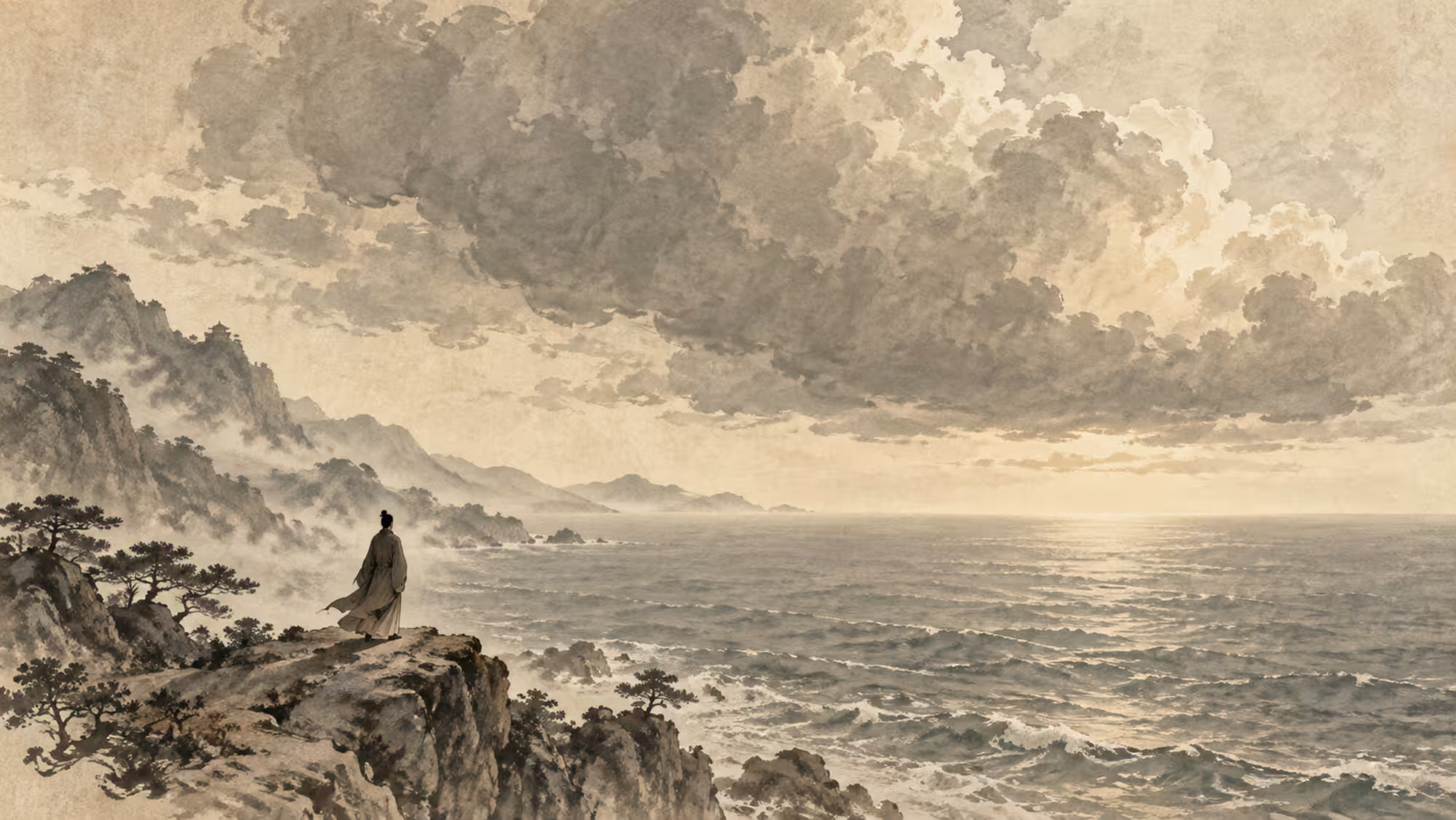
But take almost the same sky and place yourself far out on the ocean, and something changes. The cloud no longer seems merely beautiful. It seems enormous—heavy, watchful, sometimes threatening.
The sky has not changed very much.
You have.
And this small observation contains a surprisingly deep Daoist lesson.
The Cloud Is Not Just a Cloud
We often imagine that understanding something means examining it more closely. To understand a cloud, we study the cloud; to understand a tree, we study the tree; to understand ourselves, we study ourselves.
Daoism repeatedly suggests something subtler: a thing cannot be understood entirely in isolation from that which gives rise to it and the relationships within which it exists.
Chapter 52 of the Dao De Jing describes the origin of the world as its “mother.” Having understood the mother, it says, one can understand her children.
The image is remarkably useful. The individual things we encounter are the children. The deeper pattern from which they arise is the mother. We misunderstand the child when we forget the mother.
A cloud, therefore, is not merely an isolated white object floating against a blue background. It belongs to a larger process: atmosphere, pressure, moisture, wind, temperature, sunlight, land and sea.
And our experience of the cloud belongs to another process:
cloud + environment + observer.
Change one part of that relationship and apparently the same object becomes something different.
On Land, the Sky Has a Frame
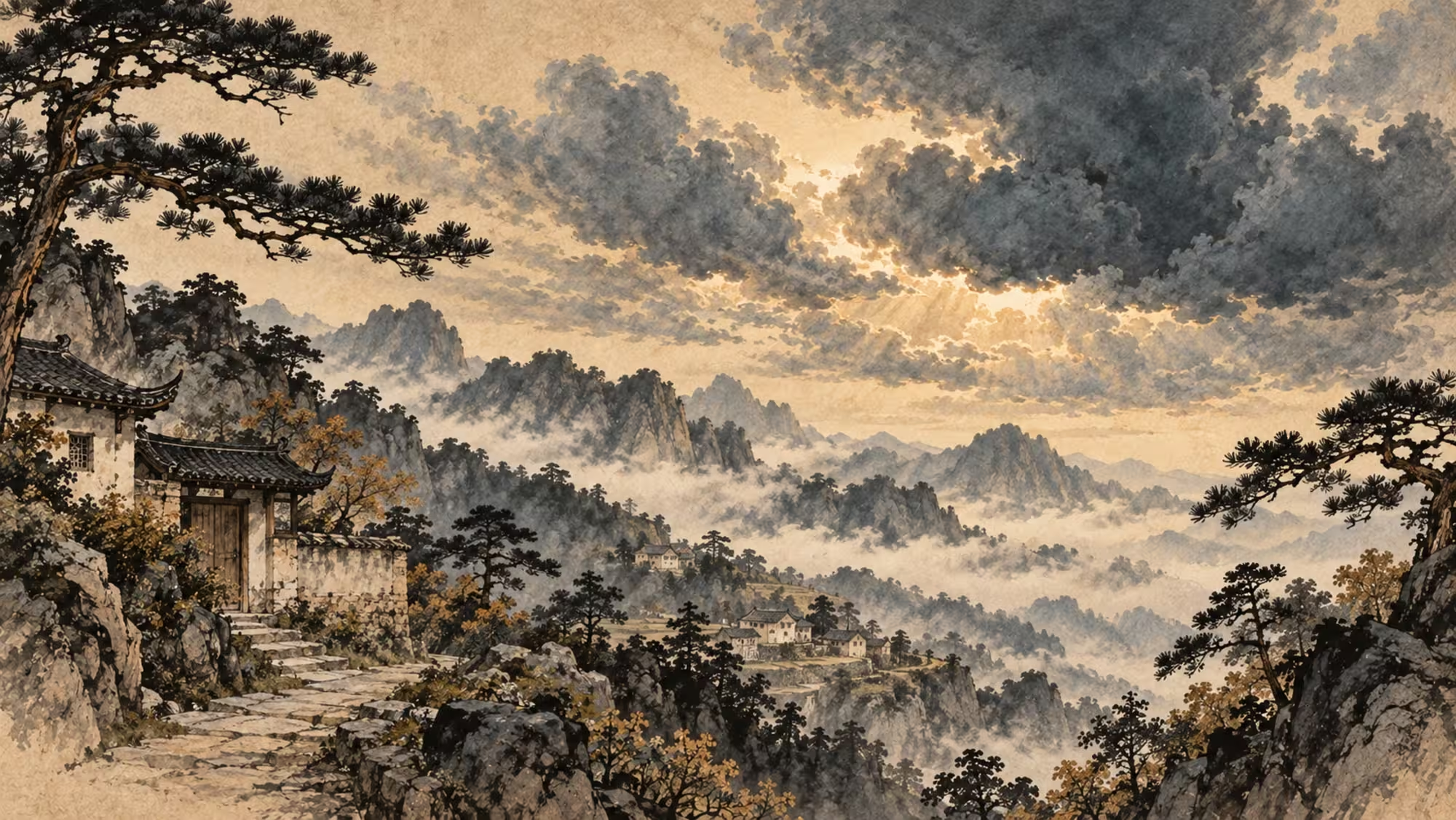
Stand beneath a summer sky in the countryside. There are trees around you. Hills. Buildings. Roads. Perhaps the edge of a forest. The cloud exists within a world of boundaries.
Your visual system has countless reference points with which to organize what it sees. Research on spatial perception shows that ground surfaces, horizons and perspective cues help us judge size and distance. A continuous terrestrial surface provides the eye with information from which a spatial world can be constructed.
This may help explain why clouds over land often appear like objects within a landscape. They are framed: a tree beneath the cloud, a mountain beside it, a house below it.
There is also something psychologically important that we rarely notice:
there is somewhere to go.
The storm may be approaching, but there is a house, a road, a car, a village, a roof. The cloud is immense, but our world still contains shelter.
And therefore the sky can remain beautiful.
The Ocean Removes the Frame
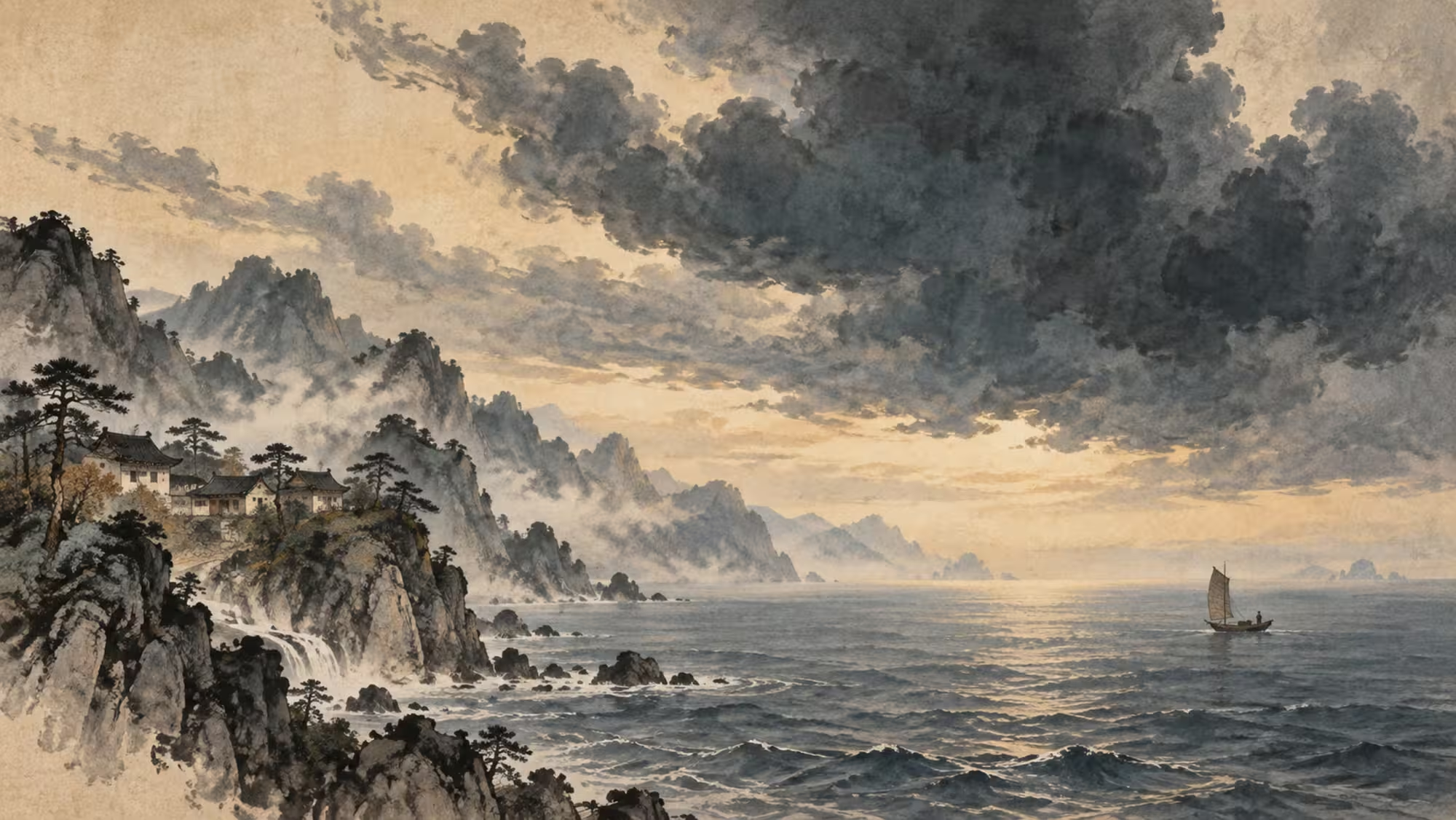
Now imagine moving far from land. The trees disappear. Then the buildings. Then the mountains. Eventually almost everything solid disappears.
There is water below you and sky above you. Between them lies a thin horizon. The scale of the world suddenly becomes difficult to grasp.
Many of the nearby fixed visual references that normally help us judge distance are gone. The horizon remains, but the landscape that usually divides space into foreground, middle distance and background has largely disappeared. Research into visual perception shows how strongly horizon, ground and perspective information influence our judgments of distance and scale.
The cloud that once seemed to sit inside the landscape now seems capable of becoming the landscape. And there is another difference. At sea, the cloud may actually matter more.
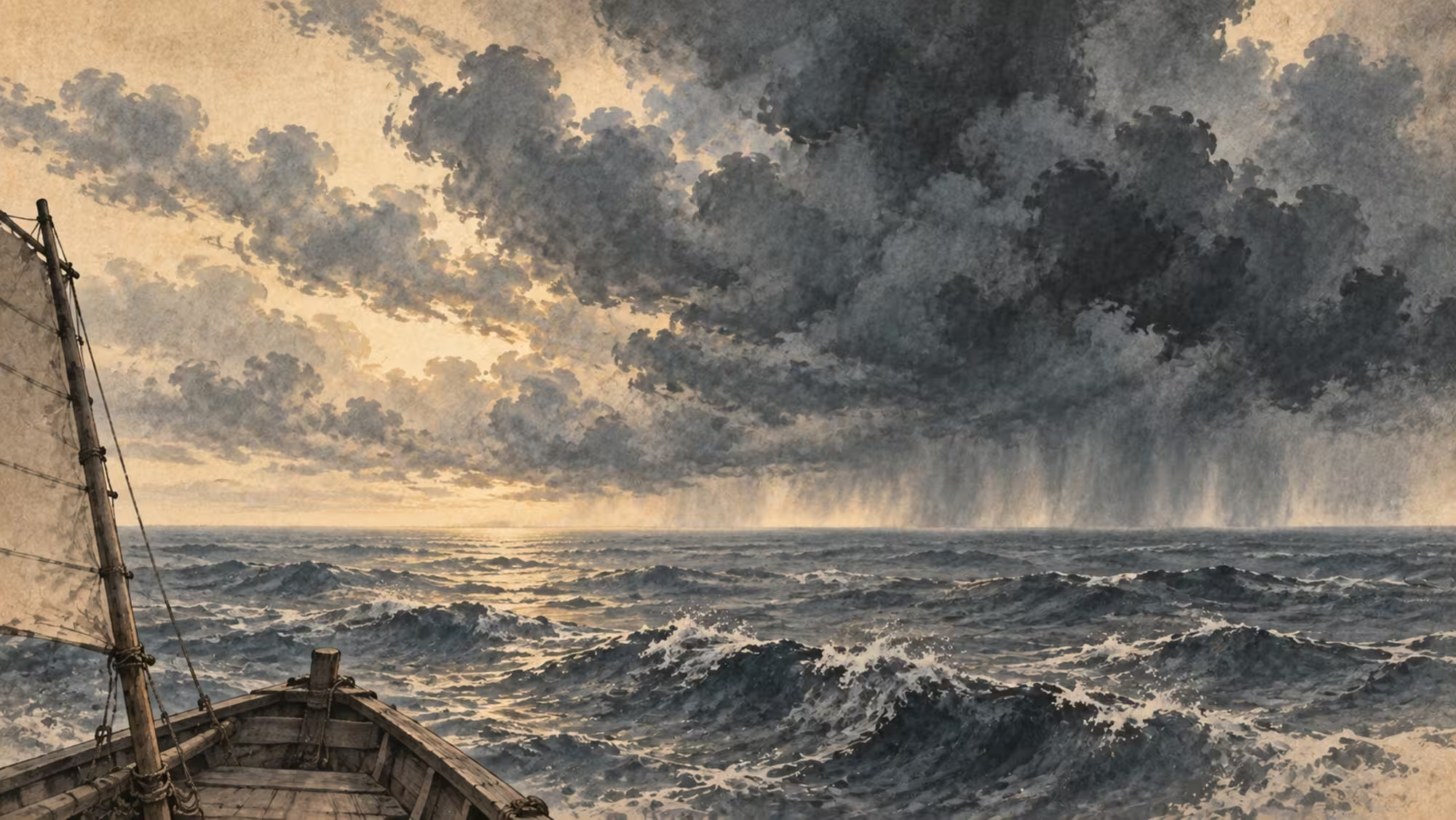
Thunderstorms can rapidly produce dangerous winds, waves, lightning and heavy rain. The U.S. National Weather Service specifically warns that mariners are unusually vulnerable because they may not be able to reach safe shelter quickly.
So the threatening feeling is not simply imagination. The relationship has genuinely changed. On land you look at the cloud. At sea you may be inside the consequences of the cloud.
Beauty and Threat Are Born Together
This brings us to another important passage from the Dao De Jing.
Chapter 2 begins with an observation about opposites: when beauty is recognized as beauty, the idea of ugliness arises with it; difficult and easy, long and short, high and low define themselves through relationship.
This is one of the great Daoist insights. Things do not always possess the qualities we give them independently. Their qualities appear through relationships.
High requires low. Near requires far. Inside requires outside. Safety makes danger intelligible. And perhaps beautiful makes threatening possible.
The cloud over the mountain and the cloud over the ocean need not be two different clouds. What changes is the relationship.
On land, cloud + distance + shelter + solid earth may become beauty. At sea, cloud + exposure + changing wind + deep water may become threat.
The Daoist mistake would be to argue endlessly about which description is the “true” cloud. Beautiful? Threatening? Both perceptions arise from conditions.
The deeper reality is the process that permits both.
Zhuangzi and the View From the Sea
There is an especially appropriate story in the Zhuangzi.
The Earl of the River is impressed by the greatness of his own waters. But eventually he reaches the North Sea and encounters something vastly larger. His understanding of “great” and “small” changes because his position has changed.
The lesson is not merely that the ocean is bigger than a river.
Zhuangzi repeatedly examines how judgments arise from a particular standpoint. What appears to be “this” from one position can become “that” from another. Our perspective is real, but it is not the only possible perspective.
Going to sea can produce exactly this kind of philosophical shock. The land-dweller believes he knows the sky. Then the horizon opens. Suddenly the familiar sky reveals another character.
Nothing supernatural has occurred. The observer has entered another relationship with the same world. And with that change of position comes another kind of knowledge.
To Understand the Thing, Understand Its Way
This is where the Daoist idea goes deeper than simply saying that “everything is relative.” Daoism is not merely telling us that everyone has a different opinion.
It asks us to look beneath isolated appearances toward the way things arise, transform and relate.
The Dao De Jing describes the Dao as the source from which the many forms of the world emerge. Chapter 1 distinguishes between the underlying mystery and its visible manifestations; Chapter 52 returns to the metaphor of the source as the mother through which the children can be understood.
So if you want to understand one particular thing, do not only stare harder at that particular thing. Ask:
- What produces it?
- What surrounds it?
- What does it depend upon?
- What does it affect?
- What position am I viewing it from?
- What changes when the relationship changes?
Only then does the individual phenomenon begin to reveal its nature. The cloud teaches this beautifully. On land we may call it scenery. At sea we may call it weather.
The cloud did not suddenly acquire another essence. Rather, we discovered more of the network to which it belongs.
Ziran: Allowing Things to Be What They Are
Another Daoist concept helps here: ziran (自然), often translated as “naturalness,” but literally carrying the sense of something being “self-so” or “so of itself.”
In the Laozi, Dao itself follows ziran. Things emerge according to their own patterns rather than according to the categories human beings attempt to force upon them.
Perhaps this is why the ocean can feel so philosophically powerful. The sea is not interested in maintaining our categories. The beautiful cloud does not promise to remain beautiful.
The calm water does not promise to remain calm. The horizon does not promise us shelter. Things simply proceed according to their conditions.
To understand them, we must become attentive to those conditions. That is very different from demanding that reality remain what we previously decided it was.
The Ocean Does Not Change the Sky. It Reveals More of It.
This may be the deeper lesson. We often think that knowing something means finding the correct label for it: beautiful, dangerous, good, bad, peaceful, hostile.
But perhaps knowledge begins when we stop mistaking the label for the thing itself. The sky seen from land is true. The sky seen from the ocean is also true.
Neither view contains the whole sky. When we move from one environment to another, the world reveals relationships that were always present but previously hidden from us.
This is why understanding the essence of things requires more than collecting individual observations. We must understand the pattern from which those observations arise.
Know the mother, and the children become intelligible.
Understand the sea, the atmosphere, the body, exposure and shelter—and suddenly it becomes obvious why the same dark cloud can inspire admiration from a field and fear from a small boat.
The wise person therefore does not ask only “What is this?” They also ask:
- “From what does this arise?”
- “With what is it connected?”
- “From where am I seeing it?”
Because the world does not consist of isolated things. It consists of relationships becoming visible. And sometimes all it takes to discover this is to leave the shore.