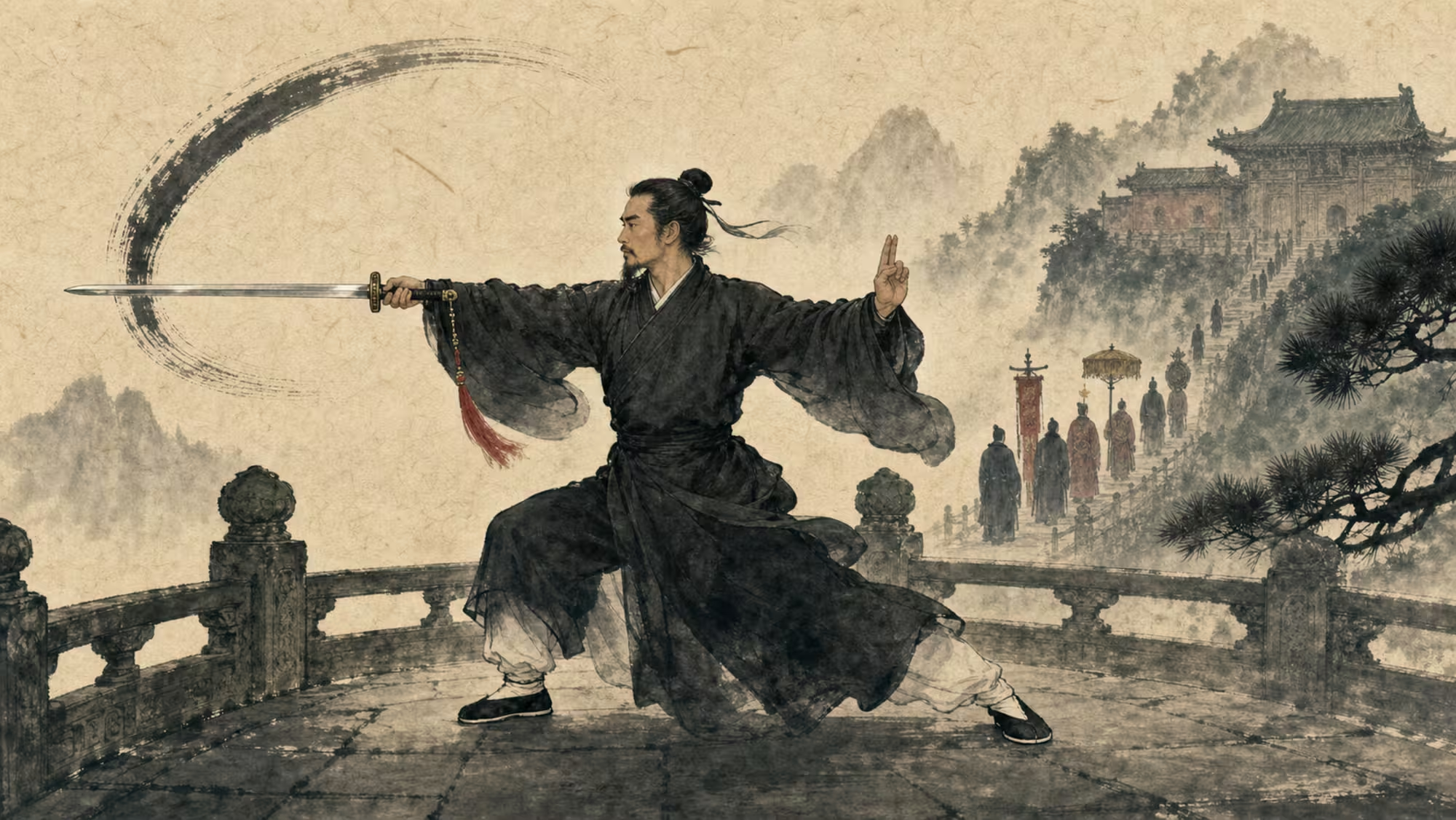
If you mention Jian (剑) — the Chinese straight, double-edged sword — to anyone with even passing knowledge of martial arts, the word "Wudang" will follow within seconds. This association runs so deep that most people assume it has always been this way, as though swords simply grew from the mountain's stone like pine trees.
The truth is more interesting. The bond between Wudang and the sword was built across more than a thousand years by Daoist monks, ambitious emperors, wandering hermits, and a Republican-era warlord who earned the title "Sword Saint." It is a story of ritual becoming combat, secrecy becoming tradition, and a mountain becoming a symbol.
The Sword Before Wudang
To understand why Wudang and the sword belong together, you first need to understand what the Jian (剑) meant in Chinese culture long before any martial system claimed it.
The earliest Chinese jian date to the Western Zhou dynasty, roughly 1000 BCE. These were short bronze weapons — secondary arms carried as a last resort when the spear or halberd failed. By the Spring and Autumn Period (770–476 BCE), sword culture had already begun to take on mythic proportions. The legendary Sword of Goujian, unearthed in 1965 from a flooded tomb in Hubei province, was over 2,500 years old and still untarnished when archaeologists pulled it from its lacquered scabbard.
By the Han dynasty (206 BCE–220 CE), the jian had largely been replaced on the battlefield by the Dao (刀) — the single-edged sabre, which was easier to mass-produce and simpler to train with. But rather than disappearing, the straight sword migrated upward. It became the weapon of scholars, officials, poets, and priests.
In Chinese tradition, the jian earned the title Junzi Zhi Bing (君子之兵) — "The Weapon of the Gentleman." It was considered one of the four great weapons alongside the staff, spear, and sabre, but it alone carried moral weight. Its double edge symbolized balance. Its flexibility — a quality blade could be bent nearly into a circle and snap perfectly straight — represented the Confucian ideal of yielding without losing one's true course.
In later literary tradition, even Confucius was said to have worn a jian to official functions — not as a fighter, but as a mark of completeness as a gentleman. Whether historically accurate or not, the anecdote captures what the jian had become in the Chinese imagination: a symbol of cultivated character.
This is critical context. By the time the sword reached Wudang Mountain, it was already more than a weapon. It was a philosophical instrument.
The Mountain and Its Meaning
Wudang Shan (武当山) sits in the northwestern part of Hubei Province. The name itself carries martial significance — according to tradition, it derives from a phrase attributed to the Daoist deity Zhenwu (真武): "Only true martial arts can provide resistance." The characters Wu (武, martial) and Dang (当, resistance) were drawn from this statement.
The mountain's spiritual history stretches back to the Spring and Autumn Period, when the region served a defensive role for the Chu Kingdom against the invading Qin army. But its transformation into a Daoist center began during the Tang dynasty, when Emperor Taizong ordered the construction of the Five Dragon Temple (Wulong Gong 五龙宫) in the 7th century — the oldest sacred structure on the mountain.
Through the Song and Yuan dynasties, temples multiplied. But everything changed under the Ming.
The Yongle Emperor and the Imperial Mountain
In the early 15th century, the Yongle Emperor (永乐帝) — the third ruler of the Ming dynasty — transformed Wudang from a regional Daoist site into the most important religious mountain in China. Having just completed the Forbidden City in Beijing, he ordered a construction effort of staggering scale: nine palaces, nine monasteries, thirty-six nunneries, and seventy-two temples, built over more than a decade by an army of laborers reportedly numbering 300,000.
This was not purely spiritual devotion. Yongle claimed the protection of Xuantian Shangdi (玄天上帝) — the Supreme Emperor of the Dark Heavens, also known as Zhenwu — and elevating Wudang served both religious and political purposes. The mountain became an imperial temple, housing over 20,000 Daoist monks at its peak. It was officially recognized as the heart of Daoism in China.
Among the surviving structures from this era is the Golden Hall (Jin Dian 金殿) on Tianzhu Peak, commissioned by Yongle in 1416 — a gilded bronze masterpiece that still stands today. The Forbidden City atop the mountain, the stone-walled Taihe Palace, was completed in 1419. In 1994, the entire complex was designated a UNESCO World Heritage Site.
Why does this matter for the sword? Because imperial patronage did not just build temples. It concentrated Daoist practitioners — monks, hermits, scholars, and martial artists — on a single mountain for generations. And within Daoist monastic practice, the straight sword was not optional. It was essential.
The Sword in Daoist Ritual
In Daoist ceremony, the jian functions much as a wand does in Western esoteric traditions. Wooden swords — ritual avatars of their steel counterparts — are used in exorcisms, purification rites, and ceremonies to clear malevolent spirits. A priest might brandish the wooden sword to all eight directions to sanctify a space.
The seven-star pattern (Qixing 七星) — representing the Big Dipper constellation — appears on many Daoist ritual swords. This constellation was associated with Shangdi (上帝), the Supreme Deity, and carried deep significance in rituals related to the boundary between life and death.
This means that every Daoist temple on Wudang Mountain had monks who trained with the sword as part of their spiritual practice — not as soldiers, but as priests. The sword was woven into the daily life of the mountain. Over centuries, these ritual movements evolved, absorbing the principles of Neidan (内丹) — internal alchemy — and the body mechanics of internal martial arts. What began as ceremonial gesture gradually became structured combat technique, emphasizing internal power over external force.
The sword on Wudang was never separate from spiritual cultivation. This is the root of everything that followed.
Zhang Sanfeng and the Legendary Origin
No discussion of Wudang martial arts can avoid Zhang Sanfeng (张三丰), though separating historical figure from cultural myth is nearly impossible at this distance. He is traditionally credited with founding the internal martial arts on the mountain, but the earliest documented link between Zhang Sanfeng and martial arts does not appear until Huang Zongxi's Epitaph for Wang Zhengnan in 1669 — centuries after his supposed lifetime. Historical accounts place him somewhere between the late Song and early Ming dynasties, a timespan so wide that it has fueled centuries of scholarly debate over whether he was one person, several, or a composite of Daoist hagiography.
What the historical record does confirm: the Ming Shi (明史) — the official History of Ming — mentions Zhang Sanfeng as a Daoist from Liaoning province who abandoned a government career to become a wandering ascetic. He reportedly spent time on Mount Hua before settling on Wudang Mountain. The Yongle Emperor sent emissaries to find him, without success. In 1459, the Yingzong Emperor (英宗) posthumously conferred on him the title Tongwei Xianhua Zhenren (通微显化真人) — "Perfected Man of Pervasive Subtlety and Manifest Transformation." Crucially, the Ming Shi describes him as a Daoist Neidan (内丹) practitioner — not as a martial artist. The martial attribution came later.
The famous legend — that Zhang Sanfeng observed a crane fighting a snake and was inspired to create an art based on softness overcoming hardness — is depicted in a fresco at Zixiao Gong (紫霄宫), the Purple Cloud Temple on Wudang. The temple itself was first built during the Northern Song dynasty (1119–1126) and rebuilt under the Yongle Emperor in 1413. The fresco's exact age is uncertain, but the story it depicts has been a cornerstone of Wudang's oral tradition for centuries.
Whether Zhang Sanfeng personally created specific sword forms is historically unverifiable. But the tradition built around his name established the philosophical framework that defines Wudang swordsmanship to this day: the integration of internal cultivation with martial technique, the principle of yielding to overcome force, and the inseparability of sword, body, and spirit.
According to lineage tradition, he took nine disciples, each founding a separate branch of Wudang martial arts. These nine branches — identified by the characters Zi, Zhu, Ji, Fu, Jian, Qi, Fu, Chou, and Dan — each preserved different aspects of the system, with the first three focusing primarily on Neigong (内功), the cultivation of internal power. This structure may reflect later systematization as much as historical reality, but it is the framework through which the tradition understands itself.
The Dan Pai: The Elixir School and the Sword Lineage
Of Zhang Sanfeng's nine branches, the one most directly responsible for Wudang's sword fame is the Dan Pai (丹派) — the Elixir School. The name reflects priorities: "Dan" refers to the alchemical elixir of Daoist internal cultivation. This was a lineage where martial arts and spiritual practice were understood as identical.
The Dan Pai's own lineage tradition names Zhang Songxi (张松溪) as its first-generation holder. From him, the art is said to have passed through a chain of masters, each taking only one successor. For generations, the lineage reportedly remained within Daoist monastic circles, with holders carrying Daoist names containing the character Dan (丹). It should be noted that verifiable historical documentation for the early generations of this lineage is sparse — the chain of transmission is preserved primarily through oral tradition and later written accounts. The earliest figures are attested mainly through the lineage's own records rather than independent sources.
What is historically verifiable begins later. The eighth-generation holder, a Daoist named Zhang Yehe (张叶赫) — also known as Huan Dan Zi (还丹子) — is credited with breaking tradition by accepting a non-monastic disciple: a layman named Song Weiyi (宋唯一).
Song Weiyi: The Ninth Generation
Song Weiyi (宋唯一) (1855–1925) was the ninth-generation successor of the Dan Pai lineage. His sword skill was extraordinary. Historical accounts describe him practicing daily with both a standard jian and a six-foot-long sword, and his Fei Jian (飞剑) — Flying Sword — techniques were famous in martial arts circles.
Song Weiyi also studied Baguazhang (八卦掌) from a brother-student of Dong Haichuan (董海川), the acknowledged creator of Bagua Zhang. This cross-pollination enriched the Wudang sword tradition with enhanced circular footwork and mobility.
In 1923, Song Weiyi published a sword manual in Beijing — the first written documentation of the Dan Pai Wudang sword tradition. Before this, the art had been transmitted entirely through oral instruction and direct demonstration. If the lineage tradition is accurate, this represented over five hundred years of unbroken transmission without a single written record.
But Song Weiyi's most consequential act was choosing his own successor: a military general named Li Jinglin.
Li Jinglin: The Sword Saint
Li Jinglin (李景林) (1885–1931) is the single most important figure in explaining why Wudang sword is famous today. Without him, the tradition might have remained a monastic secret known only to a handful of Daoist priests.
Li Jinglin was a military leader during the chaotic Warlord Era that followed the collapse of the Qing dynasty in 1912. He was also a lifelong martial artist who had trained from childhood. After studying under Song Weiyi in Liaoning Province in the early 1900s, Li became the tenth-generation lineage holder of Wudang Dan Pai Sword.
Li earned titles that no other swordsman in modern Chinese history has matched: "China's First Sword," "God of the Sword," and most famously, Jianxian (剑仙) — "Immortal Sword Saint." According to accounts from his contemporaries, Li regularly invited swordsmen from across China to his home for friendly exchanges and testing of technique. How much of his legendary reputation reflects actual combat superiority and how much reflects his considerable political status is difficult to untangle — in Republican China, martial and political networks reinforced each other. What is clear is that his skill was widely respected by fellow practitioners and that his reputation was not purely ceremonial.
But Li Jinglin's impact went far beyond personal mastery. He was a political figure with enormous influence, and he used that influence to promote Wudang sword on a national scale.
In the mid-1920s, General Zhang Zhijiang began advocating for a national martial arts academy to improve public health through traditional Chinese martial arts. The result was the Zhongyang Guoshu Guan (中央国术馆) — the Central Martial Arts Academy — established in Nanjing. Li Jinglin was appointed Vice-Chairman.
At the first national martial arts tournament organized by this academy in 1928, participants were formally divided into two categories: Shaolin and Wudang. This institutional separation — which mapped roughly onto external versus internal martial arts — cemented Wudang as a brand name in Chinese martial consciousness. And Li Jinglin's tireless promotion of the Wudang concept was a driving force behind this classification.
Li also systematized the Wudang sword curriculum. He codified the techniques into the Shisan Fa (十三法) — the Thirteen Methods — building on earlier traditions that had identified just four core techniques: striking, stabbing, blocking, and deflecting. He created training forms to make the art more accessible to students, including the Xing Jian (行剑) — Continuous-Stepping Sword — which incorporated Bagua stepping patterns, and the Dui Jian (对剑) — Two-Person Dueling Sword — to develop combat application.
Swords associated with Li's tradition also feature a distinctive upswept guard — the corners angled upward — which later practitioners attribute to his influence. Whether Li personally designed this feature or inherited it from the Dan Pai tradition is unclear, but the guard shape became closely identified with Wudang sword practice and is said to offer practical advantages in trapping an opponent's blade.
Li Jinglin died in 1931 at the age of forty-six. His disciple Huang Yuanxiu (黄元秀) published an illustrated edition of the Wudang sword manual that same year — The Major Methods of Wudang Sword — preserving Li's teachings for future generations. This book, eventually translated into English in 2010, remains one of the foundational texts of the tradition.
After Li Jinglin: Survival and Revival
Li Jinglin's network of disciples spread Wudang sword across China. Among the most significant was Meng Xiaofeng (孟小峰), who passed the art to Ma Jie (马杰). Born in 1925 to a martial arts family in Tianjin, Ma Jie entered Daoism at age six and became a disciple on Wudang Mountain at age eight. He would eventually become the twelfth-generation Gatekeeper of Wudang Dan Pai — but the world around him changed irrevocably before he could teach openly.
During the Cultural Revolution (1966–1976), Daoism and martial arts were classified as subversive. Red Guards murdered monks, burned sacred texts, destroyed temples, and sent practitioners to labor camps. Many martial artists fled Wudang Mountain and were forced to practice in secret. Ma Jie himself was injured during this period but used the internal training methods of Wudang martial arts to heal himself when no doctor would treat him.
In 1984, the Wudang Taoist Association was formally re-established. Officials tracked down old masters who had scattered during the Cultural Revolution and invited them back to teach. This began a martial arts renaissance on the mountain — a deliberate effort to recover what had nearly been lost.
Today, the lineage continues through the thirteenth generation. The Wudang Martial Arts Association has established international training centers, and the tradition that once passed from one monk to one disciple now reaches practitioners worldwide.
Why the Sword, and Why Wudang
When people ask me why Wudang is famous for the sword, they usually expect a simple answer. There is none.
The answer is that the Jian (剑) was already the most philosophically loaded weapon in Chinese culture before it ever reached the mountain. It was that Daoist monks used the sword in daily ritual for centuries, embedding sword movement into the spiritual DNA of the mountain. It was that imperial patronage concentrated thousands of practitioners in one place for generations. It was that a secretive lineage — the Dan Pai — preserved and refined sword technique through oral transmission across what tradition holds to be five hundred years. It was that Song Weiyi broke tradition to teach a layman, and that layman happened to be a general with the skill to earn the title "Sword Saint" and the political power to make an entire nation pay attention.
And it was that after everything was nearly destroyed — the monks killed, the books burned, the temples razed — people came back to the mountain and picked up the sword again.
The jian is called the Gentleman of Weapons because it does not rely on brute force. It yields, redirects, and finds the opening. In Wudang practice, the sword is not separate from the body, and the body is not separate from the mind. When you train with the jian in the Wudang tradition, you are not just learning to fight. You are learning to move with the same principles that govern breath, energy, and stillness.
The sword follows the body. The body follows the mind. The mind follows the Dao.
This is not poetry. It is a training instruction. And it has been passed down, teacher to student, on a mountain in Hubei Province, for longer than most nations have existed.
That is why Wudang is famous for the sword.