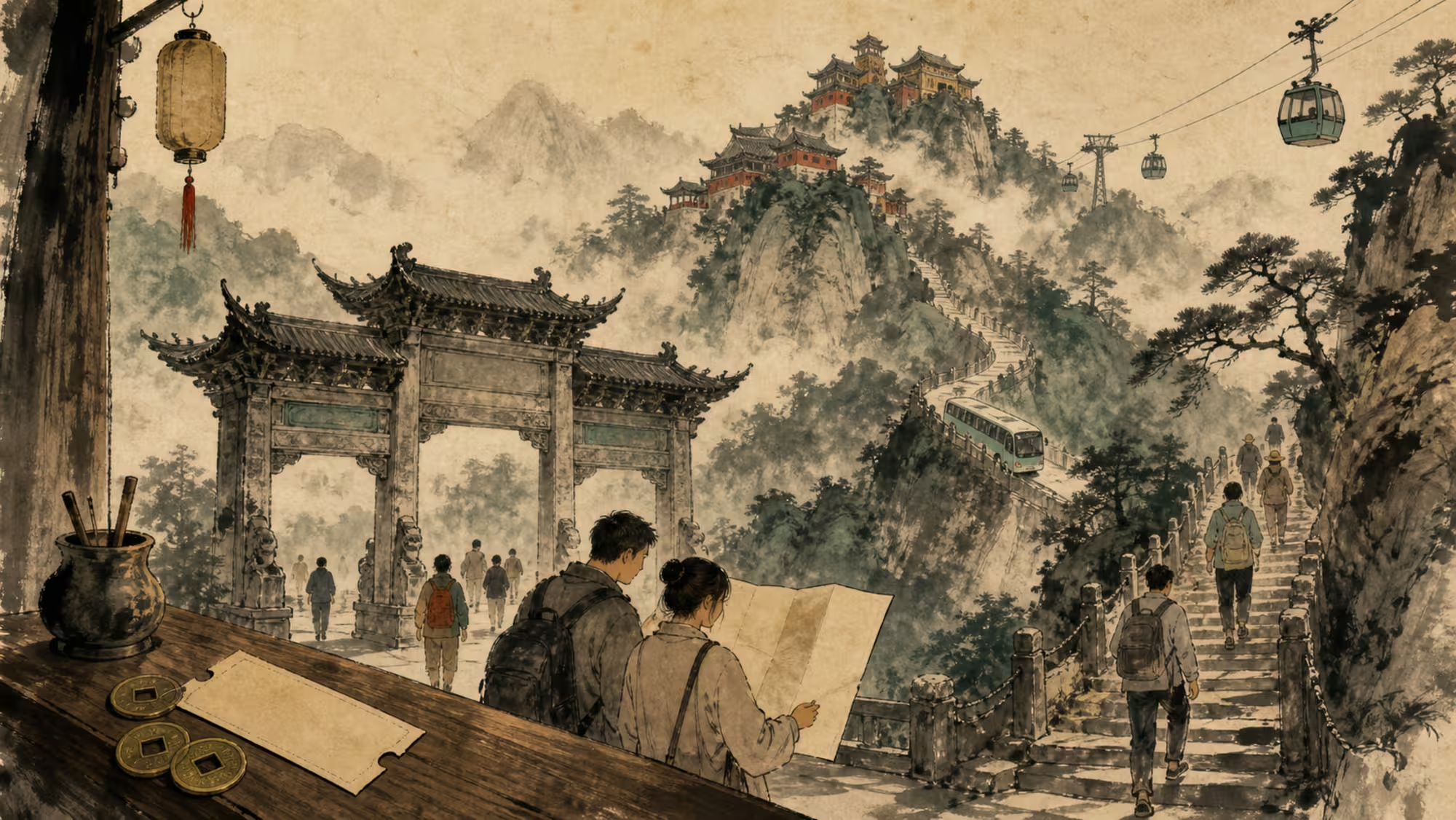
When students tell me they want to visit Wudang Mountain (武当山), the first question is almost always about money. How much does it cost to get in? Is the Golden Palace included? What about the cable car?
But the question they should be asking first is a different one: what am I actually going to see when I get there?
Because the answer is more complicated than the travel brochures suggest. And if you are spending the time and money to reach this mountain — especially from overseas — you deserve the full picture before you arrive. Not the marketing version. The real one.
A Sacred Mountain and a Tourism Machine
Wudang Mountain is real. The Daoist tradition here stretches back over two thousand years. The mountain holds a UNESCO World Heritage designation earned in 1994. Priests still live, chant, and practise on the mountain today. Purple Cloud Palace (紫霄宫) is managed by the Wudang Daoist Association as a functioning religious site. The incense burns for devotion, not just for show.
But Wudang Mountain is also a National AAAAA Tourist Attraction managed by a dedicated Tourism Economic Zone with its own governmental authority. It received over ten million visitors in 2024. The scenic area generated 10.3 billion yuan in comprehensive tourism revenue — and the local government has set a target of fourteen million visitors for 2025. There are 38 martial arts schools on or around the mountain, training nearly 10,000 students per year. There is a nightly kung fu stage show called "A Dream of Wudang" at the Taiji Theater. A newly built cultural street near Yuxu Palace sells souvenirs.
Both of these things are true at the same time. If you want to understand Wudang, you need to hold them together.
How Authentic Are the Temples?
This matters — especially for practitioners coming to Wudang expecting to touch something ancient and unbroken. For a deeper look at the temple complex and its history, the Wudang Academy Knowledge Wiki covers the major structures in detail. Here, I want to give you the honest summary.
The short answer: it depends which temple you are standing in.
The Golden Palace (金殿, Jīn Diàn) at the summit is genuinely old. It was cast in bronze and gold in 1416 and has survived largely intact for over six hundred years. The Ancient Bronze Shrine (铜殿), also on the mountain, dates to 1307 — making it the oldest surviving structure on Wudang. The stone-walled Forbidden City enclosure around the summit was built in 1419. These are authentic Ming Dynasty constructions, and standing in front of them, you are standing in front of real history.
Purple Cloud Palace (紫霄宫, Zǐxiāo Gōng) was first built during the Northern Song Dynasty around 1119–1125, then extensively rebuilt in the fifteenth century under Emperor Yongle. It has been repaired and maintained many times since, but its core structures and layout are genuinely old. UNESCO considers it one of the best-preserved examples of Ming Dynasty religious architecture in China.
Nanyan Palace (南岩宫) was originally built during the Yuan Dynasty, destroyed, then rebuilt in 1413 and expanded during the Qing Dynasty. What you see today is a mix of periods, but the site itself and its cliff-side positioning are centuries old.
Beyond these highlights, the picture becomes more complicated.
At its peak during the Ming Dynasty, Wudang Mountain held 9 palaces, 9 monasteries, 36 nunneries, and 72 temples — an astonishing complex built by over 200,000 labourers over thirteen years under Emperor Yongle's orders. The total floor space exceeded one million square metres. Today, only 53 ancient buildings and 9 architectural sites survive. The vast majority of the original complex is gone.
The losses happened in waves. War at the end of the Yuan Dynasty destroyed earlier Song and Yuan structures. Yuxu Palace (玉虚宫) — once the largest building complex on the mountain, with 2,200 rooms — was mostly destroyed in 1745 during the Qing Dynasty. Qiongtai Palace (琼台) was destroyed during fighting in 1856 and only partially restored; today it functions primarily as the cable car departure point. In 2003, the 600-year-old Yuzhengong Palace (遇真宫) burned down accidentally — a martial arts school employee started the fire that reduced three halls to ashes.
And then there is the Cultural Revolution (文化大革命). Between 1966 and 1976, Daoist sacred texts were burned, temples were damaged or destroyed, and priests were sent to labour camps. The Hui Long Guan (回龙观) — the Returning Dragon Temple — was never rebuilt. You can still see its charred black beams today, a silent reminder of what was lost. In 2013, Yuzhen Palace had to be physically elevated by fifteen metres — the entire building, jacked up — to prevent flooding from the South-to-North Water Diversion Project. It earned a Guinness World Record for it, which tells you something about how modern infrastructure priorities can collide with heritage preservation.
So when you walk through Wudang, know this: some of what you see is genuinely ancient, some is carefully restored, and some is essentially new construction on old foundations. This is not unusual for Chinese sacred sites — nearly all of them carry this layered history. But it does mean you should not assume that every temple wall you touch was laid by Ming Dynasty hands.
What the Tourist Experience Actually Looks Like
The cable car, which carries visitors to within twenty minutes of the summit in under half an hour, has fundamentally changed the character of the Golden Palace experience. The summit — once reachable only by hours of physically demanding pilgrimage on foot — is now accessible to anyone willing to pay 80 CNY. The result is predictable: on peak days and holidays, the Golden Palace area is crowded with tour groups, selfie sticks, and loudspeakers. The tranquil atmosphere that once defined the summit can be difficult to find.
The commercialisation is real, and it is accelerating. Residents have been relocated out of the scenic area. New hotels, shopping streets, and "experience centres" are being built. The mountain is managed by a dedicated economic zone with its own governmental authority. In some ways, Wudang is following the same path as Shaolin — which has been widely criticised for becoming more brand than monastery.
I do not say this to discourage you from visiting. I say it because if you arrive expecting an untouched mountain monastery where robed priests practise sword forms in misty solitude, you may be disappointed. That Wudang exists — but you have to work harder to find it now. It exists on the quieter eastern trails around Nanyan. It exists in the early morning hours before the tour buses arrive. It exists in the small, unmarked temples off the main paths that most visitors never see.
道可道,非常道。
The way that can be spoken is not the eternal way.
As a practitioner of Wudang arts, I carry a complicated feeling about all of this. The tourism brings money that funds restoration and preservation. It brings awareness of Daoist culture to millions of people who would otherwise never encounter it. But it also erodes the very qualities that made the mountain sacred in the first place — silence, remoteness, difficulty of access, the sense that reaching the summit was itself a spiritual achievement.
The difference I hold onto: Wudang still has real Daoist priests living and practising on the mountain. Purple Cloud Palace is still a functioning religious site, not a museum. The morning chanting still happens. The tradition is strained, but it is not broken.
Common Myths About Wudang Martial Arts
While we are being honest, let me address something else that colours many visitors' expectations: the popular mythology surrounding Wudang martial arts. Most of what people "know" about Wudang comes from fiction, not history, and arriving at the mountain with these myths intact leads to confusion. The Wudang Academy Knowledge Wiki covers these myths in more detail, but here are the ones I encounter most often.
"Zhang Sanfeng invented Tai Chi after watching a snake fight a crane." This is the most famous origin story in Chinese martial arts, and it is almost certainly a legend rather than documented history. Zhang Sanfeng (张三丰) is a semi-mythical figure — references to him span centuries and contradict each other on basic facts like when he was born and how long he lived. He is venerated as a patriarch within the Wudang San Feng Pai lineage, and his influence on the philosophical foundations of Wudang internal arts is significant. But the idea that one man, in one moment of animal observation, invented an entire martial system is storytelling, not biography.
"Wudang is the opposite of Shaolin — internal versus external." This neat binary was largely constructed in the early twentieth century when China's first national martial arts institutions sorted styles into two categories for tournament purposes. The reality is far more blurred. Many martial arts contain both internal and external elements. The Wudang–Shaolin division is useful shorthand, but treating it as a strict doctrinal split misrepresents both traditions.
"Wudang practitioners can control Qi to perform supernatural feats." This comes almost entirely from wuxia (武侠) fiction — the genre of Chinese martial arts novels and films that has shaped global perceptions of kung fu. Movies like Crouching Tiger, Hidden Dragon show Wudang-style swordsmen flying through bamboo forests. These are beautiful films, but they are fantasy. Real Wudang practice is grounded, demanding, and deeply physical. The cultivation of Qi (气) is a genuine part of the tradition, but it manifests as improved health, coordination, and internal awareness — not as telekinesis or gravity-defying stunts.
"The 38 martial arts schools on Wudang Mountain all teach the same traditional system." They do not. Schools on and around Wudang vary enormously in quality, lineage, curriculum, and authenticity. Some are connected to genuine lineage holders; others are commercial operations that teach a surface-level version of forms for short-term tourist courses. If you are considering training at Wudang, research the school's lineage and teacher credentials carefully before committing.
Wudang martial arts are a real, living tradition with deep roots. But separating that tradition from the mythology requires effort — and visiting the mountain is only the beginning of that process, not the end.
Now, the Practical Side: Tickets and Prices
With all of that context, let me give you what you came for. The ticketing system at Wudang changed significantly in 2022, and many English-language travel guides still quote old prices. Here is the current structure.
The One-Ticket System
In April 2022, Wudang Mountain introduced a major reform called the 一票制 (yī piào zhì) — the "one-ticket system." Before this change, visitors had to buy a base entrance ticket and then pay separate surcharges for the Golden Palace and Purple Cloud Palace. It was confusing, inconvenient, and visitors rightfully complained about it for years.
Now, the scenic area sells a unified pass — the 通票 (tōng piào) — priced at 164 CNY per person. This single ticket includes access to all major sites: Golden Palace, Purple Cloud Palace, Nanyan, Prince Slope, Xiaoyao Valley, and more. No more separate surcharges at individual temples.
The old system of buying a 140 CNY entrance and then paying 27 CNY for the Golden Palace and 15 CNY for Purple Cloud Palace separately has been replaced by a single, lower combined price. If you see English-language guides still quoting those old separate fees, they have not been updated.
The Full Package
In practice, almost every visitor purchases the full package — the 套票 (tào piào) — which bundles everything into one transaction. The unified pass is 164 CNY, the scenic area shuttle bus adds 90 CNY, and travel insurance adds 10 CNY. The total comes to 264 CNY per person.
Booking online in advance through platforms like Trip.com (Ctrip) or the official 武当山智慧旅游 (Wudang Mountain Smart Tourism) WeChat mini-program may bring this down to approximately 259 CNY with an early-bird discount.
This is the number to keep in your head: 264 CNY — roughly 35–37 USD — covers entrance to all sites plus shuttle bus transportation within the mountain.
The Shuttle Bus
The shuttle bus fare of 90 CNY is included in the full package. Private vehicles are not allowed inside the scenic area — everyone rides the green shuttle buses, no exceptions.
After passing through the Xuanyue Gate (玄岳门), you board the bus to the central transfer point at Prince Slope (太子坡, Tàizǐ Pō). From there, different buses head either east toward Nanyan (南岩) or west toward Qiongtai (琼台), where the cable car station is located. Pay attention to which direction your bus is going — getting on the wrong one can cost you hours.
The Cable Car
The cable car — officially the Taihe Cableway (太和索道) — runs from the Qiongtai area up toward Tianzhu Peak (天柱峰), the highest point on Wudang at 1,612 metres. After exiting, it is roughly a twenty-minute walk to the summit.
The cable car is not included in the standard 264 CNY package. Current adult pricing is 80 CNY per direction, or 150 CNY for a round trip. Children between 1.2 and 1.5 metres in height pay half price. Tickets can only be purchased at the two stations — not online.
Whether you take the cable car or hike is a personal decision. The hiking paths — particularly the Ming Shendao (明神道) and Qing Shendao (清神道) pilgrim routes — are beautiful and historically significant. But they are steep, sometimes slippery, and require several hours of serious climbing. For a first visit with limited time, the cable car lets you reach the summit and still have energy to absorb what you see there.
The Golden Summit area now requires a time-slot reservation when booking: 7:30–10:00, 10:00–13:00, or 13:00–16:00.
Discounts
Students aged 12–17 with valid identification pay approximately 137 CNY for the full package. Seniors aged 60–69 pay approximately 182 CNY. Children under 12 or under 1.4 metres in height enter free when accompanied by a guardian. Active military personnel, retired military cadres, disabled visitors, and firefighters with valid Chinese credentials receive significant discounts or free entry on the entrance portion, though bus fees may still apply.
You will need a valid photo ID — for international visitors, your passport. Do not leave it at the hotel.
Since June 2024, Wudang Mountain requires real-name online booking in advance through the official WeChat mini-program or a licensed booking platform. Walk-up ticket windows are still available for international visitors, but the system strongly favours advance reservation.
Ticket Validity and Re-Entry
Your entrance ticket is valid for three days. Wudang Mountain is not a place you can meaningfully experience in a single afternoon. Two days is the minimum I would recommend.
If you leave the scenic area and wish to re-enter on a subsequent day within your three-day window, you pay a small shuttle bus re-entry fee of around 20 CNY.
Your Realistic Budget
The full package covering all temples, shuttle bus, and insurance is 264 CNY. A round-trip cable car adds 150 CNY. That brings you to roughly 414 CNY — about 55–60 USD — for the mountain itself.
Add a second-day re-entry fee of 20 CNY if you stay outside the scenic area, and you are looking at under 440 CNY for a comprehensive two-day visit. Skip the cable car and hike both ways, and you are back under 300 CNY.
This does not include accommodation, food, or transportation to Wudang — only the mountain fees. But as sacred mountains go, Wudang is remarkably accessible.
Getting There
The most common approach is by high-speed train from Wuhan to either Wudangshan West Station or Wudangshan Station. The journey takes roughly two to four hours, with second-class seats running approximately 192–242 CNY.
From Wudangshan West Station, a shuttle bus to the scenic entrance takes about twelve minutes and costs around 10 CNY. From the older Wudangshan Station, bus 202 or 203 reaches the Mountain Gate in roughly twenty minutes to an hour.
The nearest airport is Shiyan Wudangshan Airport, about 30 kilometres from the scenic entrance. A taxi or airport shuttle takes around 40–45 minutes.
One practical note: the scenic area closes its gates at 17:00 in winter. If you arrive after this time, you will need to stay the night in Wudangshan Town and enter the mountain the following morning.
Practical Tips
Bring warm layers. The summit is typically 9–10 degrees Celsius colder than the base of the mountain. Even in summer, evenings at the top can be surprisingly cold.
Wear proper shoes. Many paths involve stone stairs, uneven terrain, and potentially slippery surfaces — especially after rain or in winter. Training shoes or hiking boots are far better than sandals.
Respect temple customs. Do not step on thresholds when entering temples — in Daoist tradition, they represent the shoulders of the gods. Do not point at statues. Photography is often prohibited inside temple halls. If a Daoist ceremony is in progress, observe quietly from the side or simply move on.
Carry cash. While mobile payment is widespread in China, some smaller vendors on the mountain may not accept international cards. Having a few hundred yuan in cash is wise.
Check for closures. Temple complexes occasionally close for renovation. Purple Cloud Palace, for example, underwent restoration work in 2025. Check current status before planning around a specific site.
Visit early or late. The difference between Wudang at 7:30 in the morning and Wudang at midday during a holiday week is the difference between a sacred mountain and a theme park. If you can, stay overnight inside the scenic area and begin your day before the tour buses arrive. That is where the real Wudang still lives.
A Mountain Worth the Honesty
I first climbed Wudang Mountain as a young student, carrying nothing but a bag and a head full of questions. The ticket price then was a fraction of what it is today. The mountain itself has not changed.
The mist still settles into the valleys at dawn. The ancient pines still bend in the wind above Nanyan. The Daoist priests still rise before sunrise to practise their arts in courtyards that have held those same movements for centuries.
山不在高,有仙则名。
A mountain need not be tall — if immortals dwell there, it becomes famous.
I have given you the honest picture in this guide — the history of destruction and rebuilding, the commercialisation, the myths, and the prices — not to diminish Wudang, but because this mountain deserves better than a sales pitch. It deserves visitors who arrive with open eyes, who know what was lost and what endures, and who understand that the deepest experience of Wudang is not something you can buy with a ticket.
The ticket gets you through the gate. What you find inside depends on where you look, when you go, and how willing you are to walk past the surface.
That is worth planning for.