
Why I Moved My Teaching Online
What "Online Training" Actually Means Here
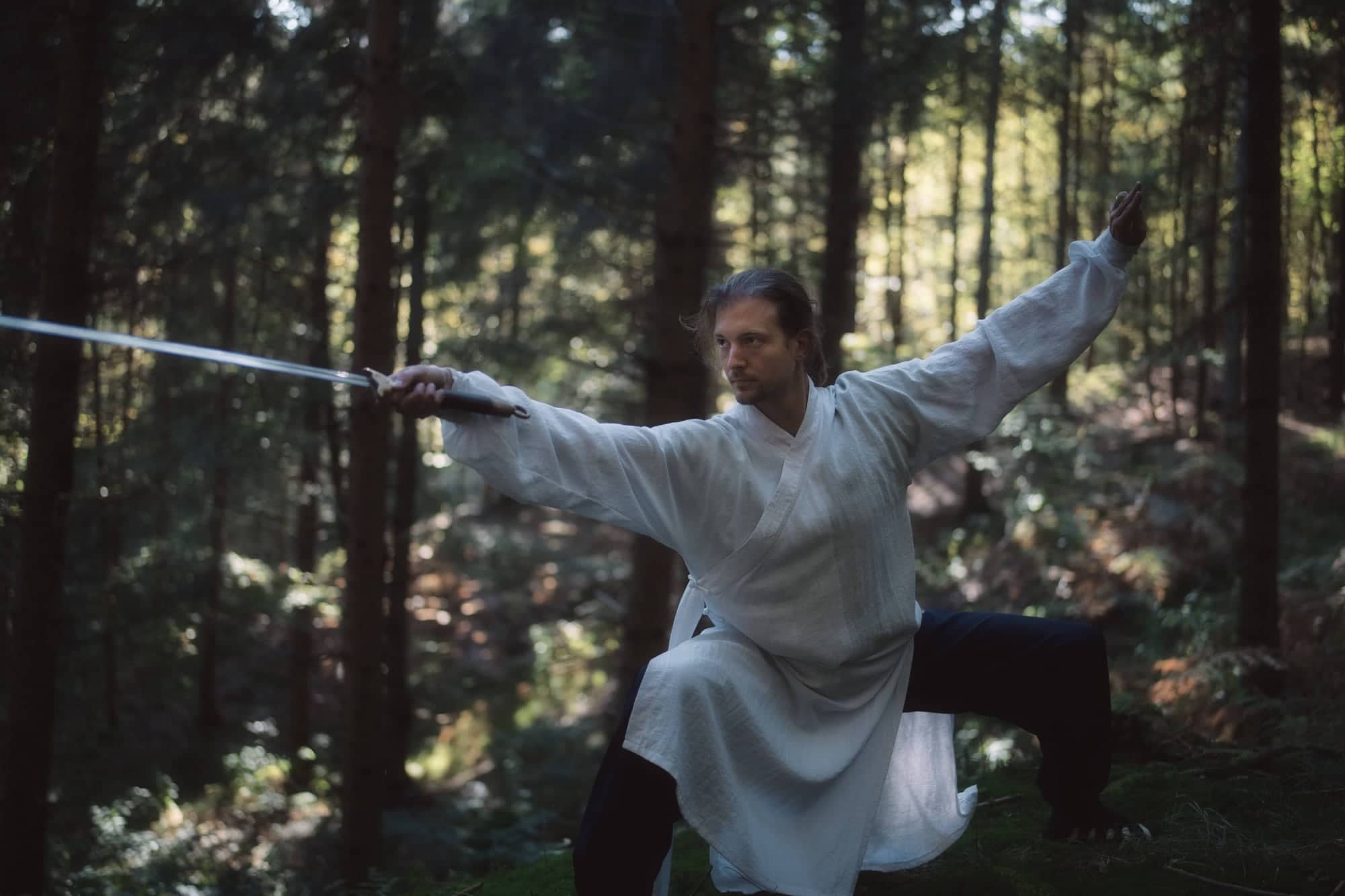
This isn't watching pre-recorded videos and hoping you got it right.
The Autism Advantage in Teaching Details
What You're Actually Learning
Form Training:
Applications:
Internal Development:
Why Online Learning Fits Taichi Better Than You Think
Traditional internal arts training had a specific structure:
Master demonstrates. Student copies. Master corrects through physical adjustment. Student practices alone for hours. Student comes back for more corrections.
Notice something? Most of the actual learning happened during solo practice.
The master's role wasn't to hold your hand through every movement. It was to:
- Show you the correct form
- Explain the principles
- Give you specific corrections when you practiced wrong
- Test your understanding periodically
That's exactly what happens here.
I demonstrate. You practice. I watch your practice and give detailed corrections. You practice more with those corrections in mind. We cycle through this process until you understand not just how to do it, but why it works.
The difference between my online teaching and traditional in-person training? You get more individual attention. In a group class, I might correct you once or twice per session. Here, every video you send gets full analysis.
What Makes This Different From Other Online Programs
I've seen other Wudang Taichi online courses. Most fall into one of three categories:
Category One: Video Libraries
Hundreds of pre-recorded videos. No feedback. No corrections. Just demonstrations you're supposed to copy perfectly despite having no way to know if you're doing it right.
This is like trying to learn surgery from YouTube. You might memorize the steps, but you'll miss every subtle detail that makes the difference between competence and incompetence.
Category Two: Simplified "Beginners" Courses
Designed for people who want to feel like they're learning without actually learning. Forms get shortened. Principles get simplified. Everything gets made "accessible."
The problem? Taichi doesn't work when simplified. The depth is the art. Remove the complexity, and you're left with slow-motion aerobics.
Category Three: Mystical Energy Work
Lots of talk about qi flow. Chakras. Energy centers. Cosmic connections.
Some of this has basis in traditional teaching. Most of it is commercialized spiritual caviar sold to Westerners who want exotic mysticism.
I teach Taichi as what it is: a sophisticated biomechanical system that develops internal power through specific structural principles. Does this connect to Daoist philosophy? Absolutely. Do you need to believe in mystical energy to make it work? No.
My Actual Background—Why This Matters
I hold the 16th generation lineage of Sanfeng Pai.
My Taoist name is 魏懋资济 (Wèi Mào Zī Jì).
This isn't decoration. It means:
- My grandmaster's name provides the first character
- My master's name provides the second character
- My master chose the final two characters to represent my path
When you see a Taoist name structured this way, you can trace the lineage back. You know who taught whom. You know the transmission is legitimate.
I trained for three years at Wudang Mountain under Masters Yuan Xiu Gang and Chen Shiyu. Not the tourist program. The actual traditional training that takes years and that almost no foreigners complete.
Before Wudang, I spent decades in other martial arts:
- Military service as a mountain trooper in Austrian special forces
- Wing Chun for close-range combat principles
- Karate for striking fundamentals
- Pencak Silat (trained in Vietnam) for weapons and angular movement
- Muay Thai for power generation and conditioning
- Hap Ki Do for joint locks and circular techniques
I'm ambidextrous in both combat and weapons work. I can fight equally well with either hand. I've trained with bladed weapons, striking weapons, rope weapons, chain weapons, throwing weapons, fans, Fu Chen, umbrellas—you name it.
This background matters for one reason: I know what works and what doesn't.
When I teach you Taichi applications, I'm not speculating. I've pressure-tested these movements against skilled opponents from multiple fighting systems. When I explain internal power generation, I can compare it to how power works in external arts. When I correct your structure, I know exactly what breaks under stress and what holds.
The Progression: What to Expect
Months 1-3: Foundation Hell
Standing practice. Basic postures. Fundamental movements.
This is boring. Your legs will shake. You'll wonder why you're not learning "real" Taichi yet.
You are. This is where internal skill begins. Skip this, and everything you build later collapses.
Months 4-6: First Form Work
You'll start learning the Wudang Taiji 13 Steps. The foundation form that contains everything.
Movements will feel awkward. You'll forget sequences. You'll get frustrated.
Normal. Everyone goes through this.
Months 7-12: Understanding Begins
Around this point, something clicks. The movements start feeling connected. You begin sensing how one posture flows into the next. Your body starts moving more efficiently.
This is when Taichi stops being memorization and starts being practice.
Year 2: Depth
You'll move to the Wudang Taiji 28 Steps. You'll discover layers you missed completely in the 13 Steps.
Applications make more sense. Internal principles become clearer. Your body moves differently than it did a year ago.
Year 3+: Refinement
Now you're ready for the Wudang Taiji 48 Steps and eventually the Wudang Taiji 108 Steps. Not perfectly—you'll refine for your entire life—but competently.
You understand the principles well enough to apply them. You can feel when your structure breaks and correct it yourself. You can learn new forms faster because you grasp the underlying patterns.
This timeline isn't negotiable. Some people progress slightly faster. Most take longer. Anyone promising mastery in months is lying.
Common Questions I Get
"Can I really learn internal arts without physical contact?"
Physical contact helps, yes. But it's not required.
Internal sensation is internal. I can push your arm to show you what structure feels like, but you still have to learn to feel it yourself. That learning happens through practice and precise instruction, not through my hands.
Most students I corrected physically in Vienna couldn't replicate the feeling I showed them anyway—not because the contact was insufficient, but because they hadn't developed the internal awareness yet. That awareness develops through solo practice guided by clear instruction.
"How do I know if I'm doing it right without someone watching me in person?"
You record your practice. I watch. I tell you exactly what's right and wrong.
The precision of video analysis often exceeds what I could see in person. I can pause, rewatch, analyze angles carefully. In live classes, I see your movement once and give feedback based on that single viewing.
"What if I have specific physical limitations or injuries?"
Tell me. I'll adapt the training to your body.
Taichi works for different body types and conditions. The principles remain the same, but applications vary. I trained through my own physical limitations. I understand how to modify techniques without losing their effectiveness.
"How much time do I need to practice?"
Daily practice. At least 30 minutes. Ideally an hour.
Less than that, and your progress crawls. More is better if you can sustain it without burning out.
Quality matters more than quantity. Thirty focused minutes beats two distracted hours.
Why Honest Teaching Matters
I won't promise you superpowers. I won't tell you legendary stories as if they're verified history. I won't sell you mystical experiences or enlightenment through movement.
Here's what I will promise:
You'll develop real internal power. Not mystical qi. Biomechanical efficiency that generates force through structure rather than muscle.
You'll understand fighting applications. Every movement has purpose. You'll know what that purpose is and how to apply it.
You'll get honest feedback. If your form needs work, I'll tell you. If you're missing the principle, I'll explain what you're missing and how to find it.
You'll learn authentic Wudang methods. The actual forms of the Sanfeng line. The actual training progression. No shortcuts, no modifications, no "beginner-friendly" simplifications.
The commercialization of traditional arts has created a market full of exaggerated claims. Teachers who learned from videos themselves now sell "authentic" training. Schools that opened last year claim ancient lineages.
I'm not interested in competing with that circus. I teach what I learned from my masters. I explain what works based on decades of testing. I give you the real art, and then it's up to you to practice it.
The Reality of Learning Internal Arts
This path is difficult. Not physically brutal like some external martial arts, but demanding in a different way.
You have to pay attention to details so small that most people never notice them. You have to practice movements that look simple but require years to execute correctly. You have to develop patience in a world that sells instant results.
Most people quit. They want faster progress. They want visible achievements. They want to feel like masters after a few months.
Those people don't understand what internal arts are. These methods transform how your body moves at a fundamental level. That transformation takes time.
But if you're reading this far, you're probably not most people.
You're someone who values depth over speed. Authenticity over marketing. Real skill over certificates.
That's who this training is for.
What Happens Next
You start with foundation work. I send you detailed instruction on standing practice, basic postures, and fundamental principles.
You practice. You record. You send me videos.
I watch. I analyze. I send you specific corrections with explanations of why each detail matters.
You practice those corrections. We cycle through this process.
Over months, your structure improves. Over years, internal power develops. Over a lifetime, you refine the art.
There's no graduation. No finish line. No point where you've "completed" Taichi.
But there are milestones. Moments when you feel your structure connect for the first time. Days when applications suddenly make sense. Breakthroughs when you realize your body has changed fundamentally.
Those moments come from consistent practice guided by someone who knows what they're looking for.
I've been training since 1986. I've completed traditional Wudang training that almost no Westerners finish. I've dedicated my life to understanding these arts.
Now I'm offering you that understanding. Not the mystified version. Not the simplified version. The real thing.
What you do with it is up to you.
Latest from my blog
